Home
Class 12
CHEMISTRY
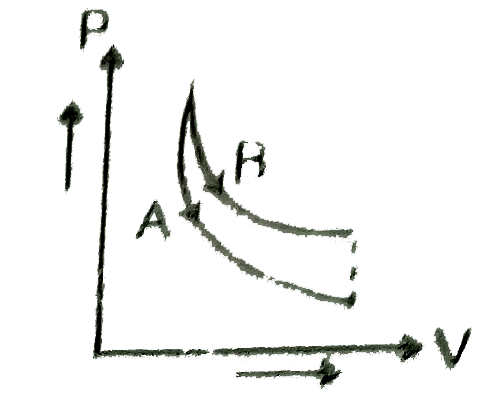
In figure, A and B are two adiabatic cur...

In figure, `A` and `B` are two adiabatic curves for two different gases. Then `A` and `B` corresponds to:

A

`Ar` and `He` respectively

B

`He` and `H_(2)` respectively

C

`O_(2)` and `H_(2)` respectively

D

`H_(2)` and `He` respectively

Text Solution

Verified by Experts

The correct Answer is:

B
Promotional Banner

Topper's Solved these Questions

  • THERMODYNAMICS

    RESONANCE|Exercise Exercise -2 Part-I: Only one option correct type|23 Videos
  • THERMODYNAMICS

    RESONANCE|Exercise Exercise-2 II: Single and double value integer type|16 Videos
  • THERMODYNAMICS

    RESONANCE|Exercise H-1|1 Videos
  • TEST SERIES

    RESONANCE|Exercise CHEMISTRY|50 Videos

Similar Questions

Explore conceptually related problems

The figure demonstrates the adiabatic curves for two gases, helium and carbon dioxide. Which curve corresponds to which gas?

If p and q are two logical statements and A and B are two sets, then p to q corresponds to

Figure shows the adiabatic curve for n moles of an ideal gas, the bulk modulus for the gas corresponding to the point P will be

A conducting piston separates a cylindrical tube into two compartments A and B. The two compartments contain equal mass of two different gases. The molar mass of two gases are M_(A) = 32 g " and " M_(B) 28 g . Find the ratio of lengths (X_(1) : X_(2)) of the two compartments in equilibrium.

P-V plot for two gases ( assuming ideal ) during adiabatic processes are given in the fig. Plot A and B should correspond respectively to :

The sum of two vectors A and B is at right angles to their difference. Then

P-V plot for two gases (assuming ideal) during adiabatic processes are given in the figure. Plot A and plot B should correspond respectively to :

The curves A and B in the figure shown P-V graphs for an isothermal and an adiabatic process for an idea gas. The isothermal process is represented by the curve A.

RESONANCE-THERMODYNAMICS-Exercise -1 Part -II Only option correct type
  1. In a cyclic process shown in the figure an ideal gas is adiabatically...

    Text Solution

    |

  2. The molar heat capacity for the process shown in fig. is

    Text Solution

    |

  3. In figure, A and B are two adiabatic curves for two different gases. T...

    Text Solution

    |

  4. If w(1).w(2),w(3) and w(4) are work done in isothermal, adiabatic, iso...

    Text Solution

    |

  5. One mole of non- ideal gas undergoes a change of state (1.0 atm, 3.0L,...

    Text Solution

    |

  6. A system containing real gas changes it's state from state -1 to state...

    Text Solution

    |

  7. For the isothernmal expansion of an ideal gas

    Text Solution

    |

  8. A container of volume 2L is seperated into equal compartments. In one ...

    Text Solution

    |

  9. A vessel contains 100 litres of a liquid X. Heat is supplied to the li...

    Text Solution

    |

  10. H(2)O((s))rarrH(2)O((l)) This phase transition is carried out at con...

    Text Solution

    |

  11. At 1 atm pressure freezing of n mole of water liquid (0^(@)C) then hea...

    Text Solution

    |

  12. The free energy change for a reversible reaction at equilibrium is:

    Text Solution

    |

  13. Delta H^(@) for the reaction X((g))+Y((g))hArrZ((g)) is -4.6 kcal, the...

    Text Solution

    |

  14. Determine which of the following reactions at constant pressure repres...

    Text Solution

    |

  15. Consider the reaction at 300 K H(2)(g)+Cl(2)(g)rarr2HCl(g), " "Del...

    Text Solution

    |

  16. If DeltaH is the enthalpy change and DeltaU the change in internal ene...

    Text Solution

    |

  17. Which plot represent an exothermic reaction ?

    Text Solution

    |

  18. For which of the following change Delta H!=Delta U?

    Text Solution

    |

  19. Calculate the standard internal energy of formation of liquid methyl a...

    Text Solution

    |

  20. 2C+O(2)rarr2CO, Delta H= - 220 kJ which of the following statements is...

    Text Solution

    |
