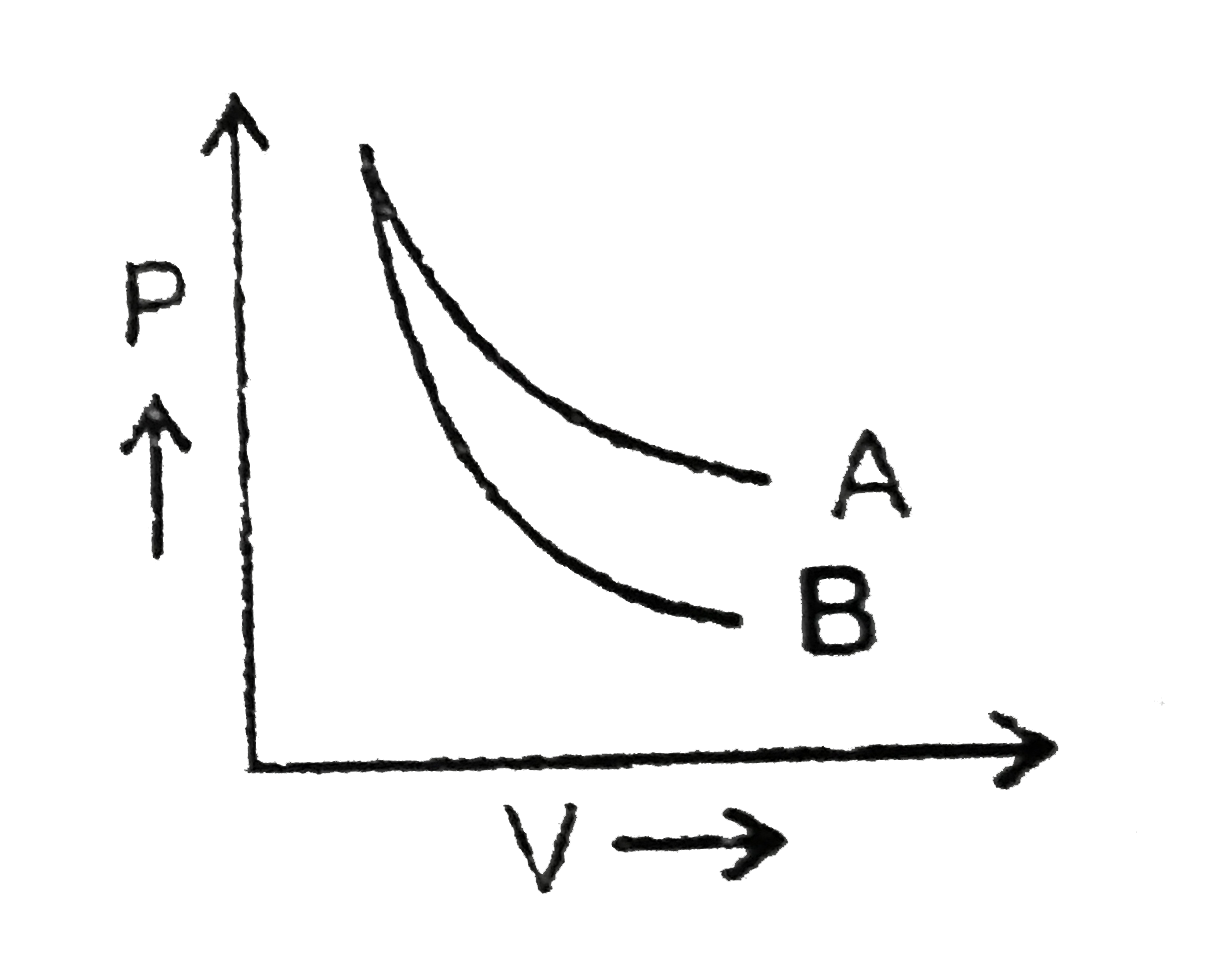
A
B
C
D
Text Solution
Verified by Experts
The correct Answer is:



Topper's Solved these Questions
Similar Questions
Explore conceptually related problems
RESONANCE-THERMODYNAMICS-Exercise 2- III : One or more than one options correct type
- Which of the following properties of system are intensive ?
Text Solution
|
- Which of the following are incorrect ?
Text Solution
|
- Choose the correct statement:
Text Solution
|
- In an isothermal expansion of a gaseous sample, the correct relation i...
Text Solution
|
- During the isothermal of an ideal gas :
Text Solution
|
- P-V plot for two gases (assuming ideal) during adiabatic processes are...
Text Solution
|
- When some potential difference V is applied across a resistance R then...
Text Solution
|
- 0.5 mole each of two ideal gasesA (C(v,m)=(5)/(2)R) and B (C(v,m)=3R) ...
Text Solution
|
- 4 KJ of heat is absorbed when 1 mole of ice melts at 0^(@)C and at con...
Text Solution
|
- 5 moles of a liqiud L are converted into its vapour at its boiling poi...
Text Solution
|
- An ideal gas undergoes adiabatic expansion against constant external p...
Text Solution
|
- Three moles of an ideal diatomic gas undergoes a change in state from ...
Text Solution
|
- Following graph is constucted for the fixed amount of the gas
Text Solution
|
- An ideal gas can be expanded form an initial state to a certain volume...
Text Solution
|