Home
Class 12
CHEMISTRY
One mole of ideal monoatmic gas is carri...

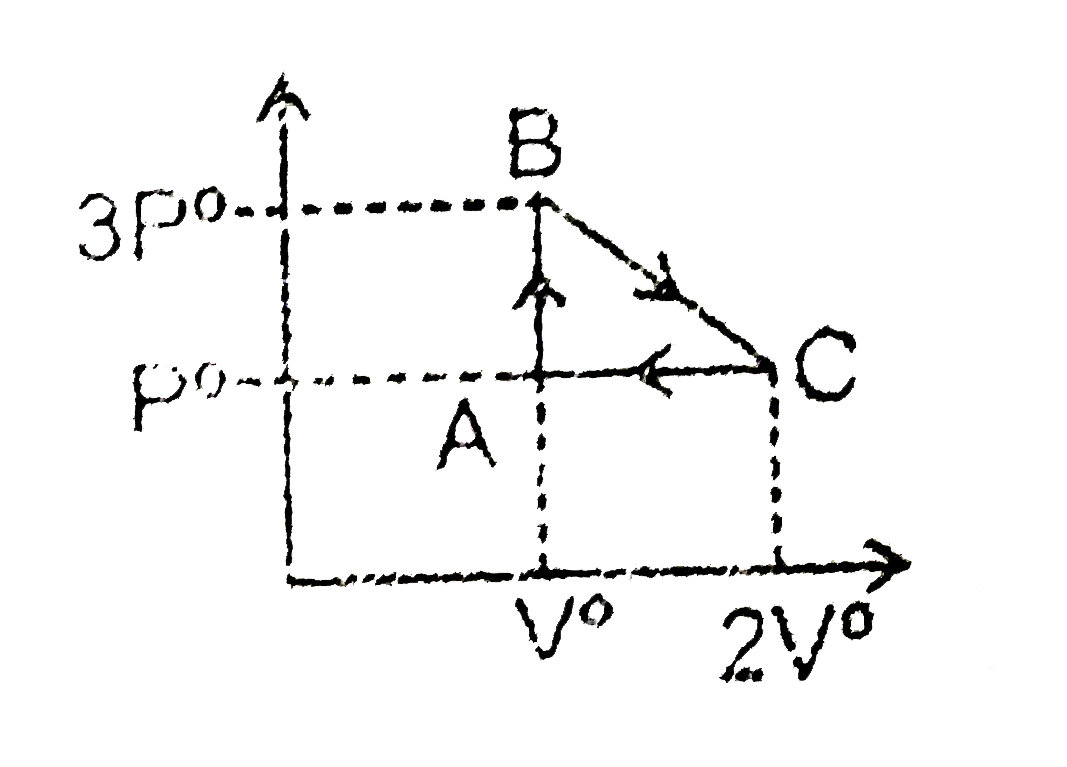
One mole of ideal monoatmic gas is carried throught the reversible cyclic process as shown in figure. Calculate net heat absorbed by the gas in the path BC

A

`(1)/(2)P^(@)V^(@)`

B

`(7)/(2)P^(@)V^(@)`

C

`2P^(@)V^(@)`

D

`(5)/(2)P^(@)V^(@)`

Text Solution

Verified by Experts

The correct Answer is:

A

`DeltaE=q+w`
`W_(BC) =(1)/(2) (2V^(@) -V^(@))(P^(@)-3P^(@))(0-P^(@))=-2P^(@)V^(@)`
`DeltaE=nC_(v)DeltaT=1xx(3)/(2)R((P^(@)2V^(@))/(R)-(3P^(@)V^(@))/(R)) =-(3)/(2) P^(@)V^(@)`
`q_("BC")=DeltaE-W=-(3)/(2) P^(@)V^(@)+2P^(@)V^(@)=(1)/(2)P^(@)V^(@)`
Promotional Banner

Topper's Solved these Questions

  • THERMODYNAMICS

    RESONANCE|Exercise exercise-3 part-2 Advanced level Solutions|27 Videos
  • THERMODYNAMICS

    RESONANCE|Exercise exercise-3 part-III Advanced level Solutions (STAGE-I)|6 Videos
  • THERMODYNAMICS

    RESONANCE|Exercise exercise-3 Part:(I)|23 Videos
  • TEST SERIES

    RESONANCE|Exercise CHEMISTRY|50 Videos

Similar Questions

Explore conceptually related problems

One mole of an ideal gas is carried through the reversible cyclic process as shown in figure. The max. temperature attained by the gas duing the cycle

One mole of an ideal mono-atomic gas is taken round cyclic process ABCD as shown in figure below. Calculate

One mole of ideal monoatomic gas is taken round the cyclic process as shown in figure. The heat rejected by the gas in the path is ………...and the heat absorbed by the gas in the path AB is ………...........

One mole of an ideal monatomic gas is taken round the cyclic process ABCA as shown in figure. Calculate (a) the work done by the gas. (b) the heat rejected by the gas in the path CA and the heat absorbed by the gas in the path AB, (c) the net heat absorbed by the gas in the path BC, (d) the maximum temperature attained by the gas during the cycle.

One mole of an ideal monoatomic gas is taken through a cyclic process as shown. Choose the correct option(s).

One mole of a monatomic ideal gas is taken along the cycle ABCA as shown in the diagram. The net heat absorbed by the gas in the given cycle is

RESONANCE-THERMODYNAMICS-exercise-3 part-1 Advanced level Solutions
  1. Ethyl chloride (C(2)H(5)Cl) , is prepared by reaction of ethylene with...

    Text Solution

    |

  2. Which statement regarding entropy is correct?

    Text Solution

    |

  3. One mole of solid Zn is placed in excess of dilute H(2)SO(4) at 27^(@)...

    Text Solution

    |

  4. The enthy change for the reaction of 50 ml of ethylene with 50. 0 m...

    Text Solution

    |

  5. When1 mole of ice melt at 0^(@) C and at constant pressure of 1 atm . ...

    Text Solution

    |

  6. One mole of ideal monoatmic gas is carried throught the reversible cyc...

    Text Solution

    |

  7. 130 g of Zn is dissolved in dilute sulphuric acid in an open beaker . ...

    Text Solution

    |

  8. The enthalpy of combustion of propance (C(3)H(8)) gas in temes of give...

    Text Solution

    |

  9. If x(1),x(2) and x(3) are enthalpies of H-H , O=O and O-H bonds respec...

    Text Solution

    |

  10. NH(3)(g) + 3Cl(2)(g) rarr NCl(3)(g) + 3HCl(g), " "DeltaH(1) N(2...

    Text Solution

    |

  11. The enthalpy of formation of H(2)O(l) is -285 KJ mol^(-1) and enthalpy...

    Text Solution

    |

  12. Ethanol can undergo decompostion to form two sets of products. If th...

    Text Solution

    |

  13. Find bond enthalpy of S-S bond from the following data: C(2)H(5)-S-C...

    Text Solution

    |

  14. Given the following equations and DeltaH^(@) values, determine the ent...

    Text Solution

    |

  15. Animals operate under conditons of constant pressure and most of the p...

    Text Solution

    |

  16. From the given table answer the following question: {:(,CO(g),CO(2)(...

    Text Solution

    |

  17. Calculate the free energy change at 298 K for the reaction, Br(2)(l)...

    Text Solution

    |

  18. One gram sample of oxygen undergoes free expansion from 0.75L to 3.0 L...

    Text Solution

    |

  19. Given that: DeltaG(F)^(@)(CuO) =-30.4 "Kcal"//"mole" DeltaG(f)^(@)...

    Text Solution

    |

  20. Calcualate Delta(f)G^(@) "for" (NH(4)Cl,s) at 310 K. Given : Delta(...

    Text Solution

    |
