Home
Class 12
PHYSICS
A proton, an electron, a neutron, an alp...

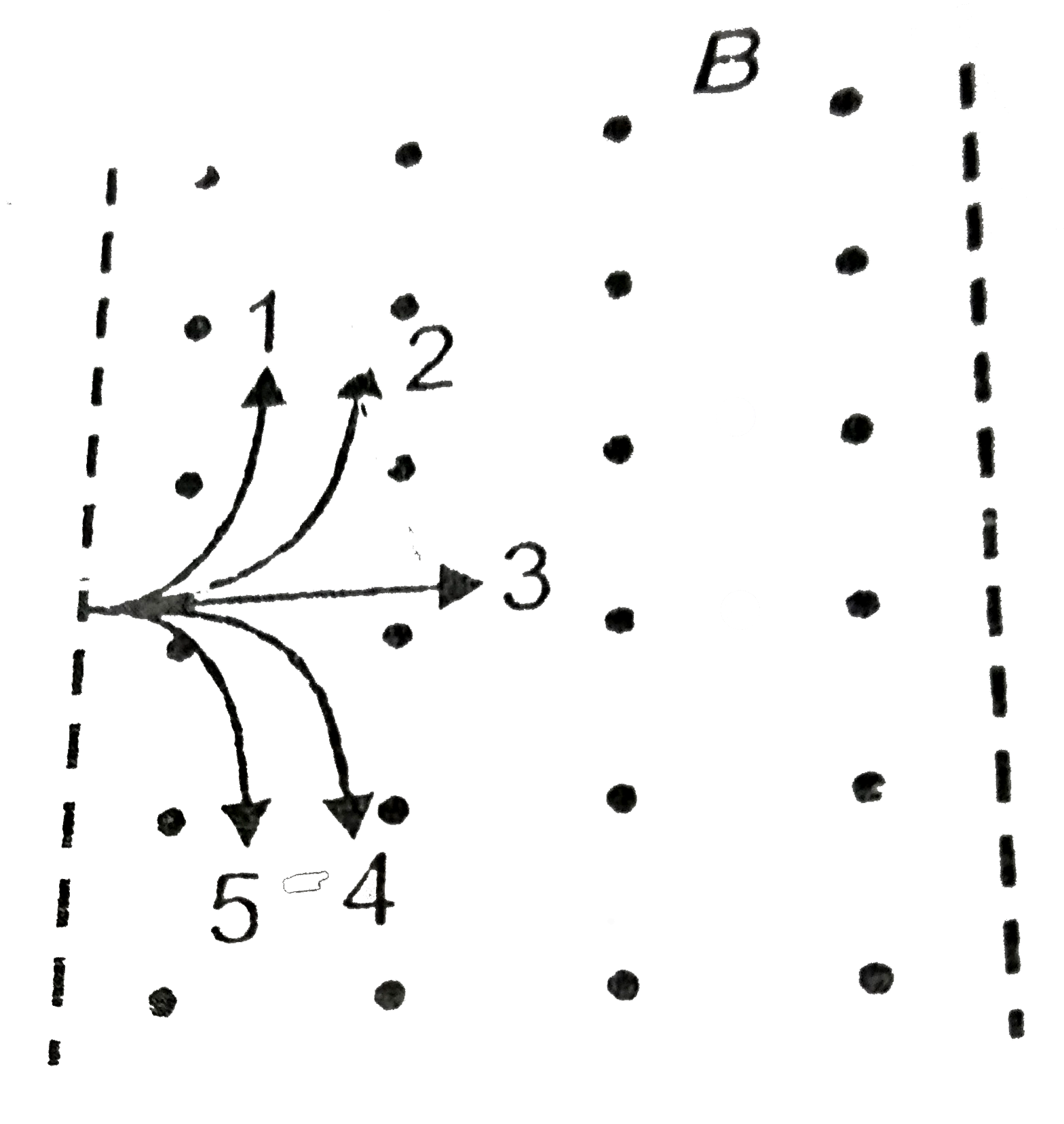
A proton, an electron, a neutron, an `alpha`-particle and an unknown particle enter a region of magnetic field with equal momental. Figure shows paths (market 1 to 5) followed by these particles. Identify which path corresponds to which particle

Text Solution

Verified by Experts

The particle going straight (path 3) must be a netron. You can check from`vecF=q(vecvxxvecB)` that particle deviating upwards are negatively charged and particles deviating down are positively charged.
Now `r=(p/(qB))impliesr prop 1/q`, as momentum is same for each particle.
`implies` Pat 4 and 5 correspond to proton and `alpha`- particle respectivley. Also 2 corresponds to electron as 4 corresponds to proton (Why)?
`implies` Unknown particle is negativley charged (obviously with charge more than that on electron), so it follows path of smaller radius.
`implies` Path 1 and path 2 correspond to unknown particle and electron respectively.
Promotional Banner

Topper's Solved these Questions

  • MOVING CHARGE AND MAGNESIUM

    AAKASH INSTITUTE|Exercise ILLUSTRATION|12 Videos
  • MOVING CHARGE AND MAGNESIUM

    AAKASH INSTITUTE|Exercise TRY YOURSELF|11 Videos
  • MOTION IN STRAIGHT LINE

    AAKASH INSTITUTE|Exercise Assignment (SECTION - J)|2 Videos
  • MOVING CHARGES AND MAGNETISM

    AAKASH INSTITUTE|Exercise Assignment Section J (Aakash Challengers Questions)|5 Videos

Similar Questions

Explore conceptually related problems

A charged particle entering magnetic field obliquely will describe a path

A charged particle enters a region of uniform magnetic field at an angle of 85@ to the magnetic line of force . The path of the particle is a circle .

The ratio of periods of alpha -particle and proton moving on circular path in uniform magnetic field is _______.

An electron and a proton enter a magnetic field with equal velocities. The particle that experiences more force is

A particle enters the region of a uniform magnetic field as shown in figure. The path of the particle inside the field is shown by dark line. The particle is :

A neutron, a proton, an electron and an alpha- particle enter a region of uniform magnetic field with equal velocities. The magnetic field is perpendicular to the paper and directed into it. The tracks of particles are labeled in Fig. 1.132. The neutron follows the track

A neutron, a proton , an electron and an alpha particle enter a region of constant magnetic field with equal velocities. The magnetic field is along the inward normal to the plane of the paper. The tracks of the particles are labled in the figure. The electron follows ______track and alpha particle follows track________. .

A neutron, a proton, an electron and an alpha particle enter a region of constant magnetic field with equal velocities. The magnetic field is along the inward normal to the plane of the paper. The tracks of the particles are lebelled in Fig. The electron follow track......... and the alpha particle follow track..........

AAKASH INSTITUTE-MOVING CHARGE AND MAGNESIUM-SECTION D
  1. A proton, an electron, a neutron, an alpha-particle and an unknown par...

    Text Solution

    |

  2. The magnetic field produced around a straight line wire when current f...

    Text Solution

    |

  3. A : A point charge cannot exert force on itself. R : Coulomb force i...

    Text Solution

    |

  4. A: Net magnetic force expericneed by a current carrying loop in a unif...

    Text Solution

    |

  5. A: The trajectory of a charge when it is projected perpendicular to an...

    Text Solution

    |

  6. A: Like currents repel and unlike currents attract each other (in con...

    Text Solution

    |

  7. A: A magnetic dipole experiences maximum torque when it is placed norm...

    Text Solution

    |

  8. A: The relation between magnetic moment and angular momentum is true f...

    Text Solution

    |

  9. A: When currents vary with time, Newton's third law is valid only if m...

    Text Solution

    |

  10. A: In the expression for Lorentza force, vecF=q(vecvxxvecB+vecE). If o...

    Text Solution

    |

  11. A: Ampere circuital law is not independent of the Biot- Savart's law. ...

    Text Solution

    |

  12. A: The work done by magnetic field on a moving charge is zero. R: Th...

    Text Solution

    |

  13. A: In any magnetic field region the line integral ointvecB.vec(dl) alo...

    Text Solution

    |

  14. A: The magnetic field always accelerates a moving charge if the moving...

    Text Solution

    |

  15. A: The magnetic moment of a current carrying planar loop does depend o...

    Text Solution

    |

  16. A: magnetic field is produced by moving charges(s). R: The magnetic ...

    Text Solution

    |

  17. A: In the middle to high latitudes on a dark night an aurora or the cu...

    Text Solution

    |
