Home
Class 12
CHEMISTRY
(a) Describe the favourable conditions f...

(a) Describe the favourable conditions for the manufacture of (i) ammonia by Haber's process, and (ii) sulphuric acid by contact process.
(b) Drawn the structures of the following :
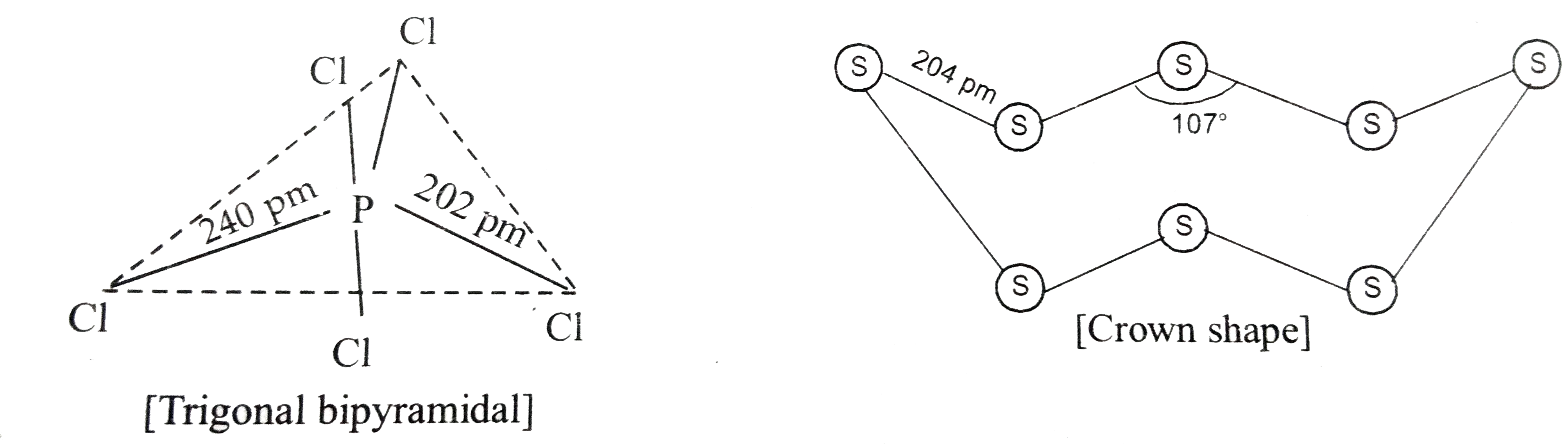
(i) `PCl_(5)(g)`
(ii) `S_(8)(g)`
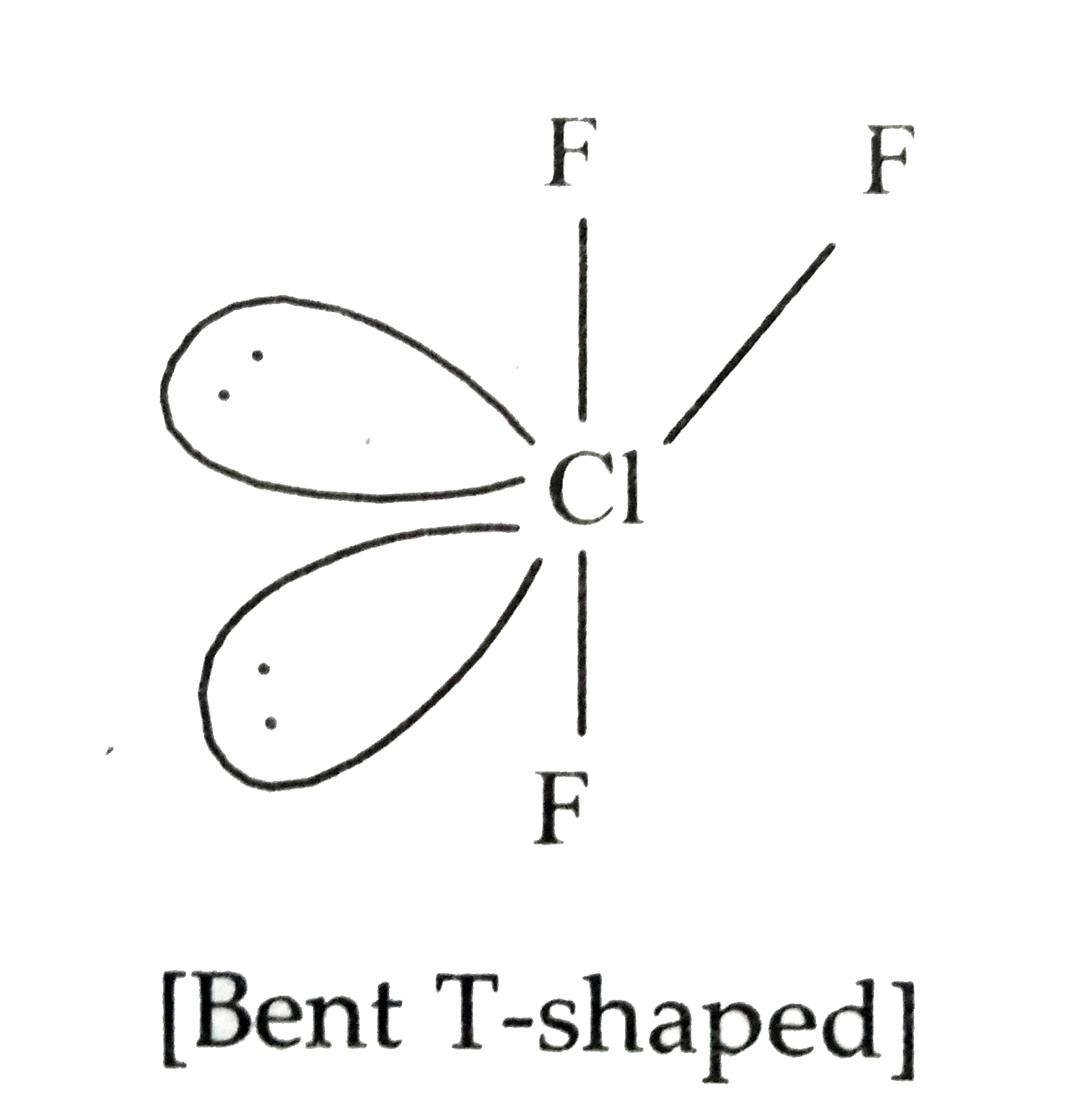
(iii) `ClF_(3)(g)`

Text Solution

Verified by Experts
(i) On a large scale, ammonia, is manufactured by Haber's process
`N_(2)(g)+3H_(2)(g)hArr2NH_(3)(g)`
The optimum conditions for the production of ammonia are apressure about 200 atm, a tempeature of about 700 K and the use of catalyst such as iron axis with small out of `K_(2)O and Al_(2)O_(3)`
(ii) Low temperature about 720 K and high pressure about 2 bar and a catalyst `V_(2)O_(5)` are favourable conditions for the manufacture of `H_(2)SO_(4)` by contact procees.
(b) (i) Structure of `PCl_(5)(g)`
(ii) Structure of `S_(8)(g)`

(iii) Structure of `ClF_(3)(g)`
Promotional Banner

Topper's Solved these Questions

  • XII BOARDS

    XII BOARDS PREVIOUS YEAR|Exercise Set I|31 Videos
  • XII BOARDS

    XII BOARDS PREVIOUS YEAR|Exercise Set II|10 Videos
  • XII BOARDS

    XII BOARDS PREVIOUS YEAR|Exercise Questions|31 Videos
  • SAMPLE PAPER 2019

    XII BOARDS PREVIOUS YEAR|Exercise SECTION: D|1 Videos

Similar Questions

Explore conceptually related problems

Mention the favourable conditions for the manufacture of sulphuric acid by contact process.

Draw the structures of (i) PCl_(5)(s) , (ii) SO_(3)^(2-)

Complete the following reactions : (i) CuO(s) +H_(2)(g) to (ii) CO(g) +H_(2)(g) to

On the basis of hybridisation, discuss the structures of (i) PCl_(5) (ii) IF_(7) (iii) SF_(6) .

(a) (i) Why PCl_(5) gives fumes in moisture ? (ii) Why Interhalogens are more reactive than pure halogens ? (b) Draw the structures of the following : {:((i) PCl_(5), (ii)H_(2)S_(2)O_(8),(iii)XeF_(4)):}

Draw electron dot structures of (i) NH_(3) (ii) PCl_(5) (iii) C_(2)H_(2).

Describe the manufacture of sulphuric acid by contact process on the basis of the following points : (i) Theory and chemical reaction (ii) Labelled diagram (iii) Any two uses.

In the manufacture of ammonia by Haber's process, N_(2)(g) +3H_(2)(g) hArr 2NH_(3)(g)+92.3kJ , which of the following conditions is unfavourable ?

XII BOARDS PREVIOUS YEAR-XII BOARDS-OUTSIDE DELHI (SET-I)
  1. Complete following reaction equation: (i) C(6)H(5)N(2)Cl+KIrarr........

    Text Solution

    |

  2. Write chemical reaction each to illustrate the following : (i) Hofma...

    Text Solution

    |

  3. Arrange the following in an incrasing order of absic strength in water...

    Text Solution

    |

  4. (i) What are thermosetting polymers ? Give one example (ii) Give che...

    Text Solution

    |

  5. Silver crystallises in a fcc lattice. The edge length of its unit is 4...

    Text Solution

    |

  6. A solution containing 8 g of substances in 100 g of diethyl ether boli...

    Text Solution

    |

  7. Calcualte the temperature at which a solution containing 54g of glucos...

    Text Solution

    |

  8. Explain what is observed when (i) KCl, an electrolyte, is added to ...

    Text Solution

    |

  9. What chemcial principal is involved in choosing a reducing agent for g...

    Text Solution

    |

  10. Describe the oxidising action of potassium dichromate and write the io...

    Text Solution

    |

  11. (a) What is the basis of formation of the spectro-chemical sereis? (...

    Text Solution

    |

  12. (a) Name the reagents and write the chemical equations for the prepar...

    Text Solution

    |

  13. What happenes when D-glucose is treated with the following reagents? ...

    Text Solution

    |

  14. Mention one use each of the following drugs : (i) Ranitidine (ii...

    Text Solution

    |

  15. (a) Define the following : (i) Order of reaction (ii) Activation e...

    Text Solution

    |

  16. The half life for radioactive decay of .^(14)C is 5730 years. An archa...

    Text Solution

    |

  17. Assign reasns for the following (i) Sulphur vapour is paramagnetic,...

    Text Solution

    |

  18. (a) Describe the favourable conditions for the manufacture of (i) ammo...

    Text Solution

    |

  19. (a) Giving a chemical equation for each, illustrate the following proc...

    Text Solution

    |

  20. An organic compound A contains 69.77% carbon, 11.63% hydrogen and the ...

    Text Solution

    |