Home
Class 12
CHEMISTRY
An organic compound A contains 69.77% ca...

An organic compound A contains `69.77%` carbon, `11.63%` hydrogen and the rest is oxygen. The molecular mass of the compounds is 86. It does not reduce Tollen's reagent but forms an addition product with sodium hydrogen sulphite and gives positive idoform test. On vigorous oxidation it gives ethanoic and propanoic acids. Write the possible structure of the compound A
(b) Write the chemical tests to distinguish between the following pairs of compounds :
(i) Acetophenone and Benzophenone
(ii) Ethanal and Propanal

Text Solution

Verified by Experts
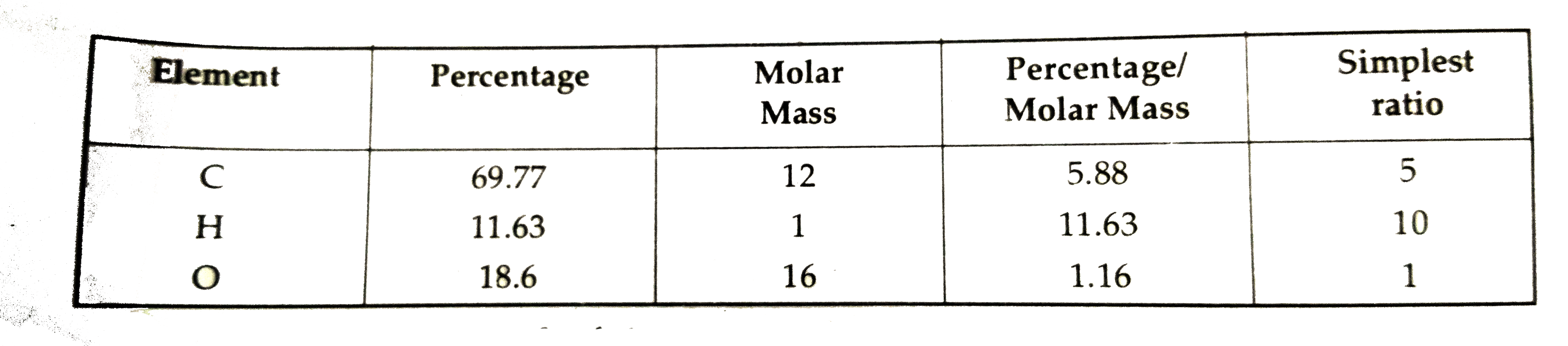
(i) Calcualation for molecule formula
`C=69.77%. H=11.63%`
`:. O=100-(69.77+11.63)=18.6%`

Emperical formula of given compound `= C_(5)H_(10)C`
Emperrical formula mass `=5xx12+10xx1xx186`

Givne molar mass = 86
`:. n=(86)/(86)=1`
Molecular formula of the given compound
`=1xx(C_(5)H_(10)O)`
`=(C_(5)H_(10)O)`
Determination of structure : Since the compound does not reduce Tollen's reagent and gives a position idoform test. So the given compound is ketone and not aldhyde.
Sinc the given compound on vigorous oxidation gives a mxiture of ethanoic acid and propanicc acid. Therfore , given Organic compound is methyl ketone and its structure would be
`CH_(3)COCH_(2)CH_(2)CH_(3)`
`{:(CH_(3)COCH_(2)CH_(2)CH_(3)underset(H_(2)SO_(4))overset(K_(2)Cr_(2)O)toCH_(3)COOH+CH_(3)CH_(2)COOH),("Pentan-2-one" " ""Ethanoic" " ""Propanoic"),(("Methyl Ketone") " ""acid" " ""acidi"):}`
(b) (i) Acetophenone and Benzophenons : These can be distinguish by teh idoform test. Acetophenone when teated with `NaOI(I_(2)//NaOH)` gives yellow ppt. of iodoform but benzenphenone does not.
`{:(C_(6)H_(5)COCH_(3)+3NaOIrarrC_(6)H_(5)COONa+CHl_(3)+2NaOH),("Acetophenone" " ""Seo. benzoate" " ""Iodoform"),(" "("yellow ppt")):}`
`underset("Benzophenone")(C_(6)H_(5)COC_(6)H_(5))overset(NaOI)to"No yellow ppt of" CH_(3)`
(ii) Ethanal and Propanal. : These can be distiguish by the idodoforms test. Ethanal when treated with NaOI `(I_(2)//NaOH)` gieves yelllow ppt of iodoform but propanal dose not give yellow ppt.
`{:(CH_(3)CHO+3I_(2)4NaOHoverset(NaOI)rarrHCOONa+CHI_(3)+3NOI),("Ethanal"" ""Sod. formate" " ""Iodoform "+3H_(2)O),(" "("yellow ppt")):}`
`underset("Propanal")(CH_(3)CH_(2)CHO)overset(NaOI)rarr"No yellow ppt of " CHI_(3)`
Promotional Banner

Topper's Solved these Questions

  • XII BOARDS

    XII BOARDS PREVIOUS YEAR|Exercise Set I|31 Videos
  • XII BOARDS

    XII BOARDS PREVIOUS YEAR|Exercise Set II|10 Videos
  • XII BOARDS

    XII BOARDS PREVIOUS YEAR|Exercise Questions|31 Videos
  • SAMPLE PAPER 2019

    XII BOARDS PREVIOUS YEAR|Exercise SECTION: D|1 Videos

Similar Questions

Explore conceptually related problems

An organic compound contains 69.77% carbon, 11.63% hydrogen, and rest oxygen. The molecular mass of the compound is 86. It does not reduce Tollens reagent but forms an aditional compound with sodium hydrogensulphite and gives positive iodoform test. On vigorous oxidation, it gives ethanoic and propanoic acid. Write the possible structure of the compound.

An organic compound contains 49.3 % carbon,6.84 % hydrogen and its vapour density is 73 Molecular formula of the compound is

Write a chemical test to distinguish between ethanol ad ethanoic acid.

(a) Illustrate the following name reactions by giving example : (i) Cannizzaro's reaction (ii) Clemmensen reduction (b) An organic compound A contains 69.77 % carbon , 11.63 % hydrogen and rest oxygen . The molecular mass of the compound is 86. it does not reduce Tollen's reagent but forms an addition compound with sodium hydrogen sulphite and give positive iodoform test. On vigorous oxidation it gives ethanoic and propanoic acid. Derive the possible structure of compound A .

An organic compound contains 49.3% carbon. 6.84% hydrogen and its vapour density is 73. Molecular formula of compound is

XII BOARDS PREVIOUS YEAR-XII BOARDS-OUTSIDE DELHI (SET-I)
  1. Complete following reaction equation: (i) C(6)H(5)N(2)Cl+KIrarr........

    Text Solution

    |

  2. Write chemical reaction each to illustrate the following : (i) Hofma...

    Text Solution

    |

  3. Arrange the following in an incrasing order of absic strength in water...

    Text Solution

    |

  4. (i) What are thermosetting polymers ? Give one example (ii) Give che...

    Text Solution

    |

  5. Silver crystallises in a fcc lattice. The edge length of its unit is 4...

    Text Solution

    |

  6. A solution containing 8 g of substances in 100 g of diethyl ether boli...

    Text Solution

    |

  7. Calcualte the temperature at which a solution containing 54g of glucos...

    Text Solution

    |

  8. Explain what is observed when (i) KCl, an electrolyte, is added to ...

    Text Solution

    |

  9. What chemcial principal is involved in choosing a reducing agent for g...

    Text Solution

    |

  10. Describe the oxidising action of potassium dichromate and write the io...

    Text Solution

    |

  11. (a) What is the basis of formation of the spectro-chemical sereis? (...

    Text Solution

    |

  12. (a) Name the reagents and write the chemical equations for the prepar...

    Text Solution

    |

  13. What happenes when D-glucose is treated with the following reagents? ...

    Text Solution

    |

  14. Mention one use each of the following drugs : (i) Ranitidine (ii...

    Text Solution

    |

  15. (a) Define the following : (i) Order of reaction (ii) Activation e...

    Text Solution

    |

  16. The half life for radioactive decay of .^(14)C is 5730 years. An archa...

    Text Solution

    |

  17. Assign reasns for the following (i) Sulphur vapour is paramagnetic,...

    Text Solution

    |

  18. (a) Describe the favourable conditions for the manufacture of (i) ammo...

    Text Solution

    |

  19. (a) Giving a chemical equation for each, illustrate the following proc...

    Text Solution

    |

  20. An organic compound A contains 69.77% carbon, 11.63% hydrogen and the ...

    Text Solution

    |

