Home
Class 12
PHYSICS
Consider the charge configuration as sho...

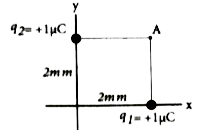
Consider the charge configuration as shown in the figure . Calculate the electric field at point A. If an electron is placed at points A, what is the acceleration exerienced by this electron? (mass of the electron `=9.1xx10^(-31)` kg and charge of electron `=-1.6xx10^(-19)C).`

Text Solution

Verified by Experts
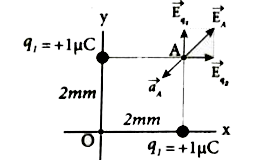
By using superposition the net electric field at point A is
`vecE_(A)=(1)/(4piepsilon_(0))(q_(1))/(r_(1A)^(2))hatr_(1A)+(1)/(4piepsilon_(0))(q_(2))/(r_(2A)^(2))hatr_(2A)`
where `r_(1A)` and `r_(2A)` are the distances of point A from the two charges respectively.
`vecE_(A)=(9xx10^(9)xx1xx10^(-6))/((2xx10^(-3))^(2))(hatj)+(9xx10^(9)xx1xx10^(-6))/((2xx10^(-3))^(2))(hati)`
`=2.25xx10^(9)hatj+2.25xx10^(9)hati=2.25xx10^(9)(hati+hatj)`
The magnitude of electric field
`|vecE_(A)|=sqrt((2.25xx10^(9))^(2)+(2.25xx10^(9))^(2))=2.25xxsqrt(2)xx10^(9)NC^(-1)`
The direction of `vecE_(A)` is given by `(vecE_(A))/(vecE_(A))=(2.25xx10^(9)(hati+hatj))/(2.25xxsqrt(2)xx10^(9))=((hati+hatj))/(sqrt(2))`
which is the unit vector along OA as shown in the figure .

The acceleration experienced by an electron placed at point A is
`veca_(A)=(vecF)/(m)=(qvecE_(A))/(m) =(-1.6xx10^(-19)xx(2.25xx10^(9))(hati+hatj))/(9.1xx10^(-31))`
`=-3.95xx10^(20)(hati+hatj)N`
The electron is accelerated in a direction exactly opposite to `vecE_(A)`
Promotional Banner

Topper's Solved these Questions

  • ELECTROSTATICS

    FULL MARKS|Exercise Textual Evaluation Solved (Multiple choice questions : )|15 Videos
  • ELECTROSTATICS

    FULL MARKS|Exercise Textual Evaluation Solved (II. Short Answer Questions : )|21 Videos
  • DUAL NATURE OF RADIATION AND MATTER

    FULL MARKS|Exercise ADDITIONAL QUESTIONS -( ADDITIONAL NUMERICAL PROBLEMS : )|10 Videos
  • MAGNETISM AND MAGNETIC EFFECTS OF ELECTRIC CURRENT

    FULL MARKS|Exercise ADDITIONAL QUESTIONS SOLVED - NUMERICAL PROBLEMS :|4 Videos

Similar Questions

Explore conceptually related problems

In the Bohr model of hydrogen atom, the electron is treated as a particle going in a circle with the centre at the proton. The proton itself is assumed to be fixed in an inertial frame. The centripetal force is provided by the Coloumb attraction. In the ground state, the electron goes round the proton in a circle of radius 5.3xx10^-11m . Find the speed of the electron in the ground state. Mass of the electron =9.1xx10^-31 kg and charge of the electron = 1.6xx10^-19C .

If mass of an electron is 9.11xx10^(-31) kg then how many electrons would weight in 1 mg?

How many electrons are in 1C of charge ?

Calculate the wavelength of an electron in a 10 MeV particle accelerator (1 MeV = 10^6eV) .

Calculate the electric potential energy of electron-proton system of hydrogen atom. The radius of the electron orbit r= 0.53xx10^-10m , Electron charge e= 1.6xx 10^-19C

