Home
Class 11
CHEMISTRY
Balance the following equations in basic...

Balance the following equations in basic medium by ion-electron method and oxidation number methods and identify the oxidising agent and the reducing agent.
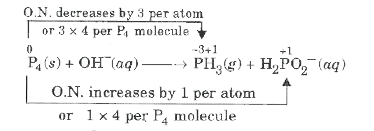
(a) `P_(4)(s) + OH^(-) (aq) to PH_(3) (g) + HPO_(2)^(-)(aq)`
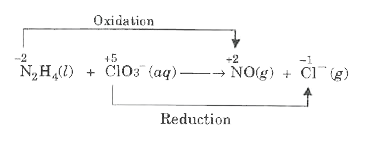
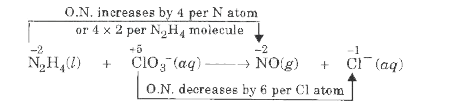
(b) `N_(2)H_(4)(1) + ClO_(3)^(-) (aq) to NO(g) + Cl^(-)(g)`
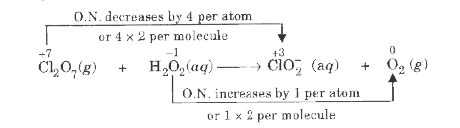
(c) `Cl_(2)O_(7)(g) + H_(2)O_(2)(aq) to ClO_(2)^(-)(aq) + O_(2) (g) + H^(+)`

Text Solution

Verified by Experts
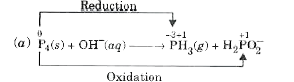

`P_4` gets oxidised to `H_2PO_2^(-)` and reduced to `PH_3` and therefore , `P_4` acts as reducing agent as we as oxidising agent .
Oxidation number method

Balance the increase or decrease in oxidation number by multiplying `H_2PO_2^(-)` by 3 and `PH_3` by 1.
`P_4(s)+OH^(-) (aq) rarr PH_3(g) +3H_2PO_2^(-) (aq)`
To balance O atoms , multiply `OH^(-)` by 6,
`P_4(s)+6OH^(-) (aq) rarr PH_3(g) +3H_2PO_2^(-) (aq)`
To balance H atom , add , 3 `H_2O` to L.H.S and `3OH^(-)` on R.H.S , we have
`P_4(s) +6OH^(-) (aq) +3H_2O(l) rarr PH_3) (g) + 3H_2PO_3^(-)(aq) +3OH^(-) (aq)`
or `P_4(s)+3OH^(-) (aq) +3H_2O(l) rarr PH_3(g) +3H_2PO_2^(-) (aq)`
Ion electron method
The equation can be split up as
Oxidation half reaction : `P_4(s) rarr H_2PO_2^(-) (aq)`
Reduction half reaction : `P_4(s) rarr PH_3(g)`
These can be balanced separately as :
Oxidation half reaction
`overset(0)P_4(s) rarrH_2overset(+1)PO_2^(-)(aq)`
`P_4(s) rarr 4H_2PO_2^(-) (aq)`
`P_4(s) rarr 4H_2PO_2^(-)(aq) +4e^(-)`
`P_4(s) +8OH^(-)(aq) rarr 4H_2PO_2^(-) (aq) +4e^(-) " "...(i)`
Reduction half reaction
`overset(0)P_4rarroverset(-3)(P)H_3(g)`
`P_4(s)rarr4PH_3(g)`
`P_4(s) +12e^(-)rarr 4PH_3(g)`
`P_4(s) +12e^(-) rarr 4PH_3(g)+12OH^(-) (aq)`
`P_4(s) +12H_2O(l) +12e^(-)rarr4PH_3(g) +12 OH^(-) (aq) " "...(ii)`
To balance electrons , multiply eq. (i) by 3 and add to eq. (ii)
`4P_4(s)+12OH^(-) (aq) +12H_2O(l) rarr 4PH_3(g) + 12 H_2PO_2^(-) (aq)`
or `P_4(s) +3OH^(-) (aq) +3H_2O(l) rarr PH_3(g) +3H_2PO_2^(-)(aq)`
(b)
In this reaction , `N_2H_4` gets oxidised and acts as a reducing and `ClO_3^(-)` gets reduced and acts as an Oxidising agent
Oxidation number method

To balance the increase or decrease in oxidation number , multiply `N_2H_4` by 3 and `ClO_3^(-)` by 4 and add
`3N_2H_4(l) +4ClO_3^(-) (aq) rarr NO(g) +Cl^(-) (aq)`
Balance N and Cl atoms on R.H.S
`3N_2H_4(l)+4ClO_3^(-)(aq) rarr 6NO(g)+4Cl^(-) (aq)` To balance O atoms add `6H_2O` molecules on R.H.S .
Since H atoms are balanced automatically , the above equation represents balanced chemical equation.
Ion electron method
Oxidation half reaction : `N_2H_4(l) rarr NO(g)`
Reduction half reaction : `ClO_3^(-) (aq) rarr Cl^(-) (aq)`
These can be balanced separately as :
Oxidation half reaction :
`N_2H_4(l) rarr NO(g)`
`N_2H_4(l) rarr 2NO(g)`
`overset(-2)(N_2)H_4(l) rarr2overset(+2)(NO)(g)+8e^(-)`
`" "("balancing " OH^(-) " ions")`
`N_2H_4(l)+8OH^(-)(aq) rarr2NO(g) +6H_2O(l) +8e^(-)" "...(i)`
Reduction half reaction
`ClO_3^(-)(aq) rarr Cl^(-) (aq)`
`overset(+5)(ClO_3^(-))+6e^(-)rarroverset(-1)(Cl^(-))(aq)`
`ClO_3^(-)(aq)+6e^(-)rarrCl^(-)(aq)6OH^(-)(aq)`
`ClO_3^(-)(aq)+3H_2O(l)+6e^(-)rarrCl^(-)(aq)+6OH^(-)(aq)" "(ii)`
To balance electrons ,multiply eq (i) by 3 and eq (ii) by 4
`3N_2H_4(l)+4ClO_3^(-) (aq) rarr6NO(g) +4Cl^(-)(aq)+6H_2O(l)`
(c)
In this reaction , `Cl_2O_7` gets reduced adn acts as an oxidising agent while `H_2O_2` gets oxidised and acts as a reducing agent .
Oxidation number method


To balance the increase or decrease in oxidation number , multiply `H_2O_2` by 4 and add
`Cl_2O_7(g) +4 H_2O_2(aq) rarr ClO_2^(-) (aq) +O_2(g)`
Balance Cl atoms and `O_2`
`Cl_2O_7(g)+4H_2O_2(aq)rarr ClO_2^(-) (aq) +4O_2(g)`
balance Cl multiply `2ClO_2^(-)(aq) +4O_2(g)`
To balance O atoms , add `3H_2O` molecules on R.H.S
`Cl_2O_7(g)+4H_2O_2(aq)rarr 2ClO_2^(-) (aq) +4O_2(g) +3H_2O(l)`
To balance H atoms , add `2H^+` on R.H.S since the medium is acidic
`Cl_2O_7(g)+4H_2O_2(aq) rarr 2ClO_2^(-) (aq) +4O_2(g) +3H_2O(l)+2H^(+)(aq)`
Ion electron method
Oxidation half reaction : `H_2overset(-1)O_2(aq)-overset(0)O_2(g)`
Reduction half reaction : `Cl_2O_7(g) rarr ClO_3^(-)(aq)`
These can be balanced separately as :
Oxidation half reaction
`H_2overset(-1)O_2(aq)-O_2(g)`
`H_2overset(-1)O_2(aq)-O_2(g)+2e^(-)`
Since the reaction occurs in acidic medium add `2H^+` on R.H.S to equate charge ,
`Cl_2O_7(g) rarr ClO_2^(-) (aq)`
`Cl_2O_7(g) rarr 2ClO_2(aq)`
`Cl_2O_7(g) +8e^(-) rarr 2ClO_2^(-) (aq)`
`Cl_2O_7(g) +8e^(-)+6H^(+)(aq) rarr 2ClO_2^(-) (aq)`
`" "("medium is acidic")`
`Cl_2O_7(g)+6H^(+) (aq) +8e^(-) rarr 2ClO_2^(-) (aq) +3H_2O" "...(iii)`
To balance electrons , multiply eq. (i) by 4 and add to eq (ii)
`Cl_2O_7(g)+4H_2O_2(aq)rarr2ClO_2^(-) (aq) +4O_2(g) +3H_2O(l) +2H^(+) (aq)`
Promotional Banner

Topper's Solved these Questions

  • REDOX REACTIONS

    MODERN PUBLICATION|Exercise NCERT FILE Solved (NCERT - Exemplar Problems)) (Multiple Choice Questions (Type - I)|1 Videos
  • REDOX REACTIONS

    MODERN PUBLICATION|Exercise NCERT FILE Solved (NCERT - Exemplar Problems) (Multiple Choice Questions (Type - I)|10 Videos
  • REDOX REACTIONS

    MODERN PUBLICATION|Exercise Conceptual Questions|20 Videos
  • ORGANIC CHEMISTRY: BASIC PRINCIPLES AND TECHNIQUES

    MODERN PUBLICATION|Exercise (Competition File) MULTIPLE CHOICE QUESTIONS ( based on the given. passage/comprehension )|8 Videos
  • S-BLOCK ELEMENTS ( ALKALI AND ALKALINE EARTH METALS )

    MODERN PUBLICATION|Exercise UNIT PRACTICE TEST|13 Videos
MODERN PUBLICATION-REDOX REACTIONS -NCERT FILE Solved (Textbook Exercises)
  1. Whenever a reaction between an oxidising agent and a reducing agent is...

    Text Solution

    |

  2. How do you count for the following observations ? (a) Though alkali...

    Text Solution

    |

  3. Identify the substance oxidised, reduced , oxidising agent and reducin...

    Text Solution

    |

  4. Consider the reaction: 2S(2)O(3)^(2-)(aq)+I(2)(s) rarr S(4)O(6)^(2-)...

    Text Solution

    |

  5. Justify giving reaction that among halogens, fluorine is the best oxid...

    Text Solution

    |

  6. Why does the following reaction occur? XeO(6)^(4-)(aq)+2F^(Θ)(aq)+6H...

    Text Solution

    |

  7. Consider the reactions: a. H(3)PO(2)(aq)+4AgNO(3)(aq)+2H(2)O(l) rarr...

    Text Solution

    |

  8. Balance the following redox reactions by ion electron method: a. MnO...

    Text Solution

    |

  9. Balance the following equations in basic medium by ion-electron method...

    Text Solution

    |

  10. What sort of informations can you draw from the following reaction? ...

    Text Solution

    |

  11. The Mn^(3+) ion is unstable in solution and undergoes disproportionati...

    Text Solution

    |

  12. Consider the elements : Ca, Na, I and F Identify the elements tha...

    Text Solution

    |

  13. Chlorine is used purify drinking water . Excess of chlorine is harmful...

    Text Solution

    |

  14. Refer to the periodic table given in your book and now answer the foll...

    Text Solution

    |

  15. In Ostwald's process for the manufacture of nitric acid, the first ste...

    Text Solution

    |

  16. Using the standard electrode potentials given is the Table 1 predict i...

    Text Solution

    |

  17. Predict the products of electrolysis each of the following : (i) An ...

    Text Solution

    |

  18. i) Arrange the following metals in the order in which they displace ea...

    Text Solution

    |

  19. Given the standard electrode potentials , K^(+)|K=-2.93V, Ag^(+) |Ag...

    Text Solution

    |

  20. Depict the galvanic cell in which the reaction Zn(s) +2Ag^(+)(aq)rarr ...

    Text Solution

    |