Home
Class 12
PHYSICS
A disc of mass m is moving with constant...

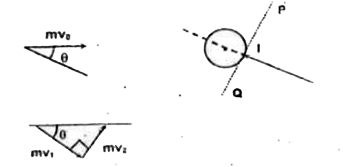
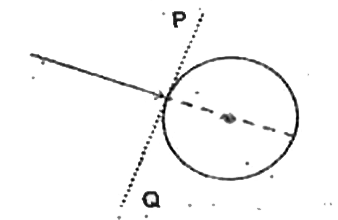
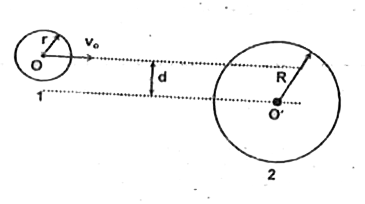
A disc of mass m is moving with constant speed `v_(0)` on a smooth horizontal table. Another disc of mass M is placed on the table at rest as shown in the figure. If the collision is elastic, find the velocity of the disc after collision. Both disc lie on the same horizontal plane of the table.

Text Solution

Verified by Experts
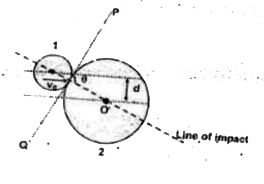
`sin theta = (d)/(r+R)`

For mass m :
Momentum before impact

Momentum after impact

For mass M :
Momentum before impact = 0
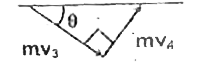
Momentum after impact

Net impulse on the system = 0
Momentum of the system is conserved.
`mv_(0) cos theta + 0=mv_(1)+Mv_(3)` ....(i)
`mv_(0)sin theta + 0 = mv_(2)+Mv_(4)` ....(ii)
Individually for mass m and M, the impulse along the tangent = 0
`therefore` For mass `m, mv_(0) sin theta = mv_(2)` ....(iii)
For mass M, `0 = Mv_(4)` .... (iv)
As the collision is elastic
`e=-(v_(3)-v_(1))/(0-v_(0)cos theta)=1`.
`v_(3)-v_(1)=v_(0)cos theta` ....(v)
Solving equations (i) through (v)
`v_(2)=v_(0)sin theta, " " v_(4)=0`
`v_(3)=(2mv_(0)cos theta)/(m+M), v_(1)=((m-M)/(m+M))v_(0)cos theta`
It can be verified that, `(1)/(2)mv_(0)^(2)=(1)/(2)m(v_(1)^(2)+v_(2)^(2))+(1)/(2)M(v_(3)^(2)+v_(4)^(2))`
`rArr` The kinetic energy is conserved in an elastic impact.
Special case : If m = M
`v_(1)=0, v_(0) sin theta`
`v_(3)=v_(0)cos theta, v_(4)=0`.
Note : The impulse along the common tangent during an impact may not be always negligible. For example, when normal reaction is impulsive and the effect of friction is to tbe considered.
Promotional Banner

Topper's Solved these Questions

  • COLLISION

    FIITJEE|Exercise SOLVED PROBLEMS (SUBJECTIVE)|10 Videos
  • COLLISION

    FIITJEE|Exercise SOLVED PROBLEMS (OBJECTIVE)|18 Videos
  • AC CIRCUITS

    FIITJEE|Exercise ASSERTION REASONING TYPE|1 Videos
  • CURRENT ELECTRICITY

    FIITJEE|Exercise Comprehension -4|3 Videos

Similar Questions

Explore conceptually related problems

A uniform disc of mass M and radius R is pivoted about the horizontal axis through its centre C A point mass m is glued to the disc at its rim, as shown in figure. If the system is released from rest, find the angular velocity of the disc when m reaches the bottom point B.

A disc of mass M and radius R moves in the x-y plane as shown in the figure. The angular momentum of the disc at the instant shown is –

A disc of mass M and radius R is kept flat on a smooth horizontal table. An insect of mass m alights on the periphery of the disc and begins to crawl along the edge. (a) Describe the path of the centre of the disc. For what value of (m)/(M) the centre of the disc and the insect will follow the same path ?

A circular disc of mass '2m' and radius '3r' is resting on a flat frictionless surface. Another circular disc of mass m and radius '2r' , moving with a velocity 'u' . hits the first disc as shown in the figure. The collision is elastic. What is the final velocity of the heavier disc?

A circular disc of mass '2m' and radius '3r' is resting on a flat frictionless surface. Another circular disc of mass m and radius '2r' , moving with a velocity 'u' . hits the first disc as shown in the figure. The collision is elastic. What is the tangential component of final velocity of the smaller disc?

A circular disc of mass '2m' and radius '3r' is resting on a flat frictionless surface. Another circular disc of mass m and radius '2r' , moving with a velocity 'u' . hits the first disc as shown in the figure. The collision is elastic. What is the magnitude of normal component of final velocity of the smaller disc'?