Home
Class 12
PHYSICS
Define the term 'wavefront of light'. A ...

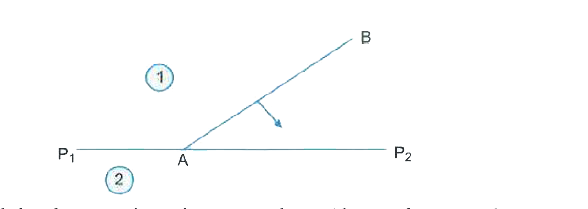
Define the term 'wavefront of light'. A plane wave front AB propagating from denser medium (1) into a rarer medium (2) is incident on the surface `P_(1)P_(2)` separating the two media as shown in figure.
Using Huygen's principle, draw the secondary wavelets and obtain the refracted wavefront in the diagram.

Text Solution

Verified by Experts
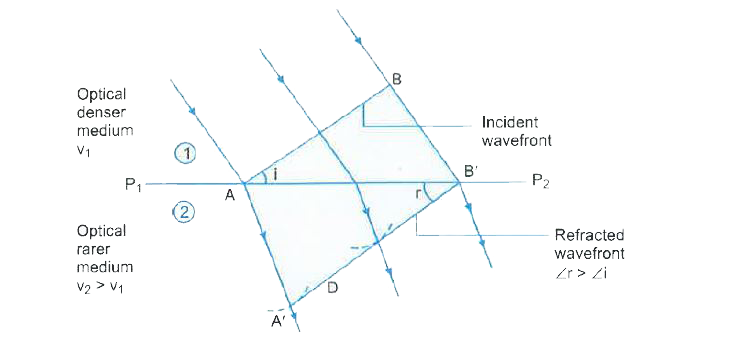
Awavefront is defined as a surface of constant phase. Alternately, a wavefront is the continuous locus of all those points which are in same phase at any instant of time. Secondary wavelets and the refracted wavefront is shown in the following diagram.
Promotional Banner

Topper's Solved these Questions

  • CBSE EXAMINATION PAPER 2020 (SOLVED)

    U-LIKE SERIES|Exercise SECTION C|11 Videos
  • CBSE EXAMINATION PAPER 2020 (SOLVED)

    U-LIKE SERIES|Exercise SECTION D|11 Videos
  • CBSE EXAMINATION PAPER 2020 (SOLVED)

    U-LIKE SERIES|Exercise SECTION D|11 Videos
  • CBSE EXAMINATION PAPER 2020

    U-LIKE SERIES|Exercise SECTION D|12 Videos
  • CBSE EXAMINATION PAPER 2020 (SOLVED)

    U-LIKE SERIES|Exercise SECTION - D|6 Videos

Similar Questions

Explore conceptually related problems

Use Huygen's principle to show how a plane wavefront propagates from a denser to rarer medium. Hence verift snell's law of refreaction.

Light from a denser medium 1 passes to a rarer medium 2. When the angle of incidence is theta the partially reflected and refracted rays are mutually perpendicular. The critical angle will be

Wave length of light in denser medium is 4000 A it is grazing into a rarer medium.If critical angle for the pair of media is sin^(-1) ((2)/(3)) then the wave length of light in rarer medium is

Huygen was the figure scientist who proposed the idea of wave theory of light he said that the light propagates in form of wavelengths. A wavefront is a imaginary surface of every point of which waves are in the same. phase. For example the wavefront for a point source of light is collection of concentric spheres which have centre at the origin w_(1) is a wavefront w_(2) is another wavefront. The radius of the wavefront at time 't' is 'ct' in thic case where 'c' is the speed of light the direction of propagation of light is perpendicular to the surface of the wavelength. the wavefronts are plane wavefronts in case of a parallel beam of light. Huygen also said that every point of the wavefront acts as the source of secondary wavelets. The tangent drawn to all secondary wavelets at a time is the new wavefront at that time. The wavelets are to be considered only in the forward direction (i.e., the direction of propagation of light) and not in the reverse direction if a wavefront w_(1) and draw spheres of radius 'cDeltat' they are called secondary wavelets. Draw a surface w_(2) which is tangential to all these secondary wavelets w_(2) is the wavefront at time t+Deltat Huygen proved the laws of reflection and laws of refraction using concept of wavefront. Q. Wavefronts incident on an interface between the media are shown in the figure. the refracted wavefront will be as shown in

