Home
Class 12
PHYSICS
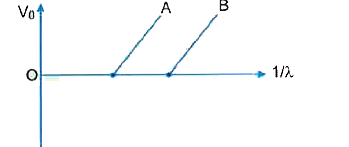
Figure shows the stopping potential (V(0...

Figure shows the stopping potential `(V_(0))` for the photo electron vers `((1)/(lambda))` graph, for two metals A and B, `lambda` being the wavelength of incident light.

If the distance between the light source and the surface of metal A is increased, how will the stopping potential for the electrons emitted from it be affected ? Justify your answer.

Text Solution

Verified by Experts

Stopping potential remains unchanged because it solely depends on the frequency (or wave length) of incident radiation and is independent of all other factors.
Promotional Banner

Topper's Solved these Questions

  • CBSE EXAMINATION PAPER 2020 (SOLVED)

    U-LIKE SERIES|Exercise SECTION C|11 Videos
  • CBSE EXAMINATION PAPER 2020 (SOLVED)

    U-LIKE SERIES|Exercise SECTION D|11 Videos
  • CBSE EXAMINATION PAPER 2020 (SOLVED)

    U-LIKE SERIES|Exercise SECTION D|11 Videos
  • CBSE EXAMINATION PAPER 2020

    U-LIKE SERIES|Exercise SECTION D|12 Videos
  • CBSE EXAMINATION PAPER 2020 (SOLVED)

    U-LIKE SERIES|Exercise SECTION - D|6 Videos

Similar Questions

Explore conceptually related problems

The stopping potential are V_(1) and V_(2) . Calculate the (V_(1)-V_(2)) , if the lambda_(1) and lambda_(2) are wavelength of incident lights, respectively.

The following graph shows the variation of stopping potential V_0 with the frequency v of the incident radiation for two photosensitive metals X and Y. (i) Which metal has larger threshold wavelength ? Give reason. (ii) Explain giving reason , which metal gives out electrons , having larger kinetic energy , for same wavelength of the incident radiation. (iii) If the distance between the light source and metal X is halved , how will the kinetic energy of electrons emitted from it change ? Given reason.

When light of wavelenght lambda incident on a metal then stopping potential is 10V. If wavelengt is increase to 3 lambda then stopping potential is 2V . Which of the following can emit electron form the metal : -

Fig. shows the variation of stopping potential V_0 with the frequency v of the incident radiation for two photosenstive metal P and Q: (i) Explain which metal has smaller threshold wavelength (ii) Explain, giving reason, which metal emits photoelectrons having smaller kinetic energy, for the same wavelength of incident radiation. (iii) If the distance between the light source and metal P is doubled, how will the stopping potential change.

The work function for a metal is 40 eV . To emit photo electrons of zero velocity from the surface of the metal the wavelength of incident light should be x nm .

A point source of light is used in a photoelectric effect. If the source is removed farther from the emitted metal, the stopping potential

If lambda_(0) is the threshold wavelength for photoelectric emission. lambda wavelength of light falling on the surface on the surface of metal, and m mass of electron. Then de Broglie wavelength of emitted electron is :-

In photoelectric experiment when wavelength of light is 642.4 nm falls on metal surface stopping potential of photo electron is 0.48eV. What will be the stoppingpotential when wavelength of light used is 474 nm?
