Home
Class 12
MATHS
Let a given line L1 intersect the X and ...

Let a given line `L_1` intersect the X and Y axes at P and Q respectively. Let another line `L_2` perpendicular to `L_1` cut the X and Y-axes at Rand S, respectively. Show that the locus of the point of intersection of the line PS and QR is a circle passing through the origin

Text Solution

Verified by Experts
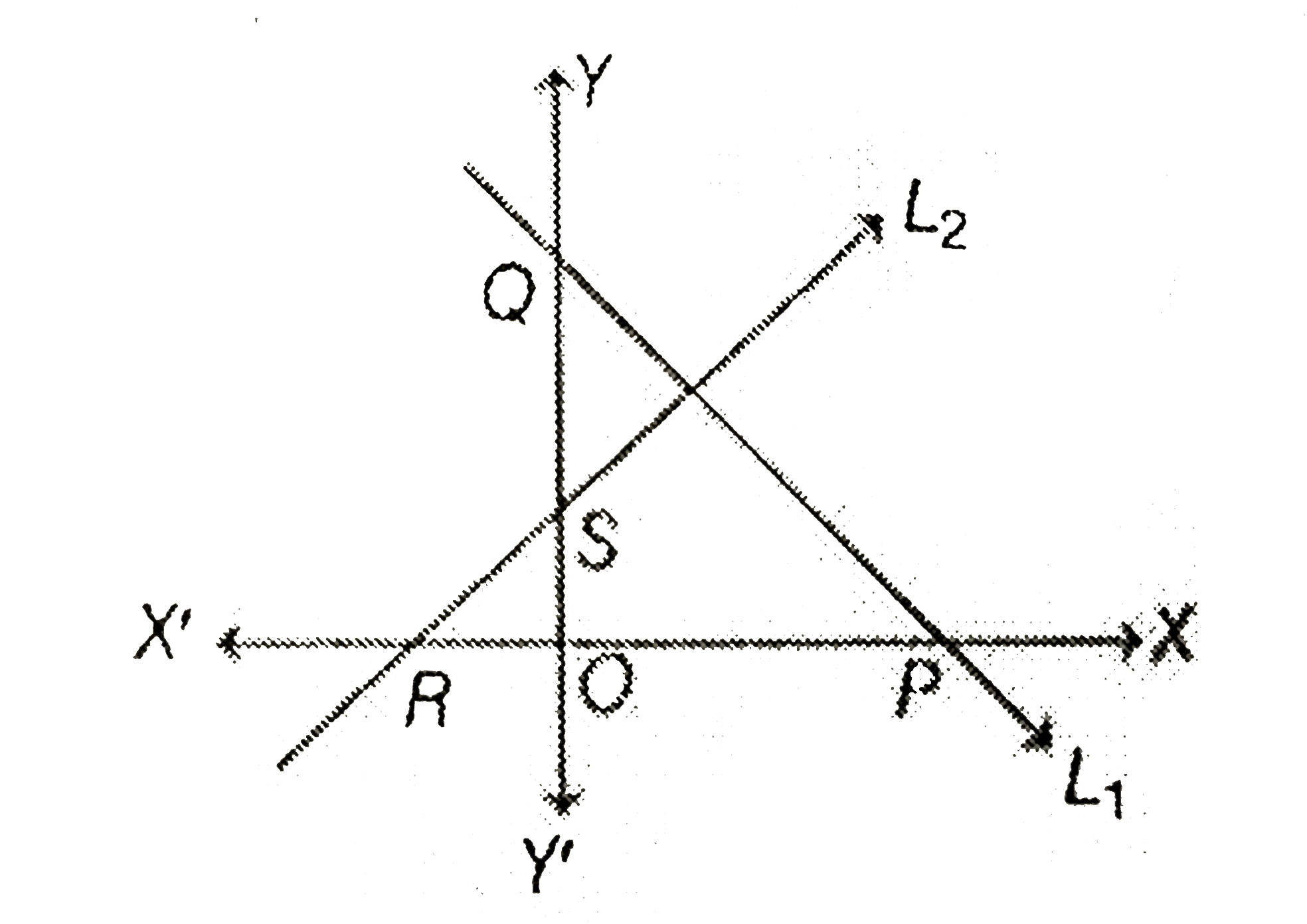
Let the equation of `L_)1)` be `xcosalpha+ysinalpha=P_(1)`
Then, any line perpendicular to `L_(1)` is

`xsinalpha-ycosalpha=p_(2)`
where, `p_(2)` is a variable.
Then, `L_(1)` meets X-axis at P `(p_(1) sec alpha , 0)` and Y-axis at `Q (0, p_(1)cosecalpha)`.
Similarly, `L_(1)` meets X-axis at `R(p_(2) cosec alpha, 0)` and Y-axis at S `(0,-p_(2)secalpha)`.
Now, equation of PS is,
`(x)/(p_(1)secalpha)+(y)/(-p_(2)secalpha)=1rArr (x)/p_(1)-(y)/(p_(2))=secalpha" "...(i)`
Similarly, equation of QR is
`(x)/(p_(2)cosecalpha)+(y)/(p_(1)cosecalpha)=1rArr (x)/p_(2)-(y)/(p_(1))=cosecalpha" "...(ii)`
Locus of point of intersection of PS and QR can be obtained by eliminating the variable `p_(2)` from Eqs, (i) and (ii).
`therefore ((x)/(p_(1))-secalpha)(x)/(y)+(y)/(p_(1))=cosecalpha`
`rArr (x-p_(1)secalpha)x+y^(2)=p_(1)y" cosec "alpha`
`rArr x^(2)+y^(2)-p_(1)xsecalpha-p_(1)y " cosec "alpha=0`
which is a circle through origin.
Promotional Banner

Topper's Solved these Questions

  • CIRCLE

    IIT JEE PREVIOUS YEAR|Exercise Topic 5 (objective Questions I)|6 Videos
  • CIRCLE

    IIT JEE PREVIOUS YEAR|Exercise Topic 5 (objective Questions II)|1 Videos
  • CIRCLE

    IIT JEE PREVIOUS YEAR|Exercise Topic 4 Fill in the blanks|4 Videos
  • BINOMIAL THEOREM

    IIT JEE PREVIOUS YEAR|Exercise Topic 2 Properties of Binomial Coefficent Objective Questions I (Only one correct option) (Analytical & Descriptive Questions )|8 Videos
  • COMPLEX NUMBERS

    IIT JEE PREVIOUS YEAR|Exercise TOPIC 5 DE-MOIVRES THEOREM,CUBE ROOTS AND nth ROOTS OF UNITY (INTEGER ANSWER TYPE QUESTION)|1 Videos

Similar Questions

Explore conceptually related problems

Let a line L_(1):3x+2y-6=0 intersect the x and y axes at P and Q respectively.Let another line L_(2) perpendicular to L_(1) cut the x and y axes at R and S respectively.The locus of point of intersection of the lines PS and QR is

A given line L_1 cut x and y-axes at P and Q respectively and has intercepts a and b/2 on x and y-axes respectively. Let another line L_2 perpendicular to L_1 cut x and y-axes at R and S respectively. Let T be the point of intersection of PS and QR . A straight line passes through the centre of locus of T . Then locus of the foot of perpendicular to it from origin is : (A) a straight line (B) a circle (C) a parabola (D) none of these

A given line L_1 cut x and y-axes at P and Q respectively and has intercepts a and b/2 on x and y-axes respectively. Let another line L_2 perpendicular to L_1 cut x and y-axes at R and S respectively. Let T be the point of intersection of PS and QR . Locus of T is a circle having centre at (A) (a, b) (B) (a, b/2) (C) (a/2, b) (D) (a/2, b/4)

The line x+y=1 cuts the coordinate axes at P and Q and a line perpendicular to it meet the axes in R and S. The equation to the locus of the point of intersection of the lines PS and QR is

A given line L_1 cut x and y-axes at P and Q respectively and has intercepts a and b/2 on x and y-axes respectively. Let another line L_2 perpendicular to L_1 cut x and y-axes at R and S respectively. Let T be the point of intersection of PS and QR . If two chords each bisected by x-axis can be drawn from (a, b/2) to the locus of T , then (A) a^2 gt 2b^2 (B) b^2 gt 2a^2 (C) a^2 lt 2b^2 (D) b^2 lt 2a^2

The line L_1-=4x+3y-12=0 intersects the x-and y-axies at Aa n dB , respectively. A variable line perpendicular to L_1 intersects the x- and the y-axis at P and Q , respectively. Then the locus of the circumcenter of triangle A B Q is (a)3x-4y+2=0 (b)4x+3y+7=0 (c)6x-8y+7=0 (d) none of these

The straight line x/a+y/b=1 cuts the axes in A and B and a line perpendicular to AB cuts the axes in P and Q. Find the locus of the point of intersection of AQ and BP .

A line L_(1) : (x)/(10)+(y)/(8)=1 intersects the coordinate axes at points A and B . Another line L_(2) perpendicular to L_(1) intersects the coordinate axes at C and D . The locus of circumcentre of Delta ABD is

