Home
Class 12
MATHS
C(1) and C(2) are two concentrate circle...

`C_(1) and C_(2)` are two concentrate circles, the radius of `C_(2)` being twice that of `C_(1)`. From a point P on `C_(2)` tangents PA and PB are drawn to `C_(1)`. Prove that the centroid of the `DeltaPAB` lies on `C_(1)`

Text Solution

Verified by Experts
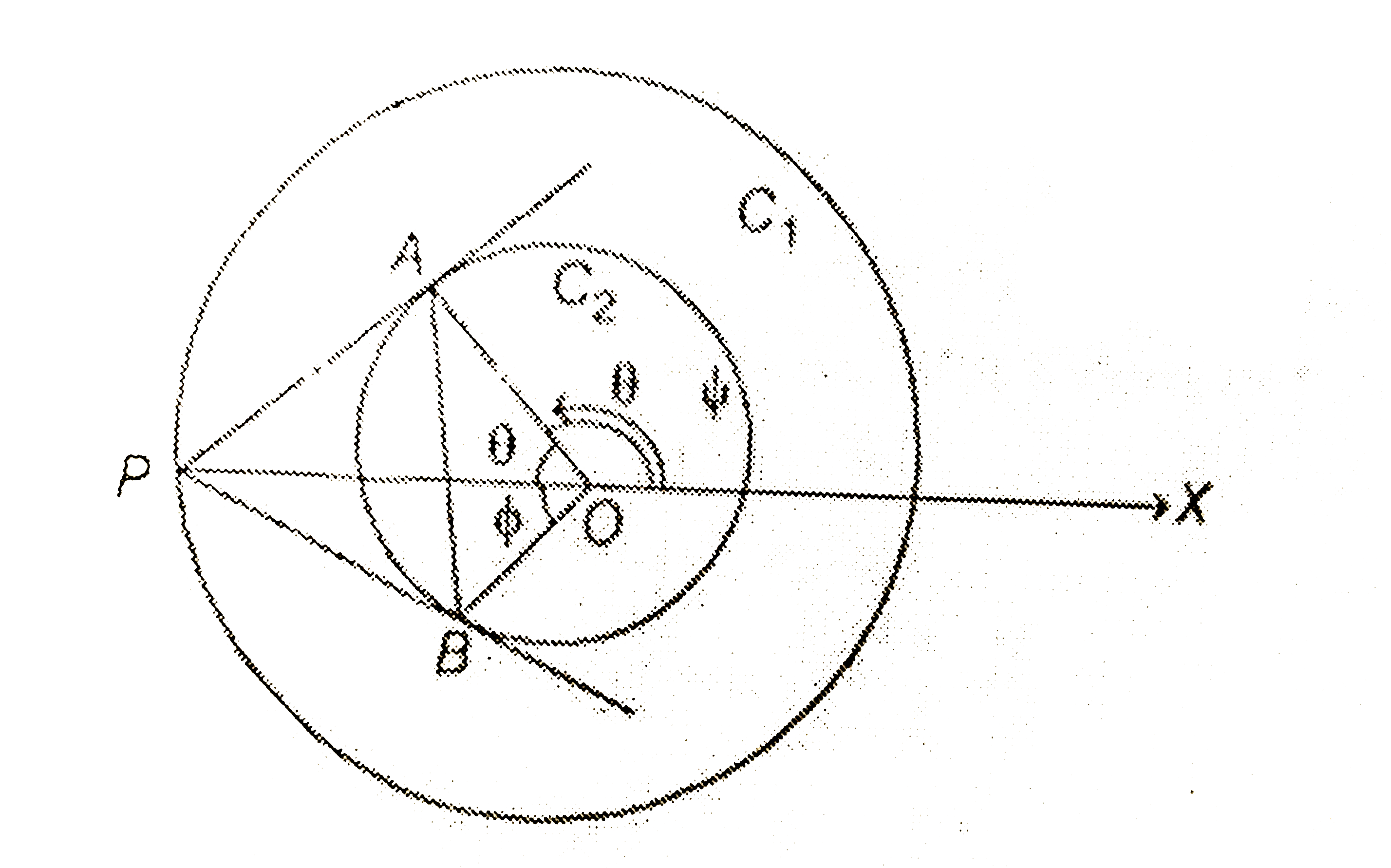
Let the coordinates of point P be `(2r cos theta, 2r sin theta)`
We have , OA = r, OP = 2r
Since, `Delta OAP` is a right angled triangle.

`cosphi=1//2rArr phi=pi//3`
`therefore` Coordinates of A are `{cos(theta-pi//3),rsin(theta-pi//3)}`
If p, q is the centroid of Delta PAB, then
`p=(1)/(3)[rcos(theta-pi//3)+rcos(theta+pi//3)+2rcostheta]`
`=(1)/(3)[r(2"cos"(theta-(pi)/(3)+theta+(pi)/(3))/(2)*"cos"(theta-(pi)/(3)-theta-(pi)/(3))/(2))+2rcostheta]`
`(1)/(3)[r{2costhetapi//3}+2rcostheta]`
`=(1)/(3)[r*costheta+2rcostheta]=rcostheta`
and `q=(1)/(3)[rsin( theta-(pi)/(3))+rsin(theta+(pi)/(3))+2rsintheta]`
`=(1)/(3)[r(2"sin"(theta-(pi)/(3)+theta+(pi)/(3))/(2)*"cos"(theta-(pi)/(3)-theta-(pi)/(3))/(2))+2rsintheta]`
`=(1)/(3)[rsin(2sinthetacospi//3)+2rsintheta]`
`=(1)/(3)[r(sintheta)+2rsintheta]=rsintheta`
Now, (p, q) = `(r cos theta, r sin theta) " lies on " x^(2) + y^(2) = r^(2)` which is called `C_(1)`.
Promotional Banner

Topper's Solved these Questions

  • CIRCLE

    IIT JEE PREVIOUS YEAR|Exercise Topic 5 Integer Answer type Question|1 Videos
  • CIRCLE

    IIT JEE PREVIOUS YEAR|Exercise Topic 5 Fill in the blanks|7 Videos
  • BINOMIAL THEOREM

    IIT JEE PREVIOUS YEAR|Exercise Topic 2 Properties of Binomial Coefficent Objective Questions I (Only one correct option) (Analytical & Descriptive Questions )|8 Videos
  • COMPLEX NUMBERS

    IIT JEE PREVIOUS YEAR|Exercise TOPIC 5 DE-MOIVRES THEOREM,CUBE ROOTS AND nth ROOTS OF UNITY (INTEGER ANSWER TYPE QUESTION)|1 Videos

Similar Questions

Explore conceptually related problems

C1 and C2 are two concentric circles, the radius of C2 being twice that of C1. From a point P on C2, tangents PA and PB are drawn to C1. Then the centroid of the triangle PAB (a) lies on C1 (b) lies outside C1 (c) lies inside C1 (d) may lie inside or outside C1 but never on C1

C_(1) and C_(2), are the two concentric circles withradii r_(1) and r_(2),(r_(1)

C_(1) and C_(2) are two concentric circles with centres at O. Their radii are 12 cm and 3 cm respectively. B and C are the points of contact of two tangents draw to C_(2) from a point A lying on the circle C_(1) . Then the area of the quadrilateral ABOC is-

C_(1) and C_(2) are two concentric circles with centres at O. Their radii are 12 cm and 3 cm respectively. B is the point of contact of tangents drawn to C_(2) from a point A lying on the circle C_(1) . Then the area of the triangle OAB is :

Let C_(1) and C_(2) be externally tangent circles with radius 2 and 3 respectively.Let C_(1) and C_(2) both touch circle C_(3) internally at point A and B respectively.The tangents to C_(3) at A and B meet at T and TA=4, then radius of circle C_(3) is:

Let C_(1) and C_(2) be two circles with C_(2) lying inside C_(1) . A circle C lying inside C_(1) touches C_(1) internally and C_(2) externally. Identify the locus of the centre of C.

From a point P outside a circle with centre at C,tangents PA and PB are drawn such that (1)/((CA)^(2))+(1)/((PA)^(2))=(1)/(16), then the length of chord AB is

