Home
Class 12
PHYSICS
Which of the following is the graph betw...

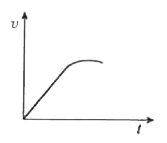
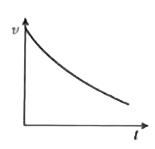
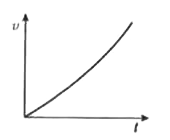
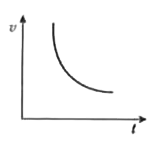
Which of the following is the graph between the time and the velocity of a body moving in a viscous fluid?

A

B

C

D

Text Solution

AI Generated Solution

The correct Answer is:

To determine the graph between time and velocity of a body moving in a viscous fluid, we need to analyze the motion of the body as it falls through the fluid. ### Step-by-Step Solution: 1. **Understanding Forces Acting on the Body**: - When a body is dropped into a viscous fluid, three primary forces act on it: - The gravitational force (weight) \( F_g = mg \) - The buoyant force \( F_b \) - The viscous drag force \( F_v = 6 \pi \eta r v \) - Here, \( \eta \) is the viscosity of the fluid, \( r \) is the radius of the body, and \( v \) is the velocity. 2. **Initial Conditions**: - Initially, when the body is dropped, the gravitational force is greater than the sum of the buoyant force and the viscous force. Thus, the body accelerates downwards. 3. **Velocity Increase**: - As the body descends, the velocity increases due to the net force acting on it. The net force can be expressed as: \[ F_{net} = F_g - F_b - F_v \] - As the velocity increases, the viscous force \( F_v \) also increases. 4. **Reaching Terminal Velocity**: - Eventually, the body will reach a point where the net force becomes zero. This occurs when the gravitational force is balanced by the sum of the buoyant force and the viscous force: \[ mg = F_b + F_v \] - At this point, the body stops accelerating and moves with a constant velocity known as the terminal velocity \( v_t \). 5. **Graphical Representation**: - The graph of velocity vs. time will show an initial increase in velocity as the body accelerates, followed by a plateau where the velocity remains constant (terminal velocity). - Therefore, the graph will start from the origin, rise sharply, and then level off as it approaches terminal velocity. 6. **Conclusion**: - Based on the analysis, the correct graph representing the relationship between time and velocity for a body moving in a viscous fluid is a graph that initially increases and then levels off, indicating the attainment of terminal velocity. ### Correct Option: - The correct option is **A**.
Promotional Banner

Topper's Solved these Questions

  • FLUIDS

    RESNICK AND HALLIDAY|Exercise PRACTICE QUESTIONS (More than One Correct Choice Type )|10 Videos
  • FLUIDS

    RESNICK AND HALLIDAY|Exercise PRACTICE QUESTIONS (Linked Comprehension )|9 Videos
  • FLUIDS

    RESNICK AND HALLIDAY|Exercise PROBLEMS|68 Videos
  • ELECTROMAGNETIC WAVES

    RESNICK AND HALLIDAY|Exercise PRACTICE QUESTIONS (Integer Type)|3 Videos
  • FORCE AND MOTION - I

    RESNICK AND HALLIDAY|Exercise PRACTICE QUESTIONS (Integer Type)|3 Videos

Similar Questions

Explore conceptually related problems

From the following displacement-time graph find out the velocity of a moving body.

From the following displacement-time graph find out the velocity of a moving body

The terminal velocity of a sphere moving through a viscous medium is :

Which of the following velocity-time graph is not possible?

Which of the following velocity-time graphs shows a realistic situation for a body in motion ?

Which of the following velocity-time graphs shows a realistic situation for a body in motion ?

For which of the following graphs the average velocity of a particl moving along a straight line for time interval (0,t) must be negative -

Which of the following graphs represents the position time-graph of a particle moving with negative velocity?

RESNICK AND HALLIDAY-FLUIDS-PRACTICE QUESTIONS (SINGLE CORRECT CHOICE TYPE)
  1. A woman is enjoying a cold drink while lying on a beach. The accelerat...

    Text Solution

    |

  2. The density rho of water of buk modulus B at a depth y then ocean i...

    Text Solution

    |

  3. Which of the following is the graph between the time and the velocity ...

    Text Solution

    |

  4. The excess pressure inside a spherical drop of water is four times tha...

    Text Solution

    |

  5. The density of ice is 0.92 g/cm^(3) and the density of seawater is 1.0...

    Text Solution

    |

  6. A piece of wood floats in water kept in a breaker. IF the beaker moves...

    Text Solution

    |

  7. Two spherical soap bubble coalesce. If V is the consequent change in v...

    Text Solution

    |

  8. A full can of soda has a mass of 0.416 kg. It contains 3.54 xx 10^(-4)...

    Text Solution

    |

  9. Assume that a drop of liquid evaporates by decreases in its surface en...

    Text Solution

    |

  10. Two capillary tubes of same radius r but of lengths l(1) and l(2) are ...

    Text Solution

    |

  11. A hemispherical portion of radius R is removed from the bottom of a cy...

    Text Solution

    |

  12. A capillary tube of inner diameter 0.5 mm is dipped in a liquid of spe...

    Text Solution

    |

  13. A cylindrical vessel contains a liquid of density rho up to height h. ...

    Text Solution

    |

  14. In a car lift , compressed air with a gauge pressure of 4.0 xx 10^(5) ...

    Text Solution

    |

  15. A capillary tube of radius r is immersed in water and water rises in t...

    Text Solution

    |

  16. The two dams are identical with the exception that the water reservoir...

    Text Solution

    |

  17. A cylindrical air duct in an air conditioning system has a length of 5...

    Text Solution

    |

  18. A balloon inflated with helium gas (density = 0.2 kg//m^(3)) has a vol...

    Text Solution

    |

  19. A glass bottle of soda is sealed with a screw cap . The absolute press...

    Text Solution

    |

  20. At a given instant , the blood pressure in the heart is 1.60 xx 10^(4)...

    Text Solution

    |
