A
B
C
D
Text Solution
Verified by Experts



Topper's Solved these Questions
INVERSE TRIGONOMETRIC FUNCTIONS
OBJECTIVE RD SHARMA|Exercise Section II - Assertion Reason Type|11 VideosINVERSE TRIGONOMETRIC FUNCTIONS
OBJECTIVE RD SHARMA|Exercise Exercise|72 VideosINVERSE TRIGONOMETRIC FUNCTIONS
OBJECTIVE RD SHARMA|Exercise Chapter Test|30 VideosINTEGRALS
OBJECTIVE RD SHARMA|Exercise Illustration|1 VideosLIMITS
OBJECTIVE RD SHARMA|Exercise Chapter Test|60 Videos
Similar Questions
Explore conceptually related problems
OBJECTIVE RD SHARMA-INVERSE TRIGONOMETRIC FUNCTIONS -Section I - Solved Mcqs
- tan(sec^(-1)x )=sin(cos^(-1)(1/sqrt5))
Text Solution
|
- Number of integral solutions of the equation 2 sin^-1sqrt(x^2-x +1 )+ ...
Text Solution
|
- If alpha, beta and gamma are the three angles with alpha = 2tan^(-1)(s...
Text Solution
|
- If f(x) =cos^(-1)x+cos^(-1){(x/2+1/2sqrt(3-3x^(2)))} then f(2/3) equ...
Text Solution
|
- The trigonometric equation sin^(-1)x=2sin^(-1)a has a solution for all...
Text Solution
|
- If alpha is the only real root of the equation x^3 + bx^2 + cx + 1 = ...
Text Solution
|
- If tan^(-1)(a/x)+tan^(-1)(b/x)+tan^(-1)(c /x)+tan^(-1)(d/x)=(pi)/(2) t...
Text Solution
|
- If u=cot^(-1)sqrt(cos theta) -tan^(-1)sqrt(cos theta) then sin u=
Text Solution
|
- If sin^(-1)x+sin^(-1)y+sin^(-1)z=pi then the value of xsqrt(1-x^(2))+y...
Text Solution
|
- if cos^(- 1)sqrt(p)+cos^(- 1)sqrt(1-p)+cos^(- 1)sqrt(1-q)=(3pi)/4 ,the...
Text Solution
|
- The solution set of the equation sin^(-1)x=2 tan^(-1)x is
Text Solution
|
- If cot(cos^(-1)x)=sec{tan^(-1)((a)/sqrt(b^(2)-a^(2)))} then x equals
Text Solution
|
- tan^(-1)(C(1)x-y)/(c(1)+c(3)c(2))+..+tan^(-1)(1)/(c(n)) is equal top
Text Solution
|
- If 0ltxlt1 then sqrt(1+x^(2))[{x cos (cot^(-1)x)+sin(cot^(-1)x}^(2)-1...
Text Solution
|
- Sigma(r=1)^(infty) tan^(-1)(1)/(2r^(2))=t then tan t is equal to
Text Solution
|
- Let (x,y)be such that sin^(-1)(ax)+cos^(-1)y+cos^(-1)(bxy)=(pi)/(2) ...
Text Solution
|
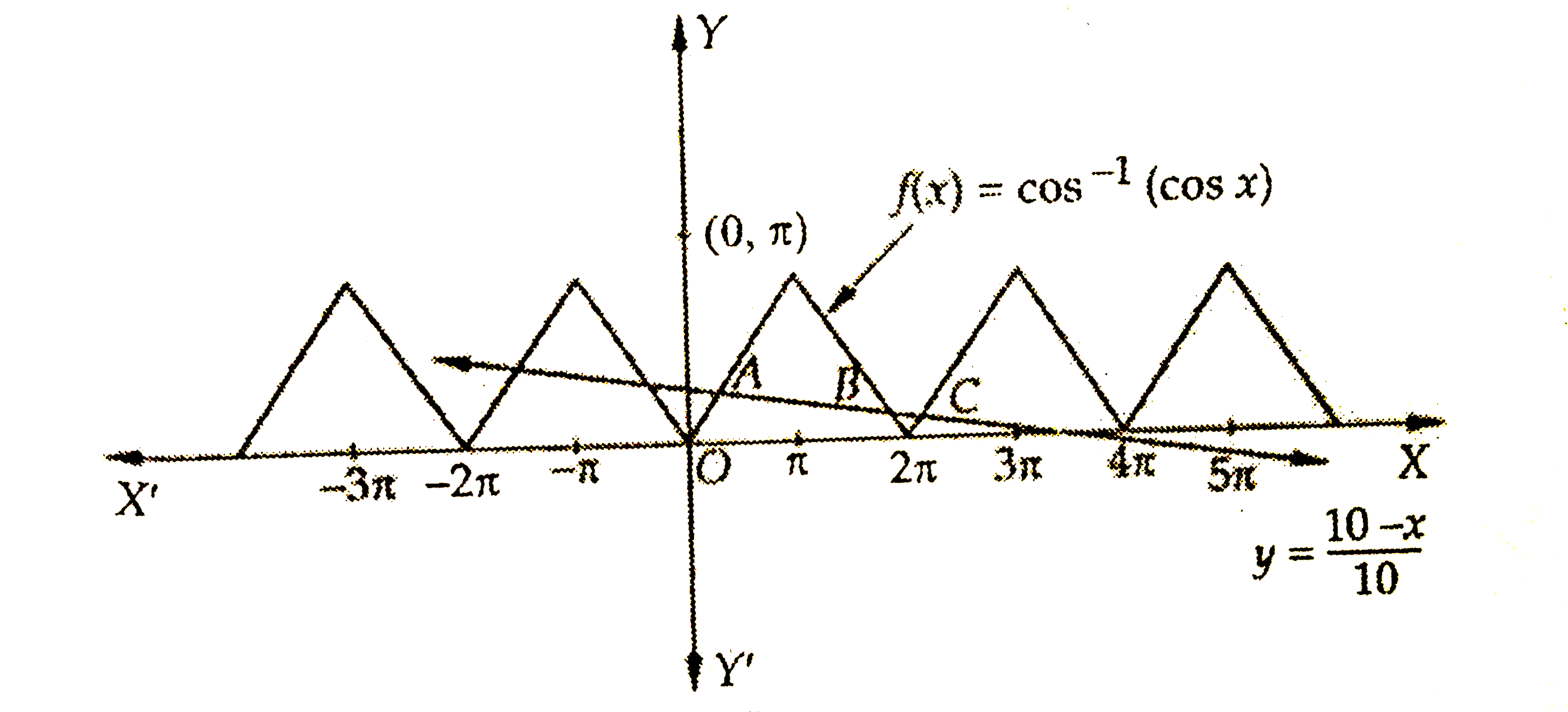
- Let f:[0,4pi]->[0,pi] be defined by f(x)=cos^-1(cos x). The number ...
Text Solution
|
- If (sin^(-1)x+sin^(-1)y)(sin^(-1)Z+sin^(-1)w)=pi^(2) and n(1),n(2),n(3...
Text Solution
|
- If sin^(-1)x+sin^(-1)y+sin^(-1)z=pi,t h e nx^4+y^2+z^4+4x^2y^2z^2=K(x^...
Text Solution
|
- Let tan^(-1)y=tan^(-1)x+tan^(-1)((2x)/(1-x^2)), where |x|<1/(sqrt(3))....
Text Solution
|