Home
Class 12
PHYSICS
A hollow cylindrical box of length 0.5m ...

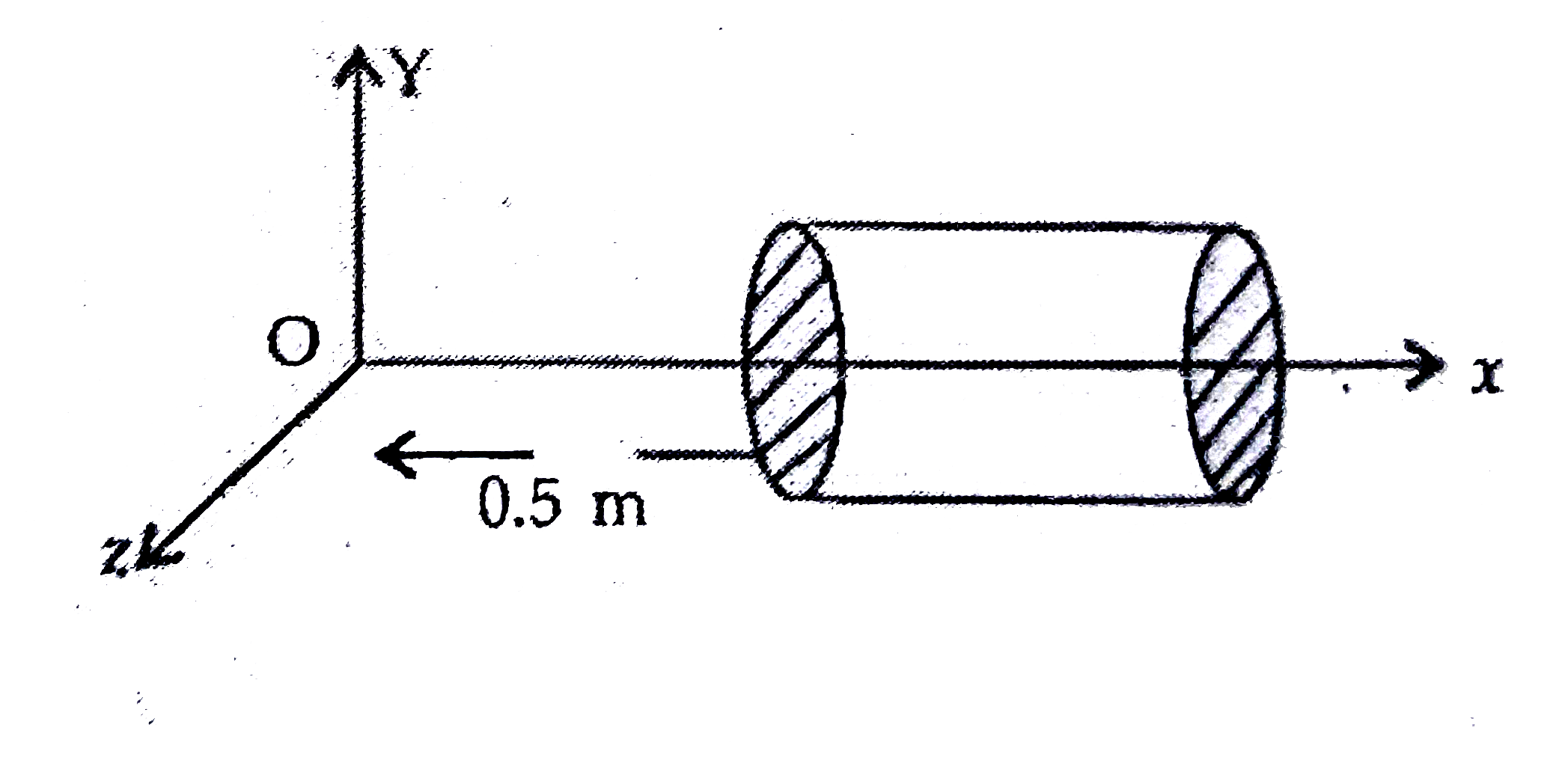
A hollow cylindrical box of length 0.5m and area of cross-section `20cm^(2)` is placed in a three dimensional coordinate system as shown in the figure. The electric field in the region is given by `vec E = 20 x hat i`, where E is `NC^(-1)` and x is in meters, Find

(i) Net flux through the cylinder.
(ii) Charge enclosed in the cylinder.

Text Solution

Verified by Experts
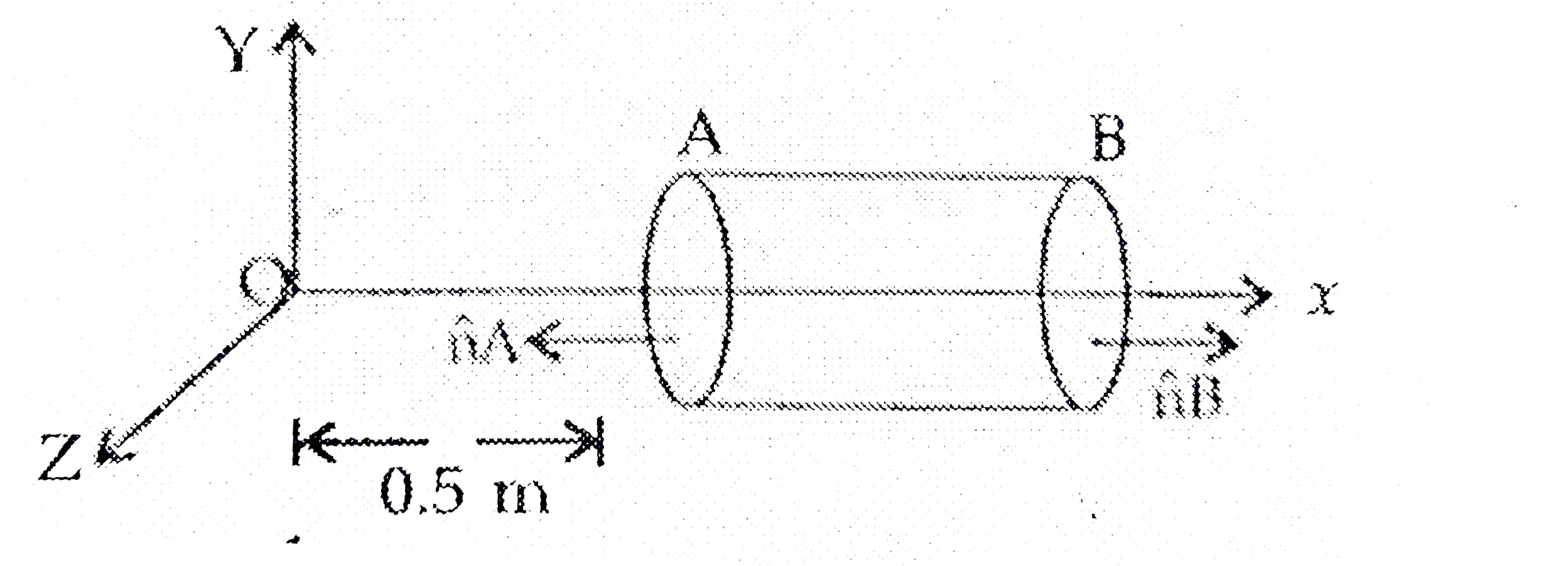
(i) Given, `vec E = 20 x hat i`
and `Delta s = 20cm^(2)=20 xx 10^(-4)m^(2)`
As the electric field is only along the x-axis, so flux will pass only through the cross-section of cylinder.
Magnitude of electric field at A,
`E_(A)=20xx0.5 = 10N//C`
Magnitude of electric field at cross-selection B.
`E_(B) = 20 xx 1 = 20NC^(-1)`

The corresponding electric fluxes are
`phi_(A)=vec E. Delta vecs`
`=10xx 20xx 10^(-4) xx cos 180^(@) = - 0.02 Nm^(2)C^(-1)`
`phi_(B)=vec E. Delta vec s `
`=20xx 20xx10^(-4) xx cos 0^(@) = 0.04Nm^(2)C^(-1)`
So, the net flux through the cylinder,
`phi = phi_(A)+phi_(B)`
`= -0.02 +0.04=0.02 Nm^(2)C^(-1)`
(ii) Using Gauss's Law:
`oint barE.bar(ds)=(q)/(E_(0))`
`0.02 =(q)/(8.85xx10^(-12))`
`q=8.85xx0.02xx10^(-12)`
`q=0.177xx10^(-12)C.`
Promotional Banner

Topper's Solved these Questions

  • XII BOARDS

    XII BOARDS PREVIOUS YEAR|Exercise [SET - I]|32 Videos
  • XII BOARDS

    XII BOARDS PREVIOUS YEAR|Exercise [SET - II DELHI BOARD]|6 Videos
  • XII BOARDS

    XII BOARDS PREVIOUS YEAR|Exercise SET - II (Delhi Board)|8 Videos
  • SAMPLE PAPER 2019

    XII BOARDS PREVIOUS YEAR|Exercise SECTION D|6 Videos

Similar Questions

Explore conceptually related problems

A bollow cylindrical box of length 1m and area of cross section 25 cm^(2) is placed in a three dimensional co-ordinate system as shown in Fig, The electric field in the region is given by vec(E) = 50 x hat(i) , where E is in NC^(-1) and x is in meter. Find (i) Net flux through the cylinder (ii) Charge enclosed by the cylinder.

A dipole is placed at origin of coordinate system as shown in figure, find the electric field at point P(0,y). [(KP)/(sqrt(2)y^(3))(-hat(i)-2hat(j))]

The electric field in a region is given by E=ahati+bhatj . Hence as and b are constants. Find the net flux passing through a square area of side I parallel to y-z plane.

A cube has sides of length L=0.2 m It is placed with one corner at the origin as shown in figure The electric field in uniform and given by vec(E)=(2.5hat(i)-4.2hat(j))N//C .Find the electric flux through the entire cube.

The electric field in a region is given by E = 3/5 E_0hati +4/5E_0j with E_0 = 2.0 x 10^3 N//C . Find the flux of this field through a rectangular surface of area 0.2 m^2 parallel to the y-z plane.

A cylinder of length L and radius b has its axis coincident with the x-axis. The electric field in the region vecE=200hati . Find the flux through (i) the left end of cylinder (ii) the right end of cylinder (iii) the cylinder curved surface, (iv) the closed surface area of the cylinder .

(A)Two point charges q_1 and q_2 are kept r distance apart in a uniform external electric field vecE . Find the amount of work done in assembling this system of charges. (B) A cube of side 20 cm is kept in a region as shown in the figure. An electric field vecE exists in the region such that the potential at a point is given by V = 10x + 5 , where V is in volt and x is in m. Find the electric field vecE and (ii) total electric flux through the cube.

The electric field in a region is given by vecE=3/5 E_0veci+4/5E_0vecj with E_0=2.0 xx 10^3 N C^(-1) . Find the flux of this field through a recatngular surface of area 0.2m^2 parallel to the y-z plane.

