Home
Class 12
PHYSICS
(a) In a nuclear reaction ""(2)^(3)He +...

(a) In a nuclear reaction `""_(2)^(3)He +""_(2)^(3)He to ""_(2)^(4)He+""_(1)^(1)H +""_(1)^(1)H +12.86` MeV, though the number of nucleons is conserved on both sides of the reaction, yet the energy is released. How? Explain.
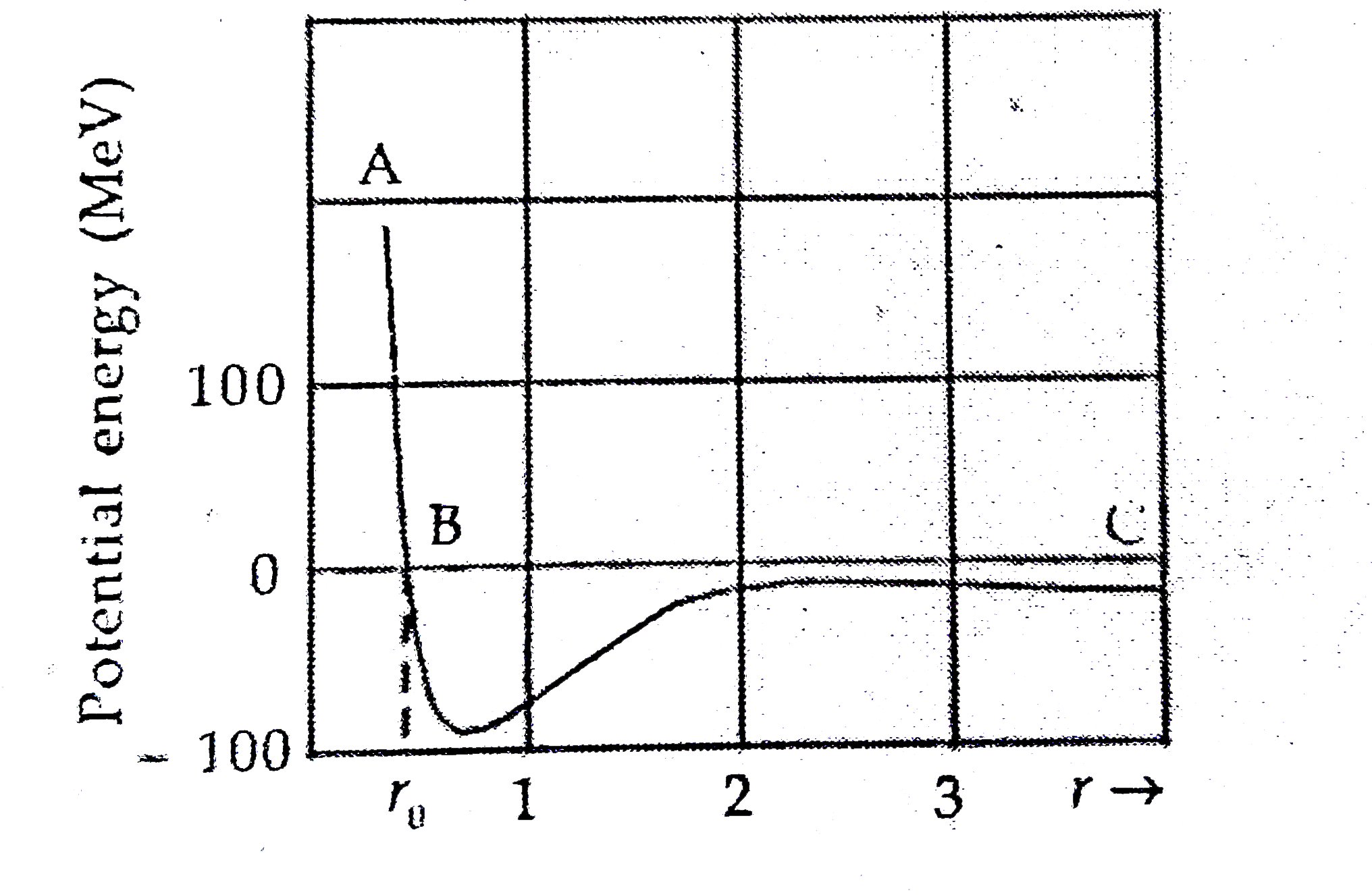
(b) Draw a plot of potential energy between a pair of nucleons as a function of their separation. Mark the regions where potential energy is (i) positive and (ii) negative.

Text Solution

Verified by Experts
(a) In a nuclear reaction, the sum of the masses of the target nuclues ` ""_(2)^(3)He` and the bombarding particle ` ""_(2)^(3)He` may be greater or less the sum of the masses of the product nucleus ` ""_(2)^(4)He` and the ` ""_(1)^(1)He`. So from the law of conservation of mass energy some energy some energy (12.86 MeV) is envolved in nuclear reaction . This energy is called Q-value of the nuclear reaction . The binding energy of the nucleus on the left side is not equal to the right side. The difference in the binding energies on two sides appears as energy released or absorbed in the nuclear reaction.
(b) The potential energy is minimum at `r_(0)`. For distances larger than `r_(0)` the negative potential energy goes on decreasing and for the distances less than `r_(0)` the negative potential energy decreases to zero and then becomes positive and increases abruptly. Thus, A to B is the positive potential energy region and B to C is the negative potential energy region.
Promotional Banner

Topper's Solved these Questions

  • XII BOARDS

    XII BOARDS PREVIOUS YEAR|Exercise [SET - I]|32 Videos
  • XII BOARDS

    XII BOARDS PREVIOUS YEAR|Exercise [SET - II DELHI BOARD]|6 Videos
  • XII BOARDS

    XII BOARDS PREVIOUS YEAR|Exercise SET - II (Delhi Board)|8 Videos
  • SAMPLE PAPER 2019

    XII BOARDS PREVIOUS YEAR|Exercise SECTION D|6 Videos

Similar Questions

Explore conceptually related problems

The nuclear reaction ._(1)^(2)H + ._(1)^(2)H to ._(2)^(4)He is called

Draw a plot of potential energy of a pair of nucleons as a function of their separation . Write two important conclusions which you can draw regarding the nature of nuclear forces .

In a typical unclear reaction, e.g. ""_(1)^(2)H+""_(1)^(2)H to ""_(2)^(3)He + n +3.27 Me V , although number of nucleons is conserved is conserved, yet energy is released. How ? Explain. (b) Show that nuclear dendity in a given nucleus is independent of mass number A.

Draw a graph between potential energy of a pair of nucleons and separation between them. Also write its main features.

