Home
Class 12
PHYSICS
(a) How does one demonstrate, using a su...

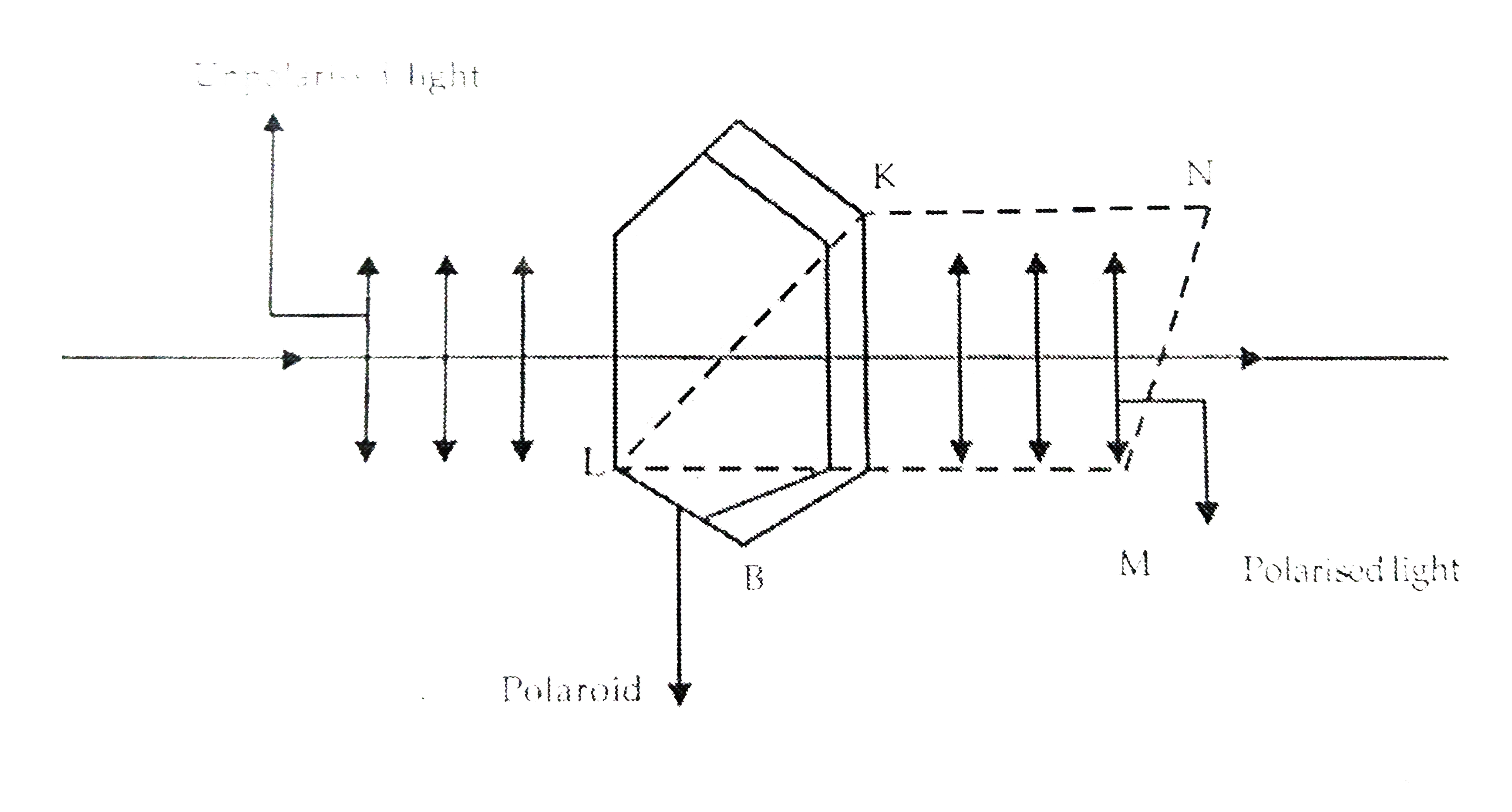
(a) How does one demonstrate, using a suitable diagram, that unpolarised light when passed through a Polaroid gets polarised?
(b) A beam of unpolarised light is incident a glass-air interface. Show using a suitable ray diagram, that light reflected from the interface is totally polarised, when `mu=tani_(B)`, when `mu` is the refractive index of glass with respect to air and `i_(B)`, is the Brewster's angle.

Text Solution

Verified by Experts
(a) (i) Two independent monochromatic sources of light cannot produce a sustained interference patter. The phase difference between these two sources will continuously vary, and the positions of maxima and minima will change with time.
(ii) `y_(1)=a cos omega t, and y_(2)=a cos (omegat+phi)`
`y=y_(1)+y_(2)=a [cos omega t+cos (omega t+phi)`
`=2acos((phi)/(2))cos(omegat+(phi)/(2))`
The resultant amplitude is `A=2a cos ((phi)/(2))`
and hence intensity `(I)=4a^(2)cos^(2)((phi)/(2))=4I_(0)cos^(2)((phi)/(2))`.
The intensity of light is directly proportional to the square of the amplitude of the wave. intensity of light at point P on the screen is given by :
`I=4a^(2) cos^(2)(phi)/(2)`.
(a)

The phenomenon of restricting the vibration of light (electric vector) in a particular direction perpendicular to the direction of the wave propagation is called polarisation of light.
When unpolarised light is passed through a polaroid, only those bibrations of light pass through the crystal, which are parallel to the axis of the crystal (AB). All other vibrations are absorbed and that is why intensity of the emerging light is reduced.
The plane ABCD in which the vibrations of the polarise light are confined is called the plane of vibration.
The plane KLMN that is perpendicular to the plane of vibration is defined as the plane of polarization. ,brgt (b) When unpolarised light is incident on the glass-air interface at Brewster angle iB, then reflected light is totally polaised. This is called Brewster's Law.
When light is incident at Brewster angle, the reflected component OB and the refracted component OC are mutually perpendicualr to each other.
From the figure, we have:
`angleBOY+angleYOC=90^(@)`
`(90^(@)-i_(B))+(90^(@)-r)=90^(@)`
where, r is angle of refraction
`90^(@)-i_(B)=r`
according to the Snell's law :
`mu=sin i-sin ri=i_(B) and`
`r=90^(@)-i_(B)mu=sini_(B) sin 90^(@)-i_(B)`
`sini_(B)cosi_(B)mu=tani_(B)`.
Hence, Proved.
Promotional Banner

Topper's Solved these Questions

  • XII BOARDS

    XII BOARDS PREVIOUS YEAR|Exercise [SET - II DELHI BOARD]|6 Videos
  • XII BOARDS

    XII BOARDS PREVIOUS YEAR|Exercise [SET - III, DELHI BOARD]|6 Videos
  • XII BOARDS

    XII BOARDS PREVIOUS YEAR|Exercise SET - III (Delhi Board)|8 Videos
  • SAMPLE PAPER 2019

    XII BOARDS PREVIOUS YEAR|Exercise SECTION D|6 Videos

Similar Questions

Explore conceptually related problems

A beam of unpolarized light is incident on a glass air interface. Show, using a suitable ray diagram that light reflected from the interface is totally polarized by reflection from a transparent medium. Write expression for Brewster's angle.

A ray of unpolarised light is incident on a glass plate of refractive index 1.54 at polarising angle, then angle of refraction is :

Unpolarized light is incident on a plane surface of glass of refractive index mu at angle i . If the reflected light gets totally polarized, write the relation between the angle i and refractive index mu .

When unpolarised light beam is incident from air onto glass ( n=1.5 ) at the polarising angle

Assertion (A) : When an unpolarised light is incident on a glass plate at Brewster angle, the reflected ray and refracted ray mutually perpendicular Reason (R ) : The refractive index of glass is equal to sine of the angle of polarisation.

XII BOARDS PREVIOUS YEAR-XII BOARDS-[SET - I]
  1. Identify the logic gates marked P and Q in the circuit Fig. Write the ...

    Text Solution

    |

  2. A capacitor C, a variable resistor R and a bulb B are connected in ser...

    Text Solution

    |

  3. A proton and deutron are accelerated through the same accelerating pot...

    Text Solution

    |

  4. (i) Mono chromatic light of frequency 6.0xx10^(14)Hz is produced by a ...

    Text Solution

    |

  5. A 12/5 eV electron beam is used to bombard gaseous hydrogen at room te...

    Text Solution

    |

  6. When Sunita, a class XII student, came to know that her parents are pl...

    Text Solution

    |

  7. A potentiometer wire of length 1 m has a resistance of 10Omega. It is ...

    Text Solution

    |

  8. (a) Draw a labelled ray diagram showing the formation of a final image...

    Text Solution

    |

  9. (a) A mobile phone lies along the principal axis of a concave mirror. ...

    Text Solution

    |

  10. (a) How is a toroid different from a solenoid? (b) Show that in an i...

    Text Solution

    |

  11. Derive an expression for the magnetic moment (vec mu) of an electron r...

    Text Solution

    |

  12. (a) State Ampere's circuital law, expressing it in the integral form. ...

    Text Solution

    |

  13. Answer the following : (a) Name the em waves which are suitable for ...

    Text Solution

    |

  14. Deduce the expression, N=N(0)^(-lambdat) for the law of radioactive de...

    Text Solution

    |

  15. (a) (i) Two independent mono chromatic sources of light cannot produc...

    Text Solution

    |

  16. (a) How does one demonstrate, using a suitable diagram, that unpolaris...

    Text Solution

    |

  17. (a) Describe a simple experiment (or activity) to show that the polari...

    Text Solution

    |

  18. Draw a schematic sketch of an generator describing its basic elements....

    Text Solution

    |

  19. Using the necessary circuit diagram, show how the V-I characteristics ...

    Text Solution

    |

  20. (a) Differentiate between three segments of a transistor on the basis ...

    Text Solution

    |

