Home
Class 12
PHYSICS
A test charge 'q' is moved without accel...

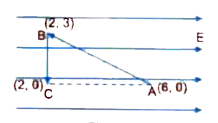
A test charge 'q' is moved without acceleration from A to C along the path from A to B and then from B to C in electric field E as shows in the figure. (i) Calculate the potential difference between A and C. (ii) At which point (of the two) is the electric potential more and why ?

Text Solution

Verified by Experts

(i) As electric field is a conservative field, work doene in moving the test charge q is exactly same along the path ABC or along straight path AC.
Distance `AC = vec r = - 4 hati`, and force applied against the electric field `vecF_("ext")= - vecE_q = -E_qhati`
`:.` Work done `W_(AC) = vec F_("ext").vecr = [-Eq hat i].[-4hati] = + 4 Eq`
`:.` Potential difference between C and A
`V_C - V_A = (W_(AC))/q = (4Eq)/q = + 4E`
(ii) Electric potential at point C is greater i.e., `V_C gt V_A`.
Promotional Banner

Topper's Solved these Questions

  • ELECTROSTATIC POTENTIAL AND CAPACITANCE

    U-LIKE SERIES|Exercise LONG ANSWER QUESTIONS-I|64 Videos
  • ELECTROSTATIC POTENTIAL AND CAPACITANCE

    U-LIKE SERIES|Exercise LONG ANSWER QUESTIONS-II|13 Videos
  • ELECTROSTATIC POTENTIAL AND CAPACITANCE

    U-LIKE SERIES|Exercise VERY SHORT ANSWER QUESTIONS|40 Videos
  • ELECTROMAGNETICE INDUCTION

    U-LIKE SERIES|Exercise Self Assessment Test Section -D|1 Videos
  • EXAMINATION PAPER 2020 (SOLVED)

    U-LIKE SERIES|Exercise SECTION D|6 Videos

Similar Questions

Explore conceptually related problems

A test charge q is moved without acceleration from A to C along the path form A to B and then from B to C in electric field E as shown in the figure. (i) Calculate the potential difference between A and C. (ii) At which point (of the two) is the electric potential more and why?

A test charge q is moved without acceleration from A to C along the path from A to B and then from B to C in electric field E as shown in Fig. (i) Calculate the potential difference between A and C (ii) At what point [of A and C] is the electric potential more and why?

The potential difference between points A and B from the figure is

There is a electric circuit as shown in the figure. Find potential difference between points a and b.

Three points A,B,C lie in a uniform electric field E of 5xx10^(3) N//C as shown in Fig. Find the potential difference between A and C.

In circuit shown in figure calculate the potential difference between the points A and B and between the points B and C in the steady state.

A test charge q_(0) is moved without acceleration from A to C over the path ABC as shown in Fig. Calcualate potential difference beetween A and C.

A charge of 5 C is moved between two point is an electric field and 20 J of work was done to do so. Calculate the potential difference between the two points.

An electric circuit is shown in figure.The potential difference between the point A and B is. (A) 10/3 (B) 20/3 (C) 5/3 (D) 7/3

U-LIKE SERIES-ELECTROSTATIC POTENTIAL AND CAPACITANCE -SHORT ANSWER QUESTIONS
  1. Calculate the electric potetial at the surface of a gold nucles. Given...

    Text Solution

    |

  2. The following data was obtained for the dependence of the magnitude of...

    Text Solution

    |

  3. A test charge 'q' is moved without acceleration from A to C along the ...

    Text Solution

    |

  4. An electric dipole is held in a uniform electric field. Show that th...

    Text Solution

    |

  5. An electric dipole is held in a uniform electric field. The dipole i...

    Text Solution

    |

  6. What is an equipotential surface ? Show that the electric field at a p...

    Text Solution

    |

  7. State main characteristics of an equipotential surface.

    Text Solution

    |

  8. Can two equipotential surfaces intersect each other? Give reasons.

    Text Solution

    |

  9. Two charges - q and + q are located at points A(0, 0, -a) and B(0, 0, ...

    Text Solution

    |

  10. Draw 3 equipotential surfaces corresponding to a field that uniformly ...

    Text Solution

    |

  11. Draw the equipotential surfaces due to an electric dipole. Locate the ...

    Text Solution

    |

  12. wo uniformly large parallel thin plates having charge densities +sigma...

    Text Solution

    |

  13. Two point charges 10 muC and -10 muC are separated by a distance of 40...

    Text Solution

    |

  14. Two point charges 10 muC and -10 muC are separated by a distance of 40...

    Text Solution

    |

  15. Two point charges + 4 muC and -2 muC are separated by a distance of 1...

    Text Solution

    |

  16. Two point charges, q1 = 10 xx 10^(-8) C and q2 = -2 xx 10^(-8) C, are...

    Text Solution

    |

  17. Two point charges, q1 = 10 xx 10^(-8) C and q2 = -2 xx 10^(-8) C, are...

    Text Solution

    |

  18. Two closely spaced equipotential surfaces A and B with potentials V an...

    Text Solution

    |

  19. Derive an expression for the potential energy of an electric dipole of...

    Text Solution

    |

  20. Calculate the amount of work done to dissociate a system of three char...

    Text Solution

    |
