Home
Class 12
PHYSICS
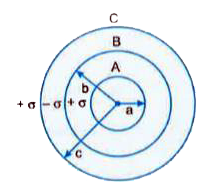
Three concentric metallic shells A , B a...

Three concentric metallic shells A , B and C of radii a, b and c `(a lt b lt c)` have surface densities `+ sigma ,- sigma` and `+sigma` respectively as shown in Fig.

Obtain the expressions for the potential of three shells A , B and C .

Text Solution

Verified by Experts

We know that potential at a point either on the surface or inside a charged spherical shell having surface density `sigma` is `V = (sigma R)/(in_(0))` , where R is radius of shell . The potential at a point outside the charged shell at a distance (where `r gt R`) is V = `(sigma R^(2))/(in_(0) r)`
In present question `sigma_(A) = + sigma , sigma_(B) = - sigma` and `sigma_(c) = + sigma` , moreover `a lt b lt c`
`therefore` Electric potential at shell A ,
`V_(A) = (sigma A * a)/(in_(0)) + (sigma_(B) * b)/(in_(0)) + (sigma_(C) * c)/(in_(0)) = (sigma a)/(in_(0)) - (sigma b)/(in_(0)) + (sigma_(c) )/(in_(0)) = (sigma)/(in_0) [a -b + c] " " ..... (i)`
Electric potential at shell B ,
`V_(B) = (sigma_(A) * a^(2))/(in_(0) b) + (sigma _(B) * b)/(in_(0)) + (sigma_(c) * c)/(in_(0)) = (sigma * a^(2))/(in_(0) b) - (sigma *b)/(in_(0)) + (sigma * c)/(in_(0)) = (sigma)/(in_(0)) [ (a^(2))/(b) - b + c] " " ..... (ii) `
and electric potential at shell C .
`V_(C) = (sigma_(A) * a^(2))/(in_(0) c) + (sigma_(B) * b^(2))/(in_(0) c) + (sigma_(c) * c)/(in_0)) = (sigma a^(2))/(in_(0) c) - (sigma b^(2))/(in_(0) c) + (sigma_(c))/(in_(0)) = (sigma)/(in_(0)) [ (a^(2) - b^(2))/(c) + c] " " ... (iii)`
Promotional Banner

Topper's Solved these Questions

  • ELECTROSTATIC POTENTIAL AND CAPACITANCE

    U-LIKE SERIES|Exercise LONG ANSWER QUESTIONS-II|13 Videos
  • ELECTROSTATIC POTENTIAL AND CAPACITANCE

    U-LIKE SERIES|Exercise SELF ASSESSMENT TEST|1 Videos
  • ELECTROSTATIC POTENTIAL AND CAPACITANCE

    U-LIKE SERIES|Exercise SHORT ANSWER QUESTIONS|48 Videos
  • ELECTROMAGNETICE INDUCTION

    U-LIKE SERIES|Exercise Self Assessment Test Section -D|1 Videos
  • EXAMINATION PAPER 2020 (SOLVED)

    U-LIKE SERIES|Exercise SECTION D|6 Videos

Similar Questions

Explore conceptually related problems

Three concentric metallic shells A, B and C of radii a, b and c(a lt b lt c) have surface charge densities +sigma, -sigma and +sigma respectively as shown. Obtain the expressions for the potential of three shells A, B and C. If shells A and C are at the same potential, obtain the relation between a, b and c.

Three concentric spherical metallic spheres A,B and C of radii a , b and c(a lt b lt c) have surface charge densities sigma , -sigma and sigma respectively.

Three concentric metallic spherical shells A,B and C of radii a,b and c(a lt blt c) have surface charge densities -sigma ,+sigma and -sigma respectively ,the potential of shell A is

Three concentric spherical metallic shells A, B and C of radii a, b and c (a lt b ltc) have surface charge densities sigma , -sigma and sigma respectively. (i) Find the potential of the three shells A, B and C. (ii) If the shells A and C are at the same potential, obtain the relation between the radii a, b and c.

Three concentric metallic spherical shell A,B and C or radiin a, b and C (a lt bgt C) have surface charge densities - singama, + sigma , and - aigba respectively . The potential of shell A is :

Three concentric spherical metallic shells A, B, and C of radii a,b, and c(a lt b lt c) have surface charge densities sigma, -sigma and sigma , respectively. If V_(A), V_(B) and V_(C) are potential of shells A, B and C, respectively, match the columns {:("Column A",,,"Column B"),(a. V_(A),,i.,sigma/epsilon_(0)[(a^(2)-b^(2)+c^(2))/c]),(b. V_(B),,ii.,sigma^(2)/epsilon_(0)[a^(2)/b-b+c]),(c. V_(C),,iii.,sigma/epsilon_(0)[a-b+c]):}

Three concentric spherical metallic shells A,B and C of radii a,b and c ( a lt b lt c) have surface charge densities sigma, - sigma and sigma respectively. If the potenital of sheel B is V_(B) = (sigma)/(in_(0)) ((a^(n))/(b) - b+c) and the potential of shell C is V_(C) = (sigma)/(in_(0)) ((a^(n))/(c) - (b^(n))/(c)+c) then n is .

U-LIKE SERIES-ELECTROSTATIC POTENTIAL AND CAPACITANCE -LONG ANSWER QUESTIONS-I
  1. Find out the amount of the work done to separate the charges at infini...

    Text Solution

    |

  2. A charge Q is distributed over the surfaces of two concentric hollow s...

    Text Solution

    |

  3. Three concentric metallic shells A , B and C of radii a, b and c (a lt...

    Text Solution

    |

  4. Three concentric metallic shells A , B and C of radii a, b and c (a lt...

    Text Solution

    |

  5. Establish a relation for electric potential due to short dipole at a p...

    Text Solution

    |

  6. Explain the underlying principle of working of a parallel plate capaci...

    Text Solution

    |

  7. Explain the underlying principle of working of a parallel plate capaci...

    Text Solution

    |

  8. Explain the underlying principle of working of a parallel plate capaci...

    Text Solution

    |

  9. Find an expression for the equivalent capacitance of a combination of ...

    Text Solution

    |

  10. Deduce an expression for the capacitance of a parallel plate capacito...

    Text Solution

    |

  11. Obtain an expression for the capacitance of a combination of three cap...

    Text Solution

    |

  12. Deduce an expression for the electrostatic energy stored in a capacita...

    Text Solution

    |

  13. Deduce an expression for the electrostatic energy stored in a capacita...

    Text Solution

    |

  14. A parallel plate capacitor of capacitance C is charged to a potential ...

    Text Solution

    |

  15. A parallel plate capacitor of capacitance C is charged to a potential ...

    Text Solution

    |

  16. A parallel plate capacitor of capacitance C is charged to a potential ...

    Text Solution

    |

  17. A parallel plate capacitor is charged by a battery . After sometime th...

    Text Solution

    |

  18. A parallel plate capacitor is charged by a battery . After sometime th...

    Text Solution

    |

  19. A parallel plate capacitor is charged by a battery . After sometime th...

    Text Solution

    |

  20. A parallel plate capacitor , each with plate area A and separation d ,...

    Text Solution

    |
