Home
Class 12
CHEMISTRY
The central metal ion in the complex mak...

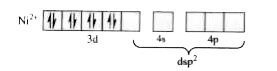
The central metal ion in the complex makes available a number of empty orbitals for the formation of co-ordinate bonds with suitable ligands. The inner d-orbitals or outer d-orbitals are involved. The empty hybrid orbitals of metal ion overlap with the filled orbitals of ligand to from metal ligand co-ordinate bonds. For co-ordination number 6 octahedral geometry and `sp^(3),d^(2)ord^(2)sp^(2)` hybridisation involved and for cordiantion number 4 tetrahedral geometry, square planar geometry and `sp^(3).dsp^(2)` hybridisation involved.
Geometry of `[Ni(CN)_(4)]^(-2)` ion is

A

tetrahedral

B

Octahedral

C

square planar

D

none.

Text Solution

Verified by Experts

The correct Answer is:

C

`CN^(-)` is a strong field ligand so rearrangement of electrons occurs.

After rearrangement :

`:.` Square planar geometry.
Promotional Banner

Topper's Solved these Questions

  • CO-ORDINATION COMPOUNDS

    AAKASH SERIES|Exercise LEVEL-II LECTURE SHEET EXERCISE-II (Linked Comprehension type questions ) Passage-V|3 Videos
  • CO-ORDINATION COMPOUNDS

    AAKASH SERIES|Exercise LEVEL-II LECTURE SHEET EXERCISE-II (Linked Comprehension type questions ) Passage-VI|3 Videos
  • CO-ORDINATION COMPOUNDS

    AAKASH SERIES|Exercise LEVEL-II LECTURE SHEET EXERCISE-II (Linked Comprehension type questions ) Passage-III|3 Videos
  • CHEMISTRY IN EVERYDAY LIFE

    AAKASH SERIES|Exercise PRACTICE SHEET - 2 (PRACTICE SHEET -2 (INTEGER ANSWER TYPE QUESTIONS))|7 Videos
  • COMPLEX COMPOUNDS

    AAKASH SERIES|Exercise PRACTICE EXERCISE|45 Videos

Similar Questions

Explore conceptually related problems

The central metal ion in the complex makes available a number of empty orbitals for the formation of co-ordinate bonds with suitable ligands. The inner d-orbitals or outer d-orbitals are involved. The empty hybrid orbitals of metal ion overlap with the filled orbitals of ligand to from metal ligand co-ordinate bonds. For co-ordination number 6 octahedral geometry and sp^(3),d^(2)ord^(2)sp^(2) hybridisation involved and for cordiantion number 4 tetrahedral geometry, square planar geometry and sp^(3).dsp^(2) hybridisation involved. Type of complex formed in [Fe(H_(2)O)_(6)]^(+3) ion

The central metal ion in the complex makes available a number of empty orbitals for the formation of co-ordinate bonds with suitable ligands. The inner d-orbitals or outer d-orbitals are involved. The empty hybrid orbitals of metal ion overlap with the filled orbitals of ligand to from metal ligand co-ordinate bonds. For co-ordination number 6 octahedral geometry and sp^(3),d^(2)ord^(2)sp^(2) hybridisation involved and for cordiantion number 4 tetrahedral geometry, square planar geometry and sp^(3).dsp^(2) hybridisation involved. Hybridisation present in [Cr(NH_(3))_(6)]^(+3)

Number of orbitals for the sub shell 3d is

The number of p atomic orbitals involved in the formation of a benzene molecule

The d-orbitals involved in sp^(3)d^(2) or d^(2)sp^(3) hybridisation of the central metal ion are :

The number of hybrid orbitals formed in sp^3 hybridization

The number of orbitals in 4d subshell is

Which d'orbital is involved in dsp hybridisation?