Home
Class 11
CHEMISTRY
Give reasons for the following (a) C C...

Give reasons for the following
(a) `C Cl_(4)` is immiscible in water, whereas `SiCl_(4)` is easily hydrolysed.
(b) Carbon has a strong tendency for catenation compared to silicon.

Text Solution

Verified by Experts
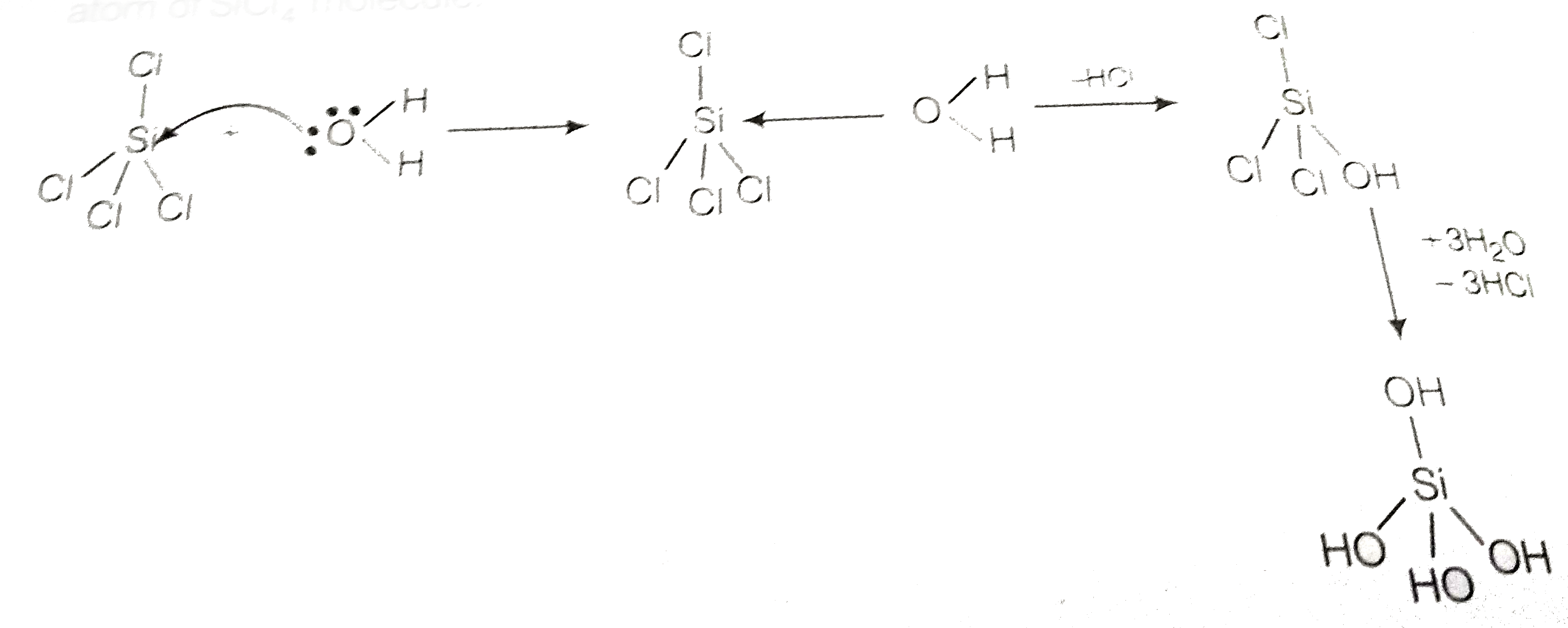
(a) Carbon tetrachloride `(C Cl_(4))` is a covalent compound while `H_(2)O` is a polar compound. `C Cl_(4)` does not form H-bond with water molecule. Hence, it is immiscible in water. Further more, `C Cl_(4)` is not hydrolysed by water because of the absence of d-orbitals in carbon while `SiCl_(4)` is readily hydrolysed by water.
`SiCl_(4)+4H_(2)Orarrunderset("Silicic acid")(Si(OH)_(4))+4HCl`
The hydrolysis of `SiCl_(4)` occurs due to coordination of `OH^(-)` with empty 3d orbitals in silicon atom of `SiCl_(4)` molecule

(b) Carbon atoms have the tendency to link with one another through covalent bonds to form chains and rings. This property is called catenation. This property is called catenation. This is because C-C bonds are very strong
Down the group, the size increases and electronegativity decreases and thereby, tendency to show catenation decreases. Thus, carbon has a strong tendency for catenation as compared to silicon.
Promotional Banner

Topper's Solved these Questions

  • THE P-BLOCK ELEMENTS

    NCERT EXEMPLAR ENGLISH|Exercise Matching|3 Videos
  • THE P-BLOCK ELEMENTS

    NCERT EXEMPLAR ENGLISH|Exercise Assertion and Reason|2 Videos
  • THE P-BLOCK ELEMENTS

    NCERT EXEMPLAR ENGLISH|Exercise Long Answer|9 Videos
  • STRUCTURE OF ATOM

    NCERT EXEMPLAR ENGLISH|Exercise All Questions|55 Videos
  • THE S-BLOCK ELEMENTS

    NCERT EXEMPLAR ENGLISH|Exercise Long Answer Type Questions|8 Videos

Similar Questions

Explore conceptually related problems

Explain giving reasons the following: C Cl_4 is not hydrolysed with water but SiCl_4 is easily hydrolysed.

C Cl_(4) is inert towards hydrolysis but SiCl_(4) is readily hydrolysed because

C Cl_(4) does not show hydrolysis but SiCl_(4) is readily hydrolysed because:

Give reasons for the following observations : Why SF_(4) undergoes hydrolysis but not SF_(6) ? Or SF_(6) is inert towards hydroysis. SF_(6) is much less reactive than SF_(4) . Or (i) SF_(4) is easily hydrolysed whereas SF_(6) is not easily hydrolysed. (ii) Sulpher exhibits greater tendency for calenation than selenium. (iii) Sulpher has a higher tendency for catenation than oxygen.

State reasons for each of the following : (i) All the P-Cl bonds in PCl_5 molecule are not equivalent. (ii) Sulphur has greater tendency for catenation than oxygen.

Assertion (A) : C Cl_4 is inert towards hydrolysis but SiCl_4 is readily hyrolyse . Reason (R) : Carbon cannot expand its octet but silicon can expand its octet .

(a) Account for the following observations : (i) SF_(4) is easily hydrolysed whereas SF_(6) is not easily hydrolysed. (ii) Chlorine water is a powerful bleaching agent. (iii) Bi (V) is a stronger oxidising agent than Sb(V) (b) What happens when : (i) White phosphorus is heated with concentrated NaOH solution in an inert atmosphere of CO_(2). (ii) XeF_(6) undergoes partial hydrolysis. (Give the chemical equations involved).

Why is SiCl_(4) readily hydrolysed but C Cl_(4) is resistant to hydrolysis?

Explain the following situations : (i) In the structure of HNO_(3) molecule , the N-O bond (121 pm) is shorter than N-OH bond (140pm). (ii) SF_(4) is easily hydrolysed whereas SF_(6) is not easily hydrolysed. (iii) XeF_(2) has a straight linear structure and not a bent angular structure.

Draw the structures of the following : (i) H_(2)S_(2)O_(8) (ii) HClO_(4) (b) How would you account for the following : (i) NH_(3) is a stronger base than PH_(3) . (ii) Sulphur has a greater tendency for catenation than oxygen. (iii) F_(2) is stronger oxidising agent than Cl_(2) .

