Home
Class 12
CHEMISTRY
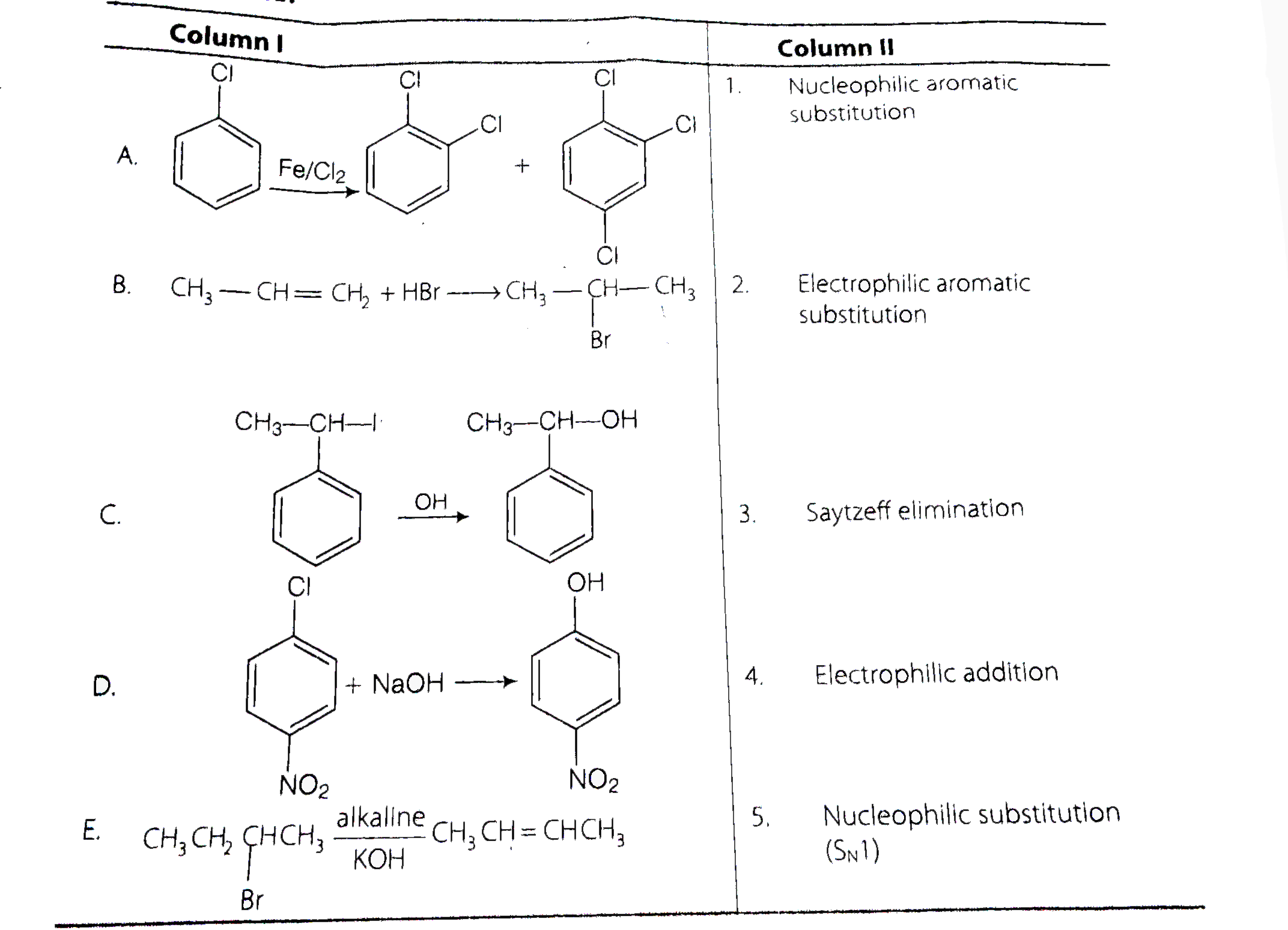
Match the reactions given in Column I wi...

Match the reactions given in Column I with the type of reactions given in Column II

Text Solution

Verified by Experts

A`to`(2) B`to`(4) C`to`(5) D`to`(1) E`to`(3)
A. In this reaction, an electrophile `Cl^(+)` attacks on to the benzene ring and substitution takes place.
B. In this reaction, addition of HBr takes place on to the doubly bonded carbons of propene in accordance with Markownikoffs rule and electrophilic addition takes place
C. In this reaction, the reactant is secondary halide Here. halogen atom is substituted by hydroxy ion. As it is secondary halide so it follows `S_(N)1` mechanism.
D. In this reaction, halogen atom is directiy bonded to aromatic ring. So, It is nucleophilic aromatic substitution as `""^(-)OH` group has substituted halogen of given compound
E. It is an elimination reaction. It follows Saytzeff elimination rule.
Promotional Banner

Topper's Solved these Questions

  • HALOALKANES AND HALOARENES

    NCERT EXEMPLAR ENGLISH|Exercise Assertion & Reason|10 Videos
  • HALOALKANES AND HALOARENES

    NCERT EXEMPLAR ENGLISH|Exercise Long Answer Type Questions|3 Videos
  • HALOALKANES AND HALOARENES

    NCERT EXEMPLAR ENGLISH|Exercise Short Answer Type Questions|35 Videos
  • GENERAL PRINCIPLE AND PROCESSES OF ISOLATION OF ELEMENTS

    NCERT EXEMPLAR ENGLISH|Exercise Long Answer Type Questions|1 Videos
  • P-BLOCK ELEMENTS

    NCERT EXEMPLAR ENGLISH|Exercise Long Answer Type Questions|3 Videos

Similar Questions

Explore conceptually related problems

Match the reactions given in column I with the type of reaction mentioned in column II and mark the appropriate choice

Match the reactions given in Column I with the suitable reagents given in Column II.

Match the reactions given in Column I with the statements given in Column II

Match the reactions given in Column I with the statements given in Column II

Match structures given in Column I with the type of detergents given in Column II.

Match the reactions given in Column I with the reaction types in Column II.

Match the salts given in Column I with their . method of preparation given in Column II :

Match the statements given in Column I with the oxidation states given in Column II.

Match the class of compounds given in Column I with their functions given in Column II.

Match the reactions given in Column I with the names given in Column II.
