Home
Class 12
MATHS
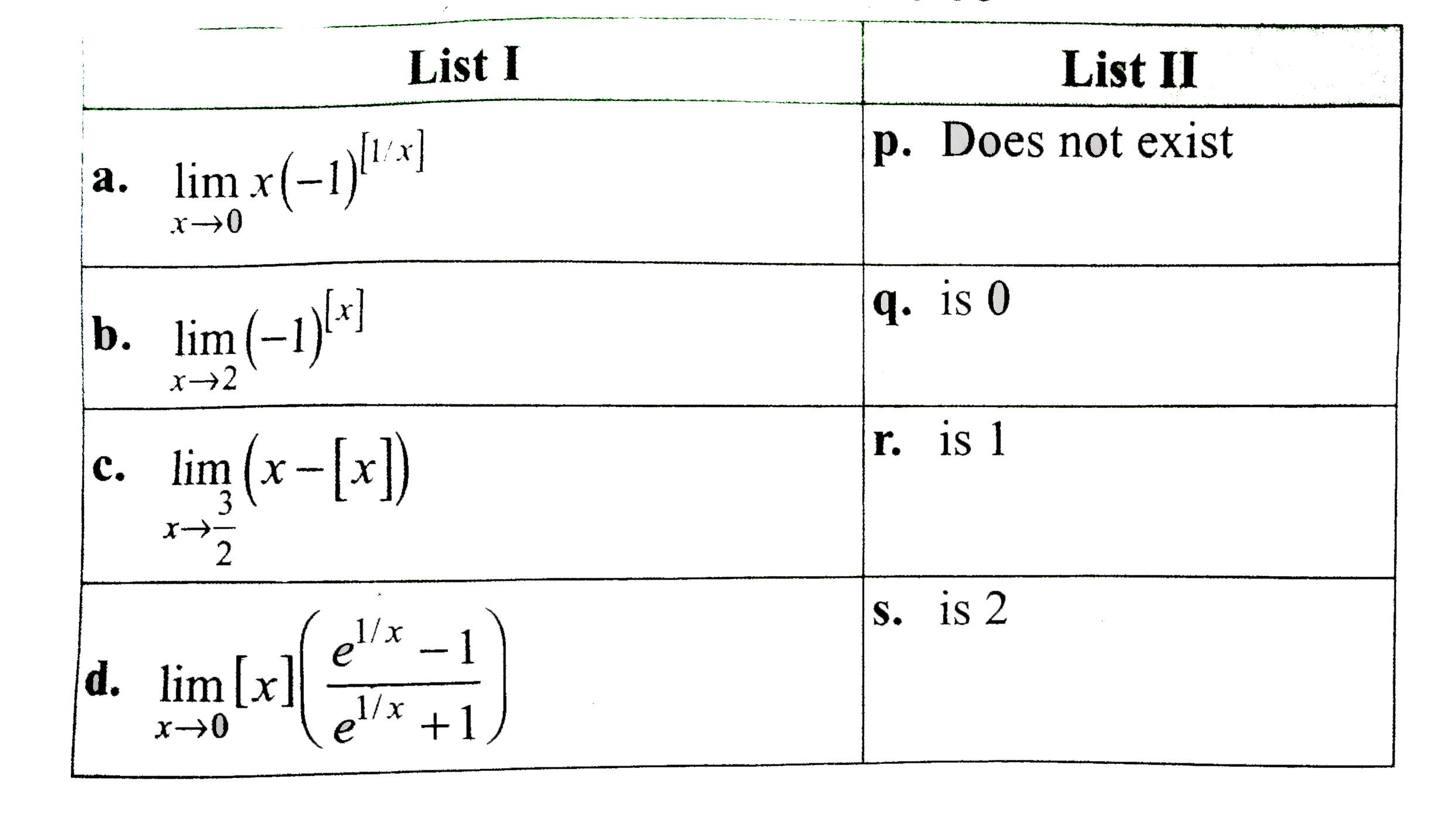
Match the following lists (where [x] rep...

Match the following lists (where `[x]` represents the greatest integer function) and then choose the correct code.

Codes :
`{:(,"a b c d"),((1),"s r q p"),((2),"q p s p"),((3), "s r p q"),((4),"p p q r"):}`

Text Solution

Verified by Experts

The correct Answer is:

`(2)`

a. `underset(xto0)lims(-1)^([1//x])`
`L.H.L.=underset(hto0)lim(0-h)(-1)^([(1)/(0-h)])=0`
`R.H.L.=underset(hto0)lim(0+h)(-1)^([(1)/(0+h)])=0`
b. `underset(xto2)lim(-1)^([x])`
`L.H.L.=underset(hto0)lim(-1)^([2-h])=(-1)^(1)=-1`
`R.H.L.=underset(hto0)lim(-1)^([2+h])=(-1)^(2)=1`
So limit does not exist.
c.`underset(xto(3)/(2))lim(x-[x])`
`L.H.L.=underset(hto0)lim(3)/(2)-h-[(3)/(2)-h]=underset(hto0)lim(3)/(2)-h-1=(1)/(2)`
`R.H.L.=underset(hto0)lim(3)/(2)+h-[(3)/(2)+h]=underset(hto0)lim(3)/(2)+h-1=(1)/(2)`
`L.H.L.=R.H.L.=(1)/(2)`
`underset(xto0)lim[x]((e^(1//x)-1)/(e^(1//x)+1))`
`L.H.L.=underset(hto0)lim[0-h](((1)/(e^(0-h)-1))/((1)/(e^(0-h)+1)))`
`=underset(hto0)lim[-h]((e^(-(1)/(h))-1)/((1)/(e^(0-h)+1)))=(-1)xx(-1)=1`
R.H.L.`=underset(hto0)lim[0+h]((e^((1)/(h))-1)/(e^((1)/(h)+1)))=0`
Limit does not exist
Promotional Banner

Topper's Solved these Questions

  • LIMITS

    CENGAGE ENGLISH|Exercise Numerical Value Type|26 Videos
  • LIMITS

    CENGAGE ENGLISH|Exercise Archives JEE MAIN|8 Videos
  • LIMITS

    CENGAGE ENGLISH|Exercise Linked Comprehension Type|20 Videos
  • JEE 2019

    CENGAGE ENGLISH|Exercise Chapter 10|9 Videos
  • LINEAR COMBINATION OF VECTORS, DEPENDENT AND INDEPENDENT VECTORS

    CENGAGE ENGLISH|Exercise DPP 1.2|10 Videos

Similar Questions

Explore conceptually related problems

lim _(xtooo)3/x [(x)/(4)]=p/q where [.] denotes greatest integer function), then p+q (where p,q are relative prime) is:

Consider int(x^(3)+3x^(2)+2x+1)/(sqrt(x^(2)+x+1))dx =(ax^(2)+bx+c)sqrt(x^(2)+x+1)+lambda int(dx)/(sqrt(x^(2)+x+1)) Now, match the following lists and then choose the correct code. Codes: {:(,a,b,c,d),((1),q,p,s,r),((2),s,p,q,r),((3),r,q,p,s),((4),q,s,p,r):}

Match the duals of the statements in List - I : {:(,"List - I",,"List - II"),((1),(p vv q) vv r,(a) ,(p vv q) vv r),((2),(p ^^ q) ^^ r,(b),(p ^^ q) vv (r ^^ s)),((3),(pvv q) ^^ (r vv s),(c ),(p ^^ q) ^^ r):} The correct match is :

Match the columns and choose correct options. (1) a-q, b-r, c-s, d-p (2) a-s, b-p, c-q, d-r (3) a-q, b-p, c-s, d-r (4) a-s, b-p, c-r, d-q

Match the coloumn {:(,A to Q, B to R, C to P, D to S),(,A to Q, B to R, C to S, D to P),(,A to R, B to Q, C to S, D to P),(,A to R, B to Q, C to P, D to S):}

The mean of is same as the mean of Then which of the following is correct? p=q=r (b) q=r=s q=r (d) p=r+s

If p+q+r=0=a+b+c , then the value of the determinant |[p a, q b, r c],[ q c ,r a, p b],[ r b, p c, q a]|i s (a) 0 (b) p a+q b+r c (c) 1 (d) none of these

Construct the truth table for the followings statements : (a) (p^^q) to ~ p " " (b) (p^^q) to (pvvq) (c) (p^^q) to r " " (d) [p^^(~r)] to (qvvr)

If P Q R S is a square, then write the measure of /_S R P

If P Q R S is a square, then write the measure of /_S R P
