Home
Class 12
MATHS
Consider a square with vertices at (1, 1...

Consider a square with vertices at `(1, 1), (-1, 1), (-1, -1) and (1, -1)`. Let S be the region consisting of all points inside the square which are nearer to the origin than to any edge. Sketch the region S and find its area.

Text Solution

Verified by Experts


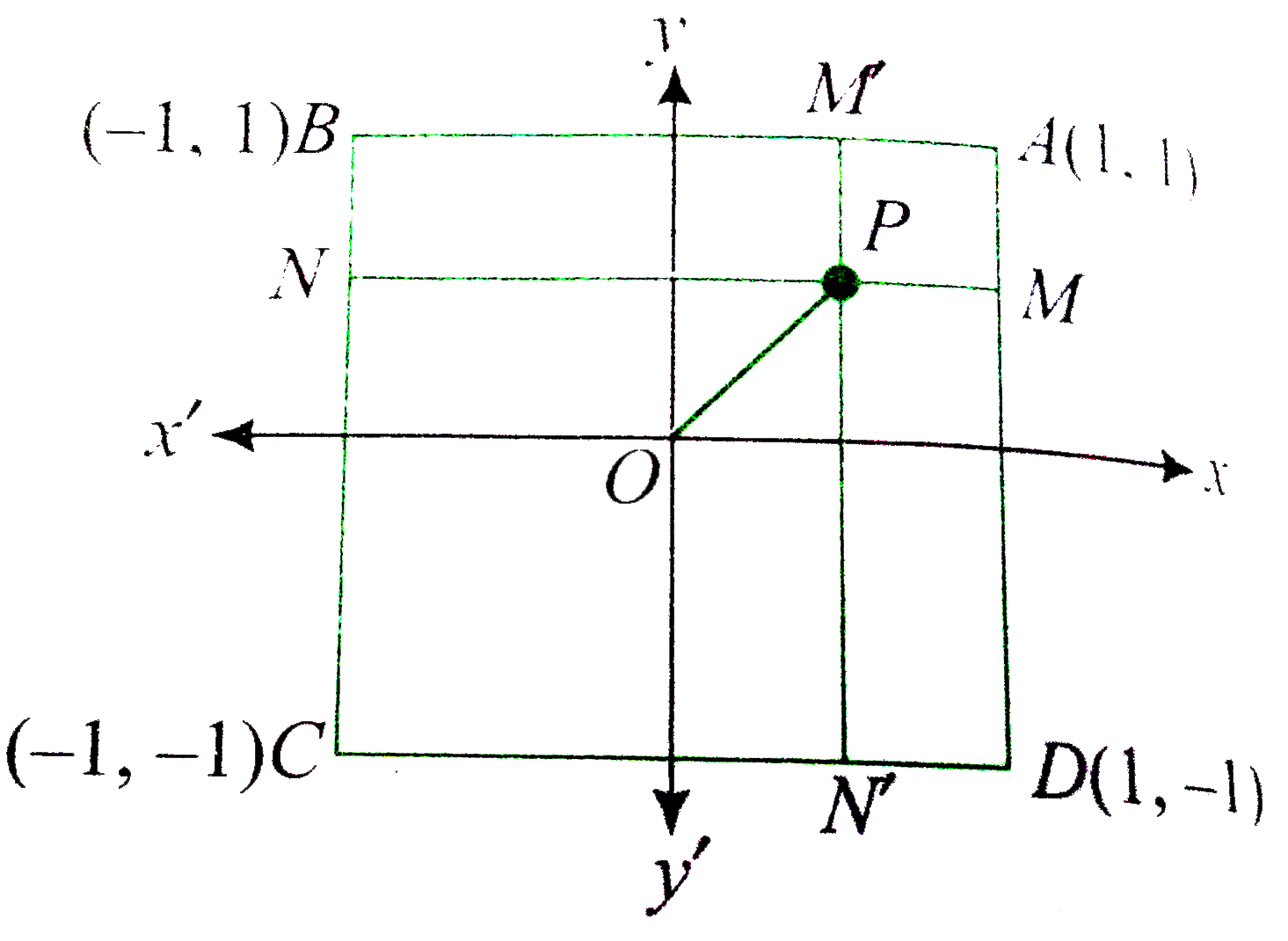
Let us consider any point (x,y) inside the square such that its distance from origin is less than its distance from any of the edges. Consider edge AD. Therefore,
`OPltPM`
`rArr" "sqrt((x^(2)+y^(2)))lt1 -x or y^(2)lt-2(x-(1)/(2))" (1)"`
Above represents all points within the parabola `y^(2)=1-2x`.
If we consider the edge BC, then `OPltPN` will imply
`y^(2)lt2(x+(1)/(2))" (2)"`
Similarly, if we consider the edges AB and CD, we will have
`x^(2)lt-2(y-(1)/(2))" (3)"`
`x^(2)lt2(y+(1)/(2))" (4)"`
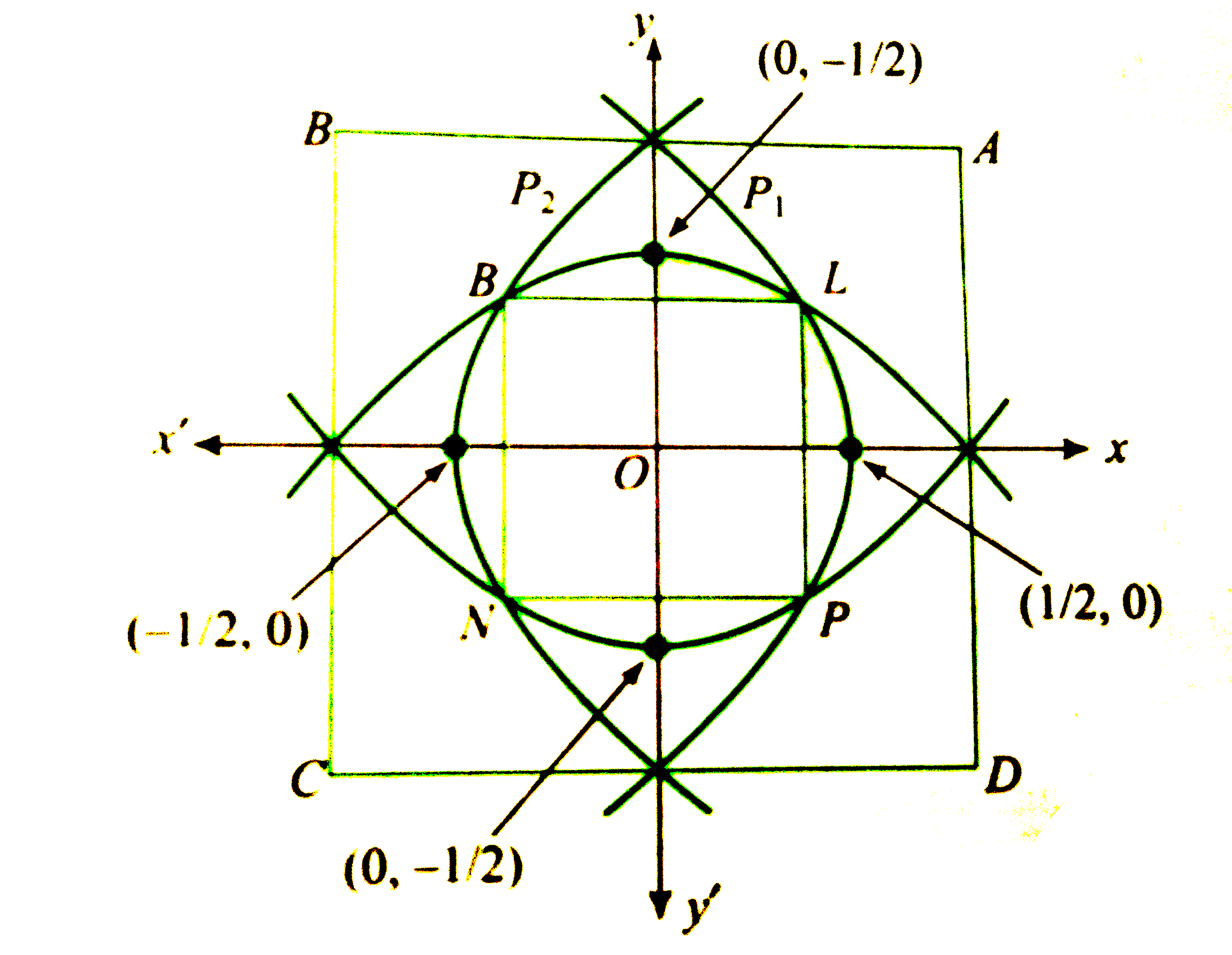
Hence, S consists of the region bounded by four parabolas meeting
`"the axes at "(pm(1)/(2),0)and (0,pm(1)/(2))`
The point L is intersection of `P_(1) and P_(3)` given by (1) and (3).
Solving, we get
`y^(2)-x^(2)=-2(x-y)=2(y-x)`
`"or "y-x=0`
`"or "y=x`
`rArr" "x^(2)+2x-1=0`
`"or "(x+1)^(2)=2`
`"or "x=sqrt(2)-1" as x is + ve"`
`therefore" L is "(sqrt(2)-1,sqrt(2)-1).`
`therefore" Total area = "4["Square of side "(sqrt(2)-1)+2int_(sqrt(2)-1)^(1//2)sqrt(1-sqrt(2x))dx]`
`=4{(sqrt(2)-1)^(2)+2int_(sqrt(2)-1)^(1//2)sqrt((1-2x))dx}`
`=4[3-2sqrt(2)-(2)/(3){(1-2x)^(3//2)}_(sqrt(2)-1)^(1//2)]`
`=4[3-2sqrt(2)-(2)/(3){0-(1-2sqrt(2)+2)^(3//2)}]`
`=4[3-2sqrt(2)+(2)/(3)(3-2sqrt(2))^(3//2)]`
`=4(3-2sqrt(2))[1+(2)/(3)sqrt((3-2sqrt(2)))]`
`=4(3-2sqrt(2))[1+(2)/(3)(sqrt(2)-1)]`
`=(4)/(3)(3-2sqrt(2))(1+2sqrt(2))=(4)/(3)[(4sqrt(2)-5)]`
`=(16sqrt(2)-20)/(3)` sq. units.

Promotional Banner

Topper's Solved these Questions

  • AREA

    CENGAGE ENGLISH|Exercise Solved Examples|10 Videos
  • AREA

    CENGAGE ENGLISH|Exercise Concept Application Exercise 9.1|9 Videos
  • APPLICATIONS OF DERIVATIVES

    CENGAGE ENGLISH|Exercise Comprehension Type|5 Videos
  • BINOMIAL THEOREM

    CENGAGE ENGLISH|Exercise Matrix|4 Videos

Similar Questions

Explore conceptually related problems

Consider a square with vertices at (1,1),(-1,1),(-1,-1),a n d(1,-1)dot Set S be the region consisting of all points inside the square which are nearer to the origin than to any edge. Sketch the region S and find its area.

Consider a square with vertices at (1,1),(-1,1),(-1,-1),a n d(1,-1)dot Set S be the region consisting of all points inside the square which are nearer to the origin than to any edge. Sketch the region S and find its area.

Show that the points (1, 7), (4, 2), (-1, -1) a n d ( -4, 4) are the vertices of a square.

Prove that the points (2, -1), (4, 1), (2, 3) and (0, 1) are the vertices of a square.

Show that the points (1,\ 7),\ (4,\ 2),\ (-1,\ -1)\ a n d\ (\- 4,\ 4) are the vertices of a square.

Show that the points A(2, 1), B(0,3), C(-2, 1) and D(0, -1) are the vertices of a square.

Let O(0,0),A(2,0),a n dB(1 1/(sqrt(3))) be the vertices of a triangle. Let R be the region consisting of all those points P inside O A B which satisfy d(P , O A)lt=min[d(p ,O B),d(P ,A B)] , where d denotes the distance from the point to the corresponding line. Sketch the region R and find its area.

Sketch the region bounded by the curves y=sqrt(5-x^2) and y=|x-1| and find its area.

The area of the region bounded by the curve y = |x - 1| and y = 1 is:

Show that the points A (5, 6), B(1,5), C(2, 1) and D(6, 2) are the vertices of a square ABCD.
