Home
Class 11
PHYSICS
A liquid flows through a horizontal tube...

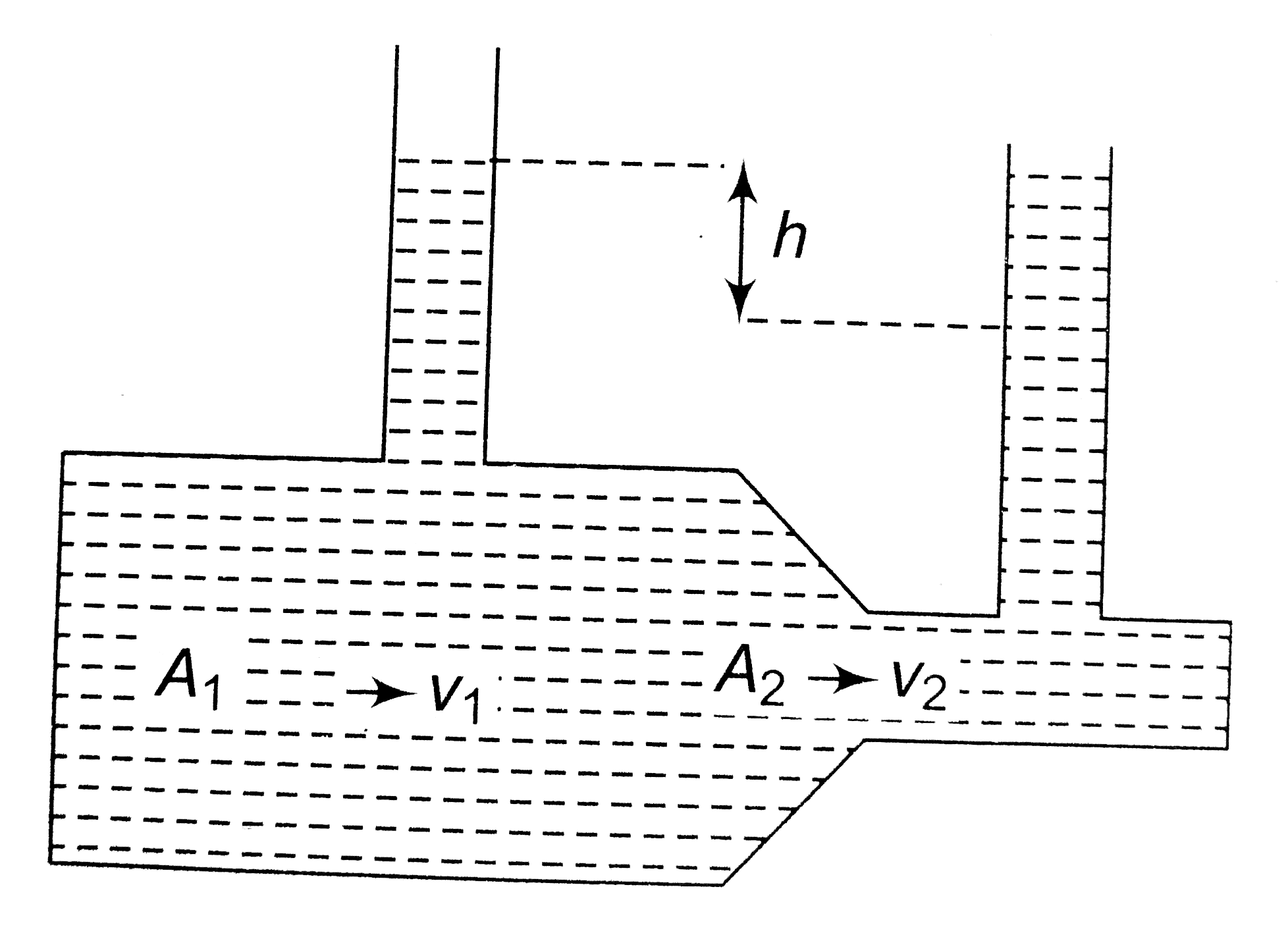
A liquid flows through a horizontal tube as shown in figure. The velocities of the liquid in the two sections, which have areas of cross-section `A_(1)` and `A_(2)` and `v_(1)` and `v_(2)` respectively. The differnece in the levels of the liquid in the two vertical tubes is `h`. then

A

`v_(2)^(2)-v_(1)^(2)=2gh`

B

`v_(2)^(2)+v_(1)^(2)=2gh`

C

`v_(2)^(2)-v_(1)^(2)=gh`

D

`v_(2)^(2)+v_(1)^(2)=gh`

Text Solution

Verified by Experts

The correct Answer is:

A

Let `rho` be density of liquid flowing in the tube. `A_(1)v_(1)=A_(2)v_(2)`
`(v_(1))/(v_(2))=(A_(2))/(A_(1))`
According to Bernoulli's equation for horizontal flow of liquid,
`P_(1) +(1)/(2)rhoV_(1)^(2)=P_(2)+(1)/(2)rhov_(2)^(2)`
`P_(1)-P_(2)=(1)/(2)(rhov_(2)^(2)-rhov_(1)^(2))`
`hrhog=(1)/(2)rho(v_(2)^(2)-v_(1)^(2))" "(because P_(1)-P_(2)=hrhog)`
`v_(2)^(2)-v_(1)^(2)=2hg`
Promotional Banner

Topper's Solved these Questions

  • MECHANICAL PROPERTIES OF FLUIDS

    NCERT FINGERTIPS ENGLISH|Exercise Higher Order Thinking Skills|8 Videos
  • MECHANICAL PROPERTIES OF FLUIDS

    NCERT FINGERTIPS ENGLISH|Exercise Exemplar Problems|5 Videos
  • LAWS OF MOTION

    NCERT FINGERTIPS ENGLISH|Exercise Assertion And Reason|15 Videos
  • MECHANICAL PROPERTIES OF SOLIDS

    NCERT FINGERTIPS ENGLISH|Exercise Assertion And Reason|15 Videos

Similar Questions

Explore conceptually related problems

A liquid flows through a horizontal tube. The velocities of the liquid in the two sections, which have areas of cross section A_(1) and A_(2) are v_(1) and v_(2) respectively. The difference in the levels of the liquid in the two vertical tubes is h . Then

An incompressible liquid flows through a horizontal tube as shown in the figure. Then the velocity 'v' of the fluid is:

Water flows through a horizontal tube as shown in figure. If the difference of heights of water colun in the vertical tubes is 2 cm and the area of cross section at A and B are 4cm^2 and 2cm^2 respectively, find the rate of flow of water across any section.

Water flows through a horizontal tube as shown in figure. If the difference of height of water column in the vertical tubes in 2cm and the areas of corss-section at A and B are 4 cm^(2) and 2 cm^(2) respectively. Find the rate of flow of water across any section. .

Two liquids which do not react chemically are placed in a bent tube as shown in figure. The height of the liquids above their surface of separation are

A horizontal thin tube of length 2L completely filled with a liquid of density delta rotates about a vertical axis passing through one of its end and along the diameter of its side face with an constant angular velocity omega . Two vertical thin long tubes are fitted with the horizontal tube to measure the pressure difference between points A and B which are at same horizontal level as shown. Neglect viscous forces and surfaces tension of liquid. The difference in the heights (h) of the liquid column in the two vertical thin tubes is :

An incompressible liquid is flowing through a horizontal pipe as shown in figure. If V_1 , V_2 and v_3 be the velocity and a, a/2 and a/3 be the area of orifice A, B and C respectively, then

Water flows through the tube shown in figure. The areas of cross section of the wide and the narrow portions of the tube are 5cm^2 and 2cm^2 respectively. The rate of flow of water through the tube is 500 cm^3s^-1 . Find the difference of mercury levels in the U-tube.

Water flows through the tube shown in figure. The areas of cross section of the wide and the narrow portions of the tube are 5cm^2 and 2cm^2 respectively. The rate of flow of water through the tube is 500 cm^3s^-1 . Find the difference of mercury levels in the U-tube.

The vessel shown in the figure has two sections of areas of cross-section A _ 1 and A _2 . A liquid of density rho fills both the section, up to a height h in each. Neglect atmospheric pressure. Choose correct options.
