Home
Class 12
PHYSICS
The fig. shows the variation of photon c...

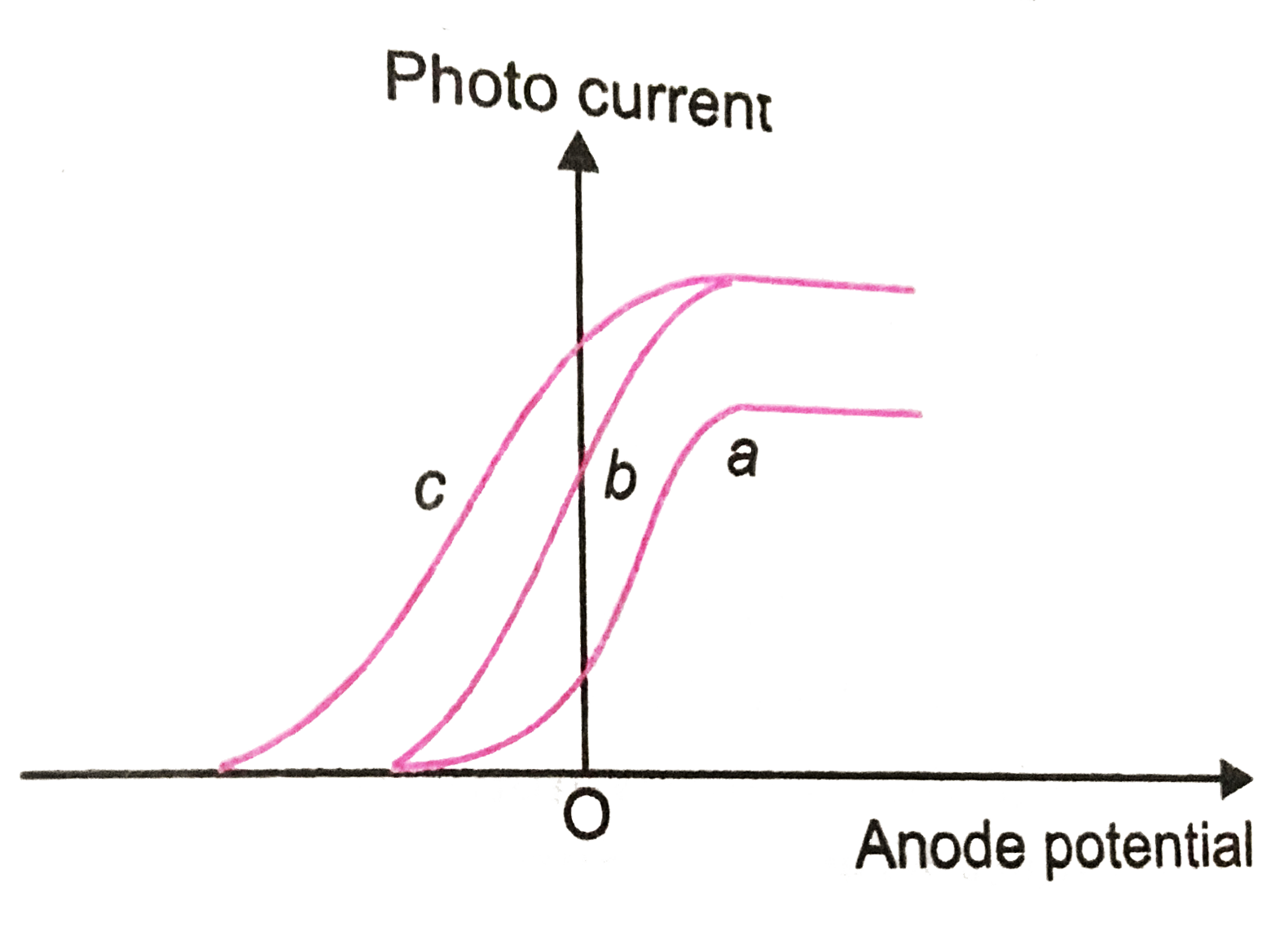
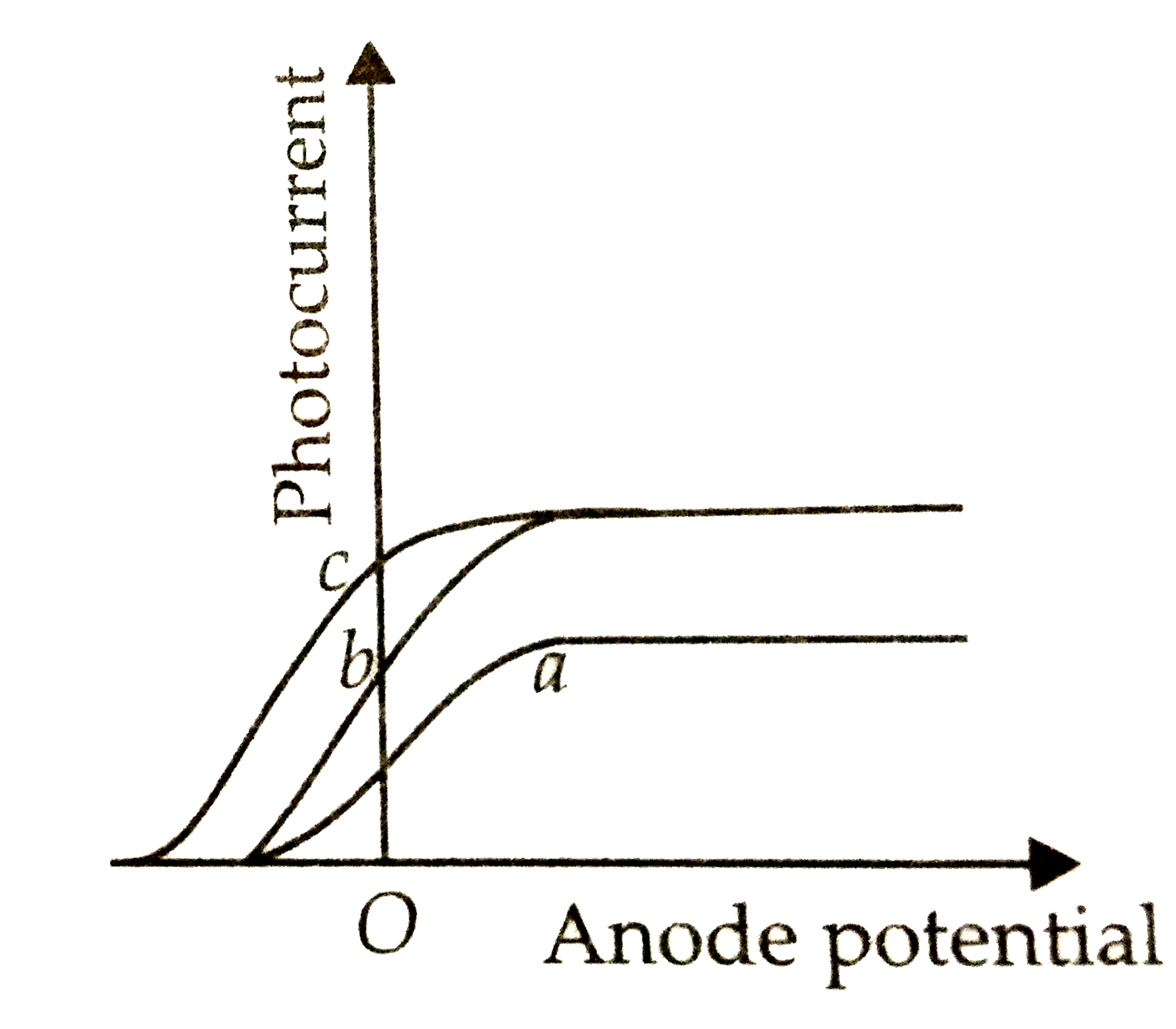
The fig. shows the variation of photon current with anode potential for a photo-sensitive surface for three different radiation. Let `I_(a), I_(b) and I_(c)` be the intensities and `f_(a), f_(b) and f_(c)` be the frequency for the curves a,b and c respectively.

A

`v_(a)=v_(b) and I_(a)!=I_(b)`

B

`v_(a)=v_(c) and I_(a)=I_(c)`

C

`v_(a)=v_(b) and I_(a)=I_(b)`

D

`v_(b)=v_(c) and I_(b)=I_(c)`

Text Solution

Verified by Experts

The correct Answer is:
A

(a) : Form the graph, we note that the saturation current is same for curves b and c but different for curve
a. Therefore, intensities of b and c will be equal but different from that of a i.e. `I_(a)!=I_(b)"but"I_(b)=I_(c)`. As stopping potential is same for curves a and b, hence `v_(a)=v_(b)`. Thus answer (a) is correct.
Promotional Banner

Topper's Solved these Questions

  • DUAL NATURE OF RADIATION AND MATTER

    NCERT FINGERTIPS ENGLISH|Exercise EINSTEIN S PHOTOELECTRIC EQUATION : ENERGY QUANTUM OF RADIATION|23 Videos
  • DUAL NATURE OF RADIATION AND MATTER

    NCERT FINGERTIPS ENGLISH|Exercise PARTICLE NATURE OF LIGHT : THE PHOTON|19 Videos
  • DUAL NATURE OF RADIATION AND MATTER

    NCERT FINGERTIPS ENGLISH|Exercise PHOTOELECTRIC EFFECT|2 Videos
  • CURRENT ELECTRICITY

    NCERT FINGERTIPS ENGLISH|Exercise Assertion And Reason|15 Videos
  • ELECTRIC CHARGES AND FIELDS

    NCERT FINGERTIPS ENGLISH|Exercise Assertion And Reason|15 Videos

Similar Questions

Explore conceptually related problems

The figure shows the variation of photocurrent with anode potential for a photosensitve surface for three different radiations. Let l_a, l_b and l_c be the curves a, b and c, respectively (a) f_a = f_b and l_a != l_b (b) f_a = f_c and l_a = l_c (c ) f_a = f_b and l_a = l_b (d) f_b = f_c and l_b = l_c

The figure shows a plot of photo current versus anode potential for a photosensitive surface for three different radiations. Which one of the following is a correct statement ?

The figure shows a plot of three curves a, b, c, showing variation of photocurrent vs collector plate potential for three different intensities I_(1), I_(2) and I_(3) having frequencies v_(1), v_(2) and v_(3) respectively incident on a photosensitive surface. Point out the two curves for which the incident radioations have same frequency but different intensities.

The graph of Fig. shows the variation of photoelectric current (I) versus applied voltage (V) for the two different photosensitive materials for two different intensities of the incident radiation. Identify the pairs of curves that correspond to different materials but same intensity of incident radiation.

Fig. shows three different modes of vibration of a string of length I. What is the ratio of frequency between (a) and (c)?

The curves (a) , (b) , ( c ) and (d) show the variation between the applied potential difference (V) and the photoelectric current (i) , at two different intensities of light (I_(1) gt I_(2)) . In which figure is the correct variation shown ?

In the photoelectric effect experiment, if f is the frequency of radiation incident on the metal surface and I is the intensity of the intensity radiations, then match the following columns:

Let I_E,I_C and I_B represent the emitter current,the collector current and the base current respectively in a transistor.then

In a photoelectric effect experiment, photons of energy 5 eV are incident on the photocathode of work function 3eV . For photon intensity I_(A)=10^(15)m^(-2)s^(-1) , saturation current of 4.0 mu A is obtained. Sketch the variation of photocurrent i_(p) against the anode voltage V_(a) in the figure below for photon intensity I_(A) ( curve A ) and I_(B)=2xx10^(15)m^(-2)s^(-1) (curve B ) ( in JEE graph was to be drawn in the answer sheet itself.)

Four open organ popes of different length and different gases at same temperature as shown in figure. Let f_(A),f_(B),f_(C) and f_(D) be their fundamental frequencies then : [Take gamma_(CO_(2)) = 4/3 ] .

