Home
Class 11
PHYSICS
A uniform bar with mass m lies symmetric...


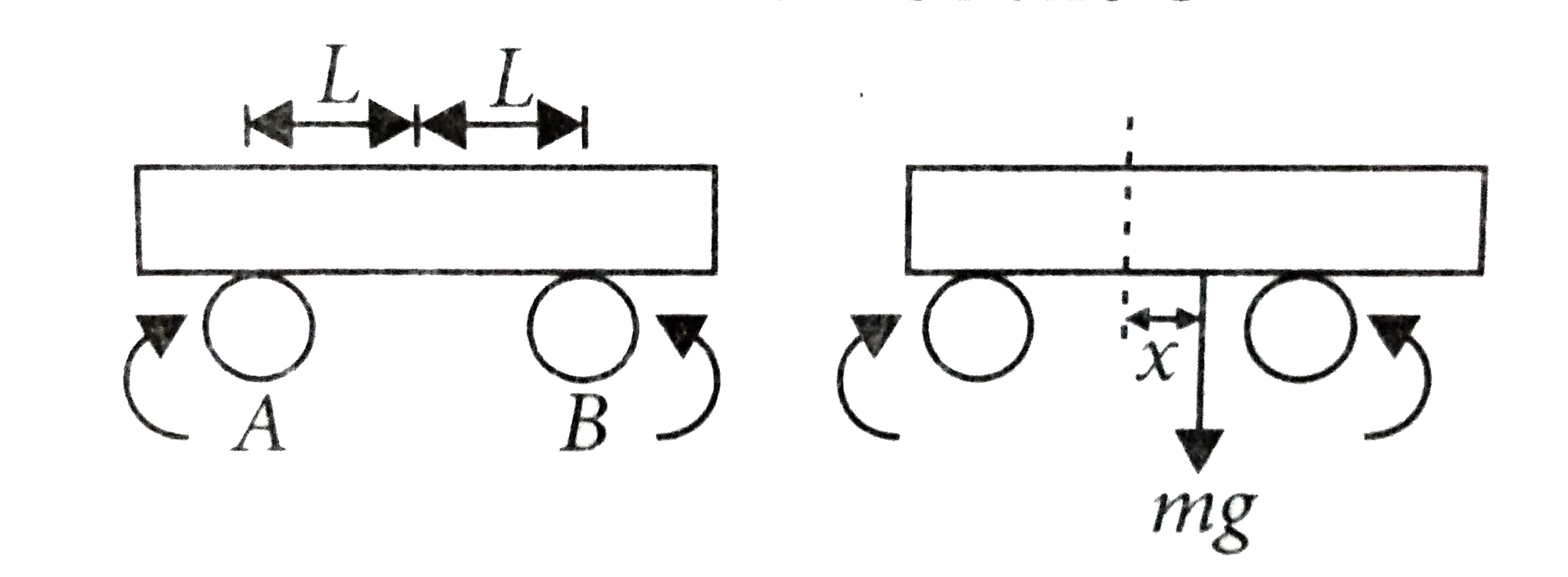
A uniform bar with mass m lies symmetrically across two rapidly rotating fixed rollers, A and B with distance L=2.0 cm between the bar's centre of mass and each roller. The rollers, whose directions of rotation are shown in figures slip against the bar with coefficient of kinetic friction `mu_(k)=0.40`. suppose the bar is displaced horizontally by the distance x as shown in figure and then released. the angular frequency `omega` of the resulting horizontal simple harmonic motion of the bar is (in `rad" "s^(-1)`)

A

20

B

15

C

16

D

17

Text Solution

Verified by Experts

The correct Answer is:
A

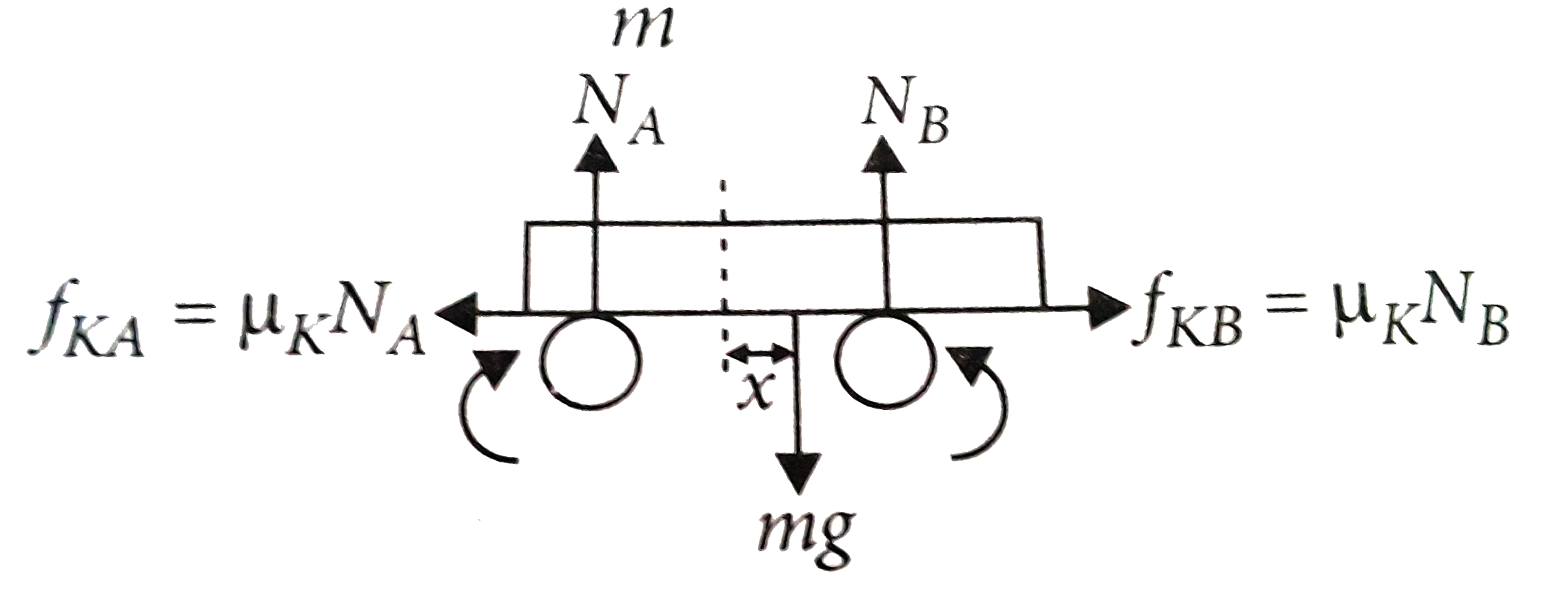
Consider horizontal forces
`mu_(k)N_(A)-mu_(k)N_(B)=ma`
or `a=(mu_(k)N_(A)-mu_(k)N_(B))/(m)` . . . (i)

Taking torque about an axis perpendicular to the plane and through the contact point between bar and roller A. the bar experiences no angular acceleration about that axis.
`N_(A)(0)+N_(B)(2L)-Mg(L+x)f_(KA)(0)+k_(KB)(0)=0` . . . (ii)
By balancing vertical forces, we have
`N_(A)+N_(B)-mg=0` . . . (iii)
solving eqns. (i), (ii) and (iii)
`N_(B)=(mg(L+X))/(2L),N_(A)=(mg(L-X))/(2L),a=-(mu_(k)g)/(L)X`
Comparing it with `a=-omega^(2)X`
we get, `omega=sqrt((mu_(k)g)/(L))=sqrt((0.40xx10)/(2xx10^(-2)))=14" rad "s^(-1)`
Promotional Banner

Topper's Solved these Questions

  • OSCILLATIONS

    NCERT FINGERTIPS ENGLISH|Exercise Exemplar Problems|9 Videos
  • OSCILLATIONS

    NCERT FINGERTIPS ENGLISH|Exercise Assertion & Reason|15 Videos
  • OSCILLATIONS

    NCERT FINGERTIPS ENGLISH|Exercise Assertion And Reason|15 Videos
  • MOTION IN A STRAIGHT LINE

    NCERT FINGERTIPS ENGLISH|Exercise NCERT Exemplar|6 Videos
  • PHYSICAL WORLD

    NCERT FINGERTIPS ENGLISH|Exercise Assertion And Reason|10 Videos

Similar Questions

Explore conceptually related problems

A uniform bar with mass m lies symmetrically across two rapidly rotating fixed rollers. A and B with distance 'l' between the bars centre of mass and each roller. The rollers whose direction of rotation are shown in figure slip against the bar with coefficient of friction mu . Suppose the bar is displaced horizontally by a small distance 'x' and then released, find the time period of oscillation.

A small coin of mass 40 g is placed on the horizontal surface of a rotating disc. The disc starts from rest and is given a constant angular acceleration alpha="2 rad s"^(-2) . The coefficient of static friction between the coin and the disc is mu_(s)=3//4 and the coefficient of kinetic friction is mu_(k)=0.5. The coin is placed at a distance r=1m from the centre of the disc. The magnitude of the resultant force on the coin exerted by the disc just before it starts slipping on the disc is?

the position vector of the centre of mass lt to r cm of an asymmetric uniform bar of negligible area of cross - section as shown in figure is :

Two bar of identical dimensions are kept as shown in figure. If K_1 and K_2 are their coefficients of thermal conductivities, then equivalent K

The resultant of the three vectors bar(OA),bar(OB) and bar(OC) shown in figure :-

Two identical bar magnets, each of magnetic moment M, are placed as shown in figure. Magnetic field at point

Two bars of radius r and 2r are kept in constant as shown in figure. An electric current I is passed through the bars. Which of the following is correct?

A small coin of mass 80g is placed on the horizontal surface of a rotating disc. The disc starts from rest and is given a constant angular acceleration alpha=2rad//s^(2) . The coefficient of static friction between the coin and the disc is mu_(s)=3//4 and cofficient of kinetic friction is mu_(k)=0.5 . The coin is placed at a distance r=1m from the centre of the disc. The magnitude of the resultant force on the coin exerted by the disc just before it starts slipping on the disc is

A small coin of mass 80g is placed on the horizontal surface of a rotating disc. The disc starts from rest and is given a constant angular acceleration alpha=2rad//s^(2) . The coefficient of static friction between the coin and the disc is mu_(s)=3//4 and cofficient of kinetic friction is mu_(k)=0.5 . The coin is placed at a distance r=1m from the centre of the disc. The magnitude of the resultant force on the coin exerted by the disc just before it starts slipping on the disc is

In the figure, a ball of mass m is tied with two strings of equal as shown. If the rod is rotated with angular velocity omega_(1) when

