Home
Class 11
PHYSICS
A rod of mass m and length l is connecte...


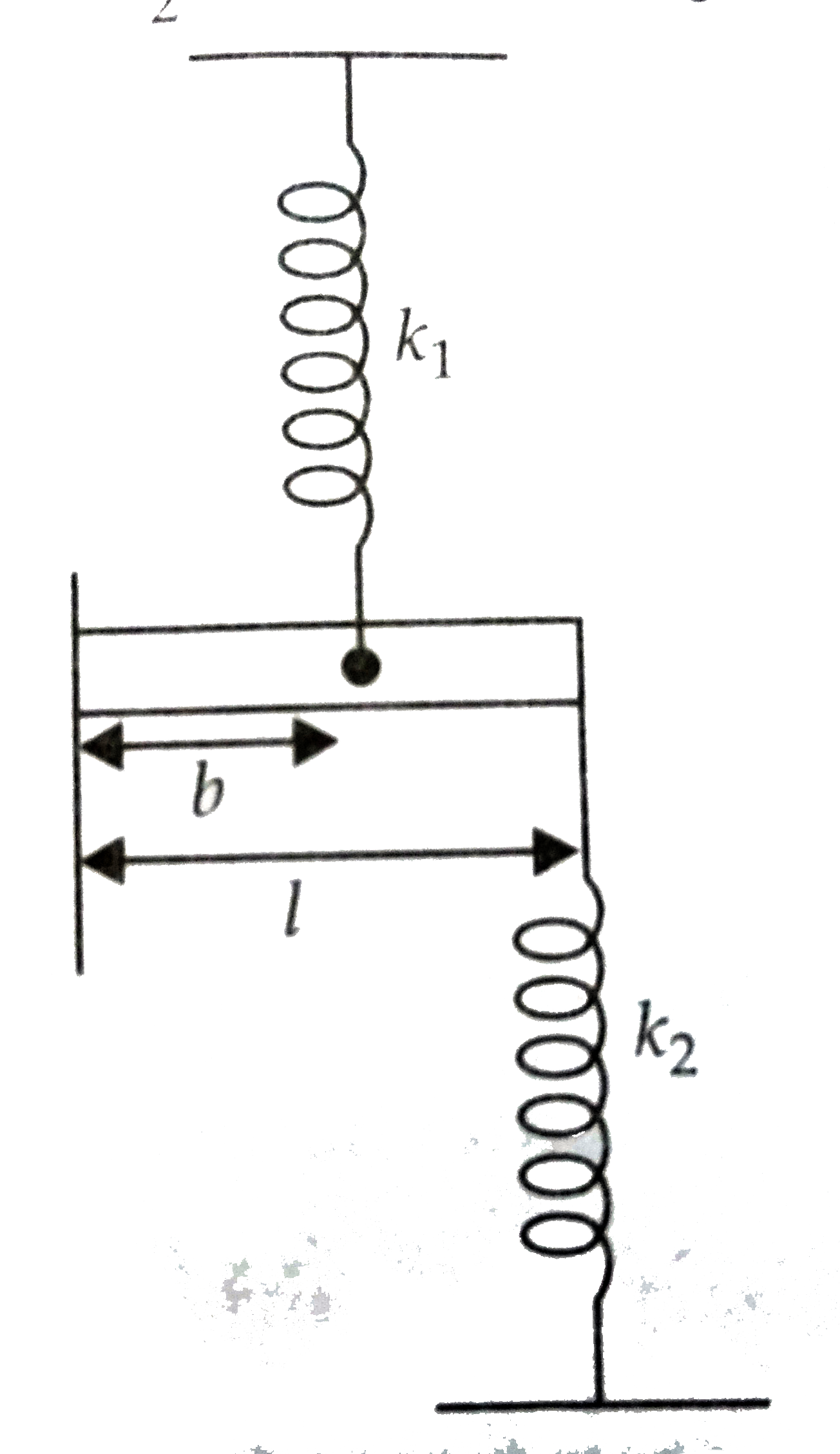
A rod of mass m and length l is connected by two spring of spring constants `k_(1) and k_(2)`, so that it is horizontal at equilibrium. What is the natural frequency of the system?

A

`(1)/(2pi)sqrt(k_(1)b^(2)+k_(2)l^(2))/(ml^(2))`

B

`(1)/(2pi)sqrt(2k_(1)b^(2)+k_(2)l^(2))/(ml^(2))`

C

`(1)/(2pi)sqrt((k_(1)b^(2)+k_(2)l^(2))/(2ml^(2)))`

D

`(1)/(2pi)sqrt((3(k_(2)b^(2)+k_(2)l^(2)))/(ml^(2)))`

Text Solution

Verified by Experts

The correct Answer is:
D

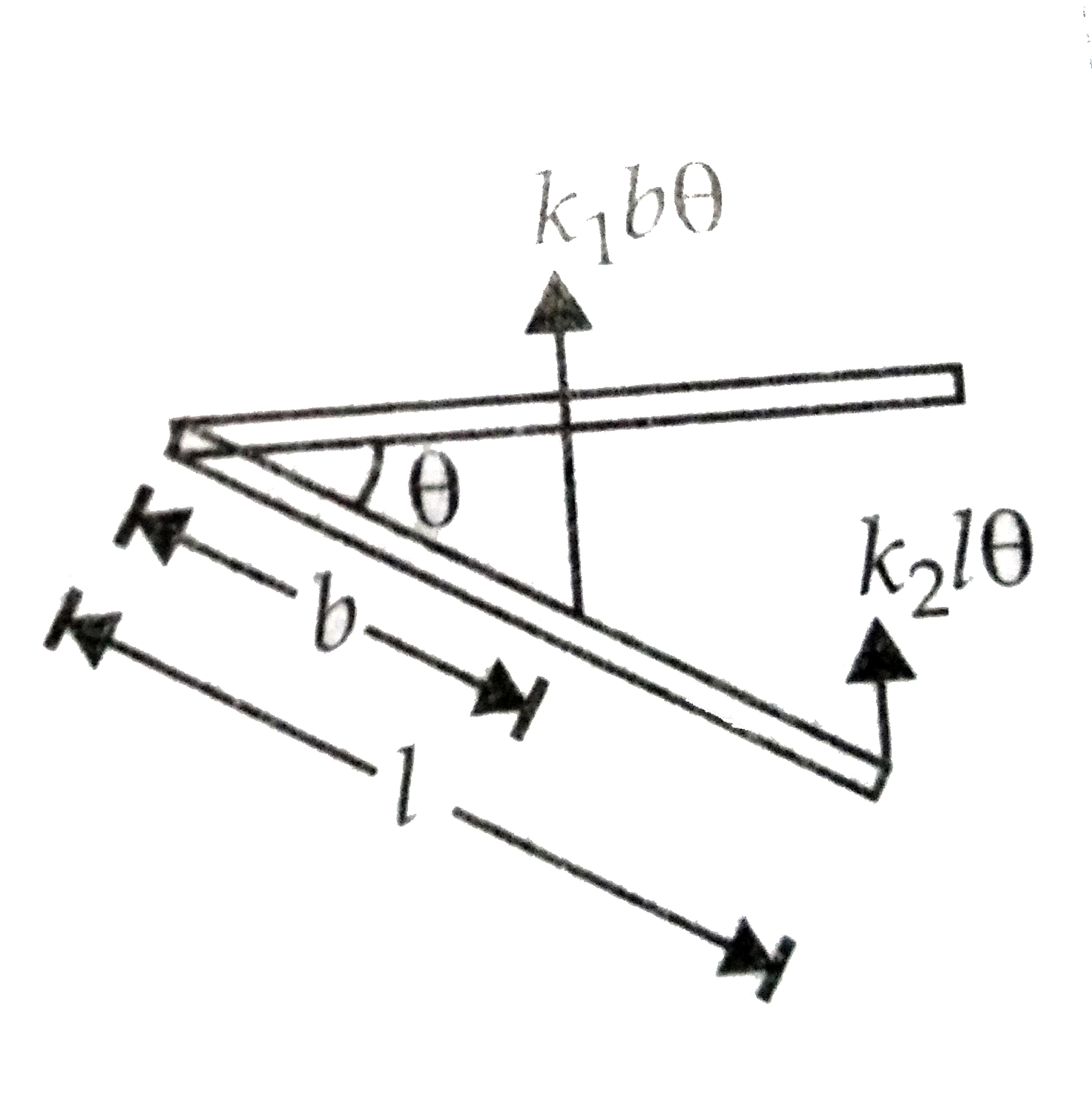
Let rod is displaced by an angle `theta`, taking torque about edge of rod
`k_(b)bthetaxxbcostheta+k_(2)lthetaxxlcostheta=-(Id^(2)theta)/(dt^(2))`
Here, `I=(ml^(2))/(3) and theta` is small `costheta~~1`
`therefore(ml^(2)alpha)/(3)+(k_(1)b^(2)+k_(2)l^(2))theta=0`
`impliesalpha=(-3(k_(1)b^(2)+k_(2)l^(2))theta)/(ml^(2))`
`thereforeomega=sqrt((3(k_(1)b^(2)+k_(2)l^(2)))/(ml^(2)))`
Promotional Banner

Topper's Solved these Questions

  • OSCILLATIONS

    NCERT FINGERTIPS ENGLISH|Exercise Exemplar Problems|9 Videos
  • OSCILLATIONS

    NCERT FINGERTIPS ENGLISH|Exercise Assertion & Reason|15 Videos
  • OSCILLATIONS

    NCERT FINGERTIPS ENGLISH|Exercise Assertion And Reason|15 Videos
  • MOTION IN A STRAIGHT LINE

    NCERT FINGERTIPS ENGLISH|Exercise NCERT Exemplar|6 Videos
  • PHYSICAL WORLD

    NCERT FINGERTIPS ENGLISH|Exercise Assertion And Reason|10 Videos

Similar Questions

Explore conceptually related problems

A rod of mass m and length l hinged at one end is connected by two springs of spring constant k_1 and k_2 so that it is horizontal at equilibrium What is the angular frequency of the system? (in (rad)/(s) ) (Take l=1m , b=(1)/(4)m , K_1=16(N)/(m) , K_2=61(N)/(m) .

A block of mass m is connected two springs of spring constant 2k annd k , respectively , as shown in the vertical plane. At equilibrium , both springs are compressed by same length. If suddenly lower spring is cut, then acceleration of block, just after spring cut , is

A disk of mass m is connected to two springs of stiffness k_(1) and k_(2) as shown in the figure. Find the angular frequency of the system for small oscillation. Disc can roll on the surface without slipping

In the figure shown, PQ is a uniform sphere of mass M and radius R hinged at point P , with PQ as horizontal diameter. QT is a uniform horizontal rod of mass M and length 2R rigidly attached to the sphere at Q, supported by a vertical spring of spring constant k. If the system is in equilibrium, then the potential energy stored in the spring is

Two blocks of masses m and M connected by a light spring of stiffness k, are kept on a smooth horizontal surface as shown in figure. What should be the initial compression of the spring so that the system will be about to break off the surface, after releasing the block m_1 ?

A horizontal metallic rod of mass 'm' and length 'l' is supported by two vertical identical springs of spring constant 'k' each and natral length l_(0) A current 'l' is flowing in the rod in the direction shown if the rod is in equilibrium then the length of each spring in this state is:

Two springs of spring constants K_(1) and K_(2) are joined in series. The effective spring constant of the combination is given by

Two springs of spring constants K_(1) and K_(2) are joined in series. The effective spring constant of the combination is given by

A horizontal rod of mass m and length L is pivoted at one end The rod's other end is supported by a spring of force constant k. The rod is displaced by a small angle theta from its horizontal equilibrium position and released. The angular frequency of the subsequent simple harmonic motion is

Two masses m_1 and m_2 re connected by a spring of spring constant k and are placed on as frictionless horizontal surface. Initially the spring is stretched through a distance x_0 when the system is released from rest. Find the distance moved by the two masses before they again come to rest.

