Home
Class 11
PHYSICS
A block rests on a rough plane whose inc...

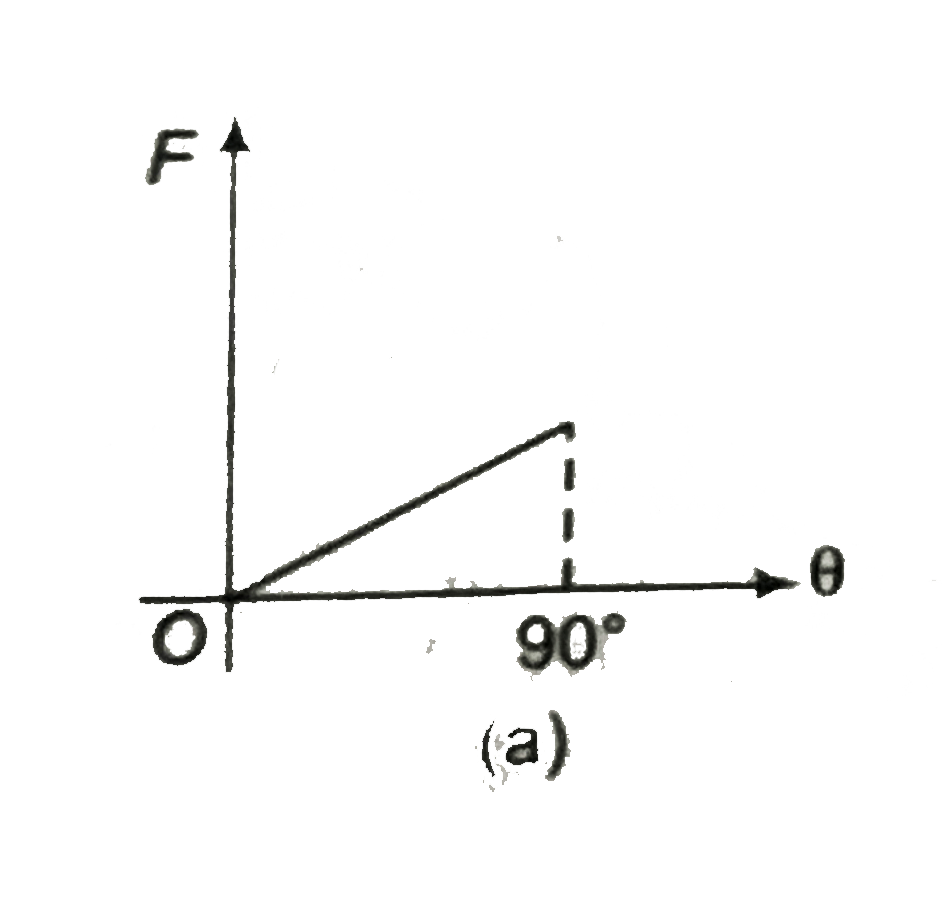
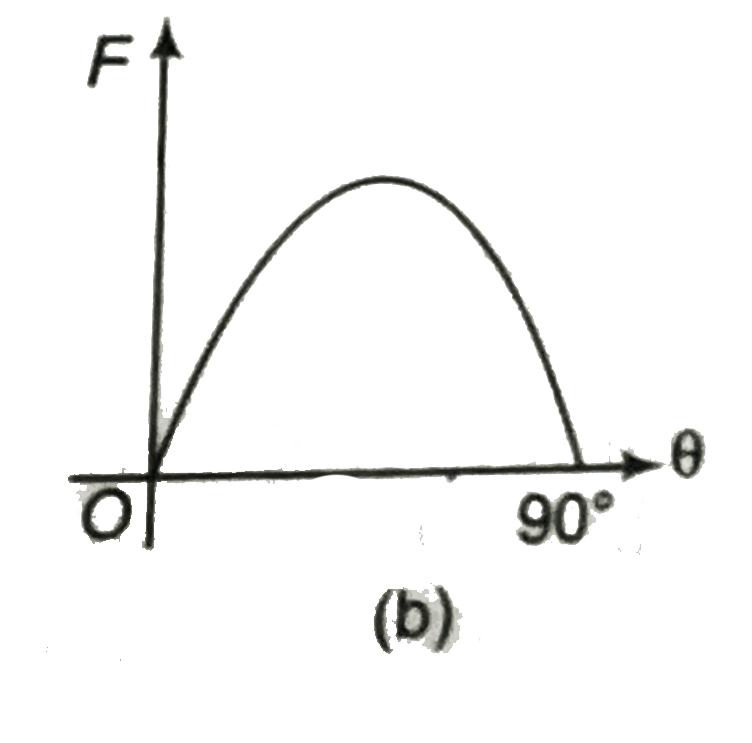
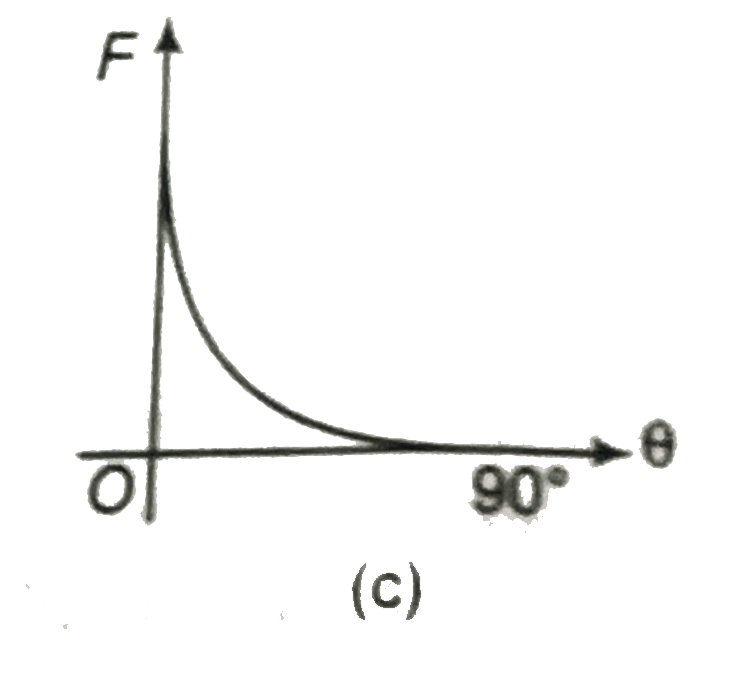
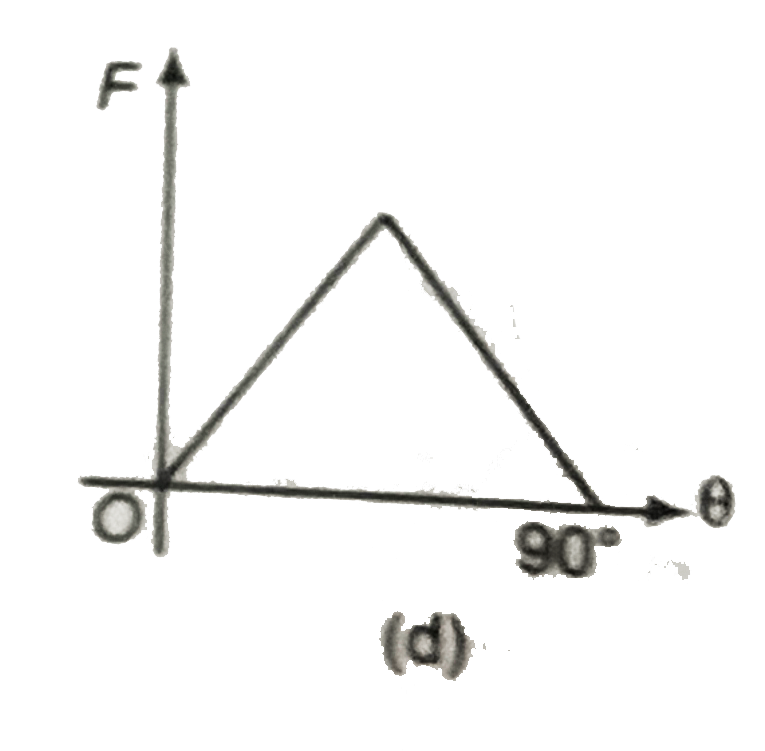
A block rests on a rough plane whose inclination `theta` to the horizontal can be varied. Which of the following graphs indicates how the friction force `F` between the block and the plane varies as `theta` is increased?

A

B

C

D

Text Solution

AI Generated Solution

The correct Answer is:

To solve the problem, we need to analyze how the friction force \( F \) between the block and the inclined plane varies as the angle \( \theta \) is increased. ### Step-by-Step Solution: 1. **Understanding the Forces**: When a block is resting on an inclined plane, the forces acting on it include gravitational force, normal force, and frictional force. The gravitational force can be resolved into two components: one parallel to the incline (which tries to slide the block down) and one perpendicular to the incline (which affects the normal force). 2. **Static Friction**: For small angles \( \theta \) (where \( \theta < \alpha \), with \( \alpha \) being the angle of repose), the block does not slide. The frictional force \( F \) will balance the component of the gravitational force acting down the slope. This can be expressed as: \[ F = mg \sin \theta \] Here, \( m \) is the mass of the block and \( g \) is the acceleration due to gravity. 3. **Behavior as \( \theta \) Increases**: As \( \theta \) increases, \( \sin \theta \) also increases, which means the frictional force \( F \) increases as long as the block remains stationary. 4. **Angle of Repose**: When \( \theta \) reaches the angle of repose \( \alpha \), the block is on the verge of sliding. At this point, the maximum static friction force is equal to: \[ F_{\text{max}} = \mu_s mg \cos \theta \] where \( \mu_s \) is the coefficient of static friction. 5. **Transition to Kinetic Friction**: Once \( \theta \) exceeds \( \alpha \), the block starts to slide down the plane. The frictional force now becomes kinetic friction, which is given by: \[ F = \mu_k mg \cos \theta \] where \( \mu_k \) is the coefficient of kinetic friction. 6. **Graphical Representation**: - For \( \theta < \alpha \), \( F \) increases with \( \sin \theta \). - For \( \theta \geq \alpha \), \( F \) decreases with \( \cos \theta \). 7. **Conclusion**: The graph that represents this behavior will show an increase in friction force \( F \) as \( \theta \) increases until it reaches a maximum at \( \theta = \alpha \), and then it will decrease as \( \theta \) continues to increase beyond \( \alpha \). ### Final Answer: The correct graph indicates that the friction force \( F \) increases with \( \theta \) until it reaches the angle of repose and then decreases as \( \theta \) continues to increase.

To solve the problem, we need to analyze how the friction force \( F \) between the block and the inclined plane varies as the angle \( \theta \) is increased. ### Step-by-Step Solution: 1. **Understanding the Forces**: When a block is resting on an inclined plane, the forces acting on it include gravitational force, normal force, and frictional force. The gravitational force can be resolved into two components: one parallel to the incline (which tries to slide the block down) and one perpendicular to the incline (which affects the normal force). 2. **Static Friction**: For small angles \( \theta \) (where \( \theta < \alpha \), with \( \alpha \) being the angle of repose), the block does not slide. The frictional force \( F \) will balance the component of the gravitational force acting down the slope. This can be expressed as: \[ ...
Promotional Banner

Topper's Solved these Questions

  • LAWS OF MOTION

    DC PANDEY ENGLISH|Exercise Objective Question|32 Videos
  • LAWS OF MOTION

    DC PANDEY ENGLISH|Exercise Comprehension|9 Videos
  • LAWS OF MOTION

    DC PANDEY ENGLISH|Exercise Assertion And Reason|28 Videos
  • KINEMATICS 1

    DC PANDEY ENGLISH|Exercise INTEGER_TYPE|15 Videos
  • LAWS OF THERMODYNAMICS

    DC PANDEY ENGLISH|Exercise Level 2 Subjective|18 Videos
DC PANDEY ENGLISH-LAWS OF MOTION-Single Correct
  1. In the figure shown find relation between magnitudes of a(A) and a(B).

    Text Solution

    |

  2. In the figure block moves downwards with velocity v(1), the wedge righ...

    Text Solution

    |

  3. In the figure the minimum value of a at which the cylinder starts risi...

    Text Solution

    |

  4. When the trolley show in figure is given a horizontal acceleration a, ...

    Text Solution

    |

  5. In the arrangement shown in the figure the mass M is very heavy compar...

    Text Solution

    |

  6. A block rests on a rough plane whose inclination theta to the horizont...

    Text Solution

    |

  7. The minimum value of mu between the two blocks for no slipping is

    Text Solution

    |

  8. A block is sliding along an inclined plane as shown in figure . If the...

    Text Solution

    |

  9. In the figure the wedge is pushed with an acceleration of sqrt3 m//s ^...

    Text Solution

    |

  10. Two block A and B are separted by some distance and tied by a string a...

    Text Solution

    |

  11. All the surface and pulleys are frictionless in the shown arrangement....

    Text Solution

    |

  12. Two blocks of 2 kg and 4 kg are connected by a light string and kept o...

    Text Solution

    |

  13. A smooth rod length l is kept inside a trolley at an angle theta as sh...

    Text Solution

    |

  14. A car begains from rest at time t = 0, and then acceleration along a s...

    Text Solution

    |

  15. A horizontal plank is 10.0 m long with uniform density and mass 10 kg ...

    Text Solution

    |

  16. A block is kept on a smooth inclined plane of angle of inclination the...

    Text Solution

    |

  17. A uniform cube of mass m and slidea is resting in equilibrium on a rou...

    Text Solution

    |

  18. A horizontal force F = (mg)/(3) is applied on the upper surface of a u...

    Text Solution

    |

  19. Two persons of equal heights are carrying a long uniform wooden plank ...

    Text Solution

    |

  20. A ball connect ed with string is released at an angle 45^(@) with the ...

    Text Solution

    |
