Home
Class 12
PHYSICS
An electron (mass m) with na initial vel...

An electron (mass m) with na initial velocity `v=v_(0)i(v_(o)gtO)` is in an electric field `E=-E_(0)hati(E_(0)="constant"gt0).` It's de-Broglie wavelength at time t is given by

A

`lambda_(0)t`

B

`lambda_(0)(1+(eE_(0))/(mv_(0))t)`

C

`lambda_(0)/((1+(eE_(0))/(mv_(0))t))`

D

`lambda_(0)`

Text Solution

Verified by Experts

The correct Answer is:
C

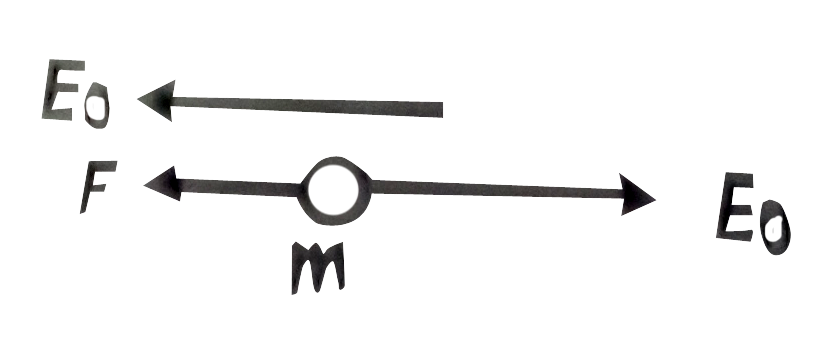
According to the question.
`v= v_(0)hat(i)`
`E=-E_(0)hat(i)`

Thus, magnitude of force on the electron due to the electric field,
`|F|=q|E| rArrF=eE_(0)`
From Newton's second law of motion,
F=ma
`therefore F=ma = eE_(0) rArr F=eE_(0) rArr a=(eE_(0))/m`........(i)
or `a=((-e)(-E_(0)hati))/m=(eE_(0))/mhat(i)`
From first equation of motion,
v=u + at
Here, u(initial velocity) = `v_(0)`
`rArr v=v_(0)+(eE_(0))/mt`...............(ii) from Eq. (i)
Initial de-broglie wavelength of the electron is given as
`lambda_(0) = h/((mv_(0)))rArr h=lambda mv_(0)`............(iii)
After time t, de-Broglie wavelength is given as
`lambda = h/(mv)`
Substituting the value of v from Eq. (ii) , we get
`lambda=h/(m(v_(0)+(eE_(0))/mt)) = h/(mv_(0)[1+(eE_(0))/(mv_(0))t])`
`(lambdamv_(0))/(mv_(0)[1+(eE_(0))/(mv_(0))t])`
`=lambda_(0)/[1+(eE_(0))/(mv_(0))t]`
`therefore (lambdamv_(0))/(mv_(0)[1+(eE_(0))/(mv_(0))t])`
`=lambda_(0)/[1+(eE_(0))/(mv_(0))t]`
Promotional Banner

Topper's Solved these Questions

  • SOLVED PAPERS 2018

    DC PANDEY ENGLISH|Exercise AIIMS|22 Videos
  • SOLVED PAPERS 2018

    DC PANDEY ENGLISH|Exercise Assertion and Reasons|10 Videos
  • SOLVED PAPER 2017

    DC PANDEY ENGLISH|Exercise Solved papers 2017(JIPMER)|32 Videos
  • WAVE OPTICS

    DC PANDEY ENGLISH|Exercise For JEE Advanced E. Integer Type Questions|13 Videos

Similar Questions

Explore conceptually related problems

An electron (mass m) with an initial velocity v=v_(0)hat(i)(v_(0)gt0) is in an electric field E=-E_(0)hat(l)(E_(0)="constant"gt0) . Its de-Broglie wavelength at time t is given by

An electron (mass m) with an initial velocity v=v_(0)hat(i)(v_(0)gt0) is in an electric field E=-E_(0)hat(l)(E_(0)="constant"gt0) . Its de-Broglie wavelength at time t is given by

An electron (mass m) with an initial velocity vecv=v_(0)hati is in an electric field vecE=E_(0)hatj . If lambda_(0)=h//mv_(0) . It's de-broglie wavelength at time t is given by

An electron (mass m) with initial velocity bar(v) = -v_(0)hati + 3v_(0)hatk is in an electric field hatE = = 2E_(0)hatj . If lamda_(0) is initial de-Broglie wavelength of electron, its de-Broglie wave length at time t is given by :

An electron (mass m ) with initival velocity vecv = v_(0) hati + v_(0) hatj is the an electric field vecE = - E_(0)hatk . It lambda_(0) is initial de - Broglie wavelength of electron, its de-Broglie wave length at time t is given by :

An electron of mass m with an initial velocity vec(v) = v_(0) hat (i) (v_(0) gt 0) enters an electric field vec(E ) =- E_(0) hat (j) (E_(0) = constant gt 0) at t = 0 . If lambda_(0) is its de - Broglie wavelength initially, then its de - Broglie wavelength at time t is

An electron (mass m) with initial velocity vecv = v_0 hati + 2v_0 hatj is in an electric field vecE = E_0 hatk . If lamda_0 is initial de-Broglie wavelength of electron, its de-Broglie wave length at time t is given by :

An electron is moving with an initial velocity vecv=v_(0)hati and is in a magnetic field vecB=B_(0)hatj . Then it's de-Broglie wavelength

An electron is moving with an initial velocity vecv=v_(0)hati and is in a magnetic field vecB=B_(0)hatj . Then it's de-Broglie wavelength

An electron is moving initially with velocity v_o hati+v_ohatj in uniform electric field vec E=-E_0 hatk . If initial wavelength of electron is lambda_0 and mass of electron is m. Find wavelength of electron as a function of time.

DC PANDEY ENGLISH-SOLVED PAPERS 2018-JIPMER
  1. An electron (mass m) with na initial velocity v=v(0)i(v(o)gtO) is in a...

    Text Solution

    |

  2. What is the magnetic moment of an electron orbiting in a circular orbi...

    Text Solution

    |

  3. Two point charges q(1)=2xx10^(-3) C and q(2)=-3xx10^(-6) C are separat...

    Text Solution

    |

  4. Find R(net) between A and B.

    Text Solution

    |

  5. In the circuit shown in the figure,

    Text Solution

    |

  6. Find V(P)-V(Q) in the circuit shown in figure.

    Text Solution

    |

  7. If a capacitor having capacittance 2F and plate separation of 0.5 cm w...

    Text Solution

    |

  8. Find the capacitance in shown figure

    Text Solution

    |

  9. If minimum deviation = 30^(@), then speed of light in shown prism will...

    Text Solution

    |

  10. A current .I. flows through a metallic wire of radius .r. and the free...

    Text Solution

    |

  11. Find i in shown figure.

    Text Solution

    |

  12. which of these is a fustion reaction ?

    Text Solution

    |

  13. An electron is accelerated through a potential difference V. Write th...

    Text Solution

    |

  14. An atomic power nuclear reactor can deliver 300 MW. The energy release...

    Text Solution

    |

  15. in the fusion reaction ""(1)H^(2)+""(1)H^(2)to ""(2)He^(3) +""(0)N^...

    Text Solution

    |

  16. A prism of crown glass with refracting angle of 5^(@) and mean refract...

    Text Solution

    |

  17. Two slits are separated by a distance of 0.5mm and illuminated with li...

    Text Solution

    |

  18. Calculate the dispersive power for crown glass from the given data m...

    Text Solution

    |

  19. The force of attractions between two charges 8muC and -4muC is 0.2 N. ...

    Text Solution

    |

  20. In a L-C circuit, angular frequency at resonance is omega. What will b...

    Text Solution

    |

  21. If an electron is moving with velocity v produces a magnetic field vec...

    Text Solution

    |

