Text Solution
Verified by Experts



Topper's Solved these Questions
MOTION IN ONE DIMENSION
ICSE|Exercise EXERCISE -2 (C)|3 VideosMOTION IN ONE DIMENSION
ICSE|Exercise EXERCISE -2 (C) ( Multiple choice type :) |17 VideosMOTION IN ONE DIMENSION
ICSE|Exercise EXERCISE -2 (B) ( Multiple choice type :) |3 VideosMEASUREMENTS AND EXPERIMENTATION
ICSE|Exercise TOPIC 2 SIMPLE PENDULUM (4 Marks Questions ) |1 VideosPRESSURE IN FLUIDS AND ATMOSPHERIC PRESSURE
ICSE|Exercise Exercise -4(B)Numericals|5 Videos
Similar Questions
Explore conceptually related problems
ICSE-MOTION IN ONE DIMENSION -EXERCISE -2 (B) ( Numericals )
- Fig. 2.37 (a) shows the displacement-time graph for the motion of a bo...
Text Solution
|
- Following table gives the displacement of a car at different instants ...
Text Solution
|
- A body is moving in a straight line and its displacement at various in...
Text Solution
|
- Fig. 2.38 shows the displacement of a body at different times. ...
Text Solution
|
- From the displacement-time graph of a cyclist, given in Fig. 2.39, fin...
Text Solution
|
- Fig. 2.40 ahead represents the displacement-time sketch of motion of t...
Text Solution
|
- A body at rest is made to fall from the top of a tower. Its displaceme...
Text Solution
|
- Fig. 2.41 (a) shows the velocity-time graph for the motion of a body. ...
Text Solution
|
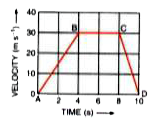
- Fig. 2.42 given below shows a velocity-time graph for a car starting f...
Text Solution
|
- The velocity-time graph of a moving body is given below in Fig. 2.43.(...
Text Solution
|
- A ball moves on a smooth floor in a straight line with a uniform veloc...
Text Solution
|
- Fig. 2.44 shows the velocity-time graph of a particle moving in a stra...
Text Solution
|