 .
.Text Solution
Verified by Experts



Topper's Solved these Questions
KINEMATICS-1
CENGAGE PHYSICS ENGLISH|Exercise Exercise 4.4|16 VideosKINEMATICS-1
CENGAGE PHYSICS ENGLISH|Exercise Subjective|29 VideosKINEMATICS-1
CENGAGE PHYSICS ENGLISH|Exercise Exercise 4.2|12 VideosGRAVITATION
CENGAGE PHYSICS ENGLISH|Exercise INTEGER_TYPE|1 VideosKINEMATICS-2
CENGAGE PHYSICS ENGLISH|Exercise Exercise Integer|9 Videos
Similar Questions
Explore conceptually related problems
CENGAGE PHYSICS ENGLISH-KINEMATICS-1-Exercise 4.3
- A train 200 m long is moving with a velocity of 72 km h^(-1) Find the ...
Text Solution
|
- Two cars A and B are moving on the straight parallel paths with speeds...
Text Solution
|
- Two trains 110 m and 90 m log respectively, are trunning in opposite d...
Text Solution
|
- A moving sidewalk in an airport terminal building moves at a speed of ...
Text Solution
|
- A railroad flatcar is traveling to the right at a speed of 13.0 ms^(-1...
Text Solution
|
- A lift is moving up with acceleration a A person inside the ligt throw...
Text Solution
|
- Consider two cities P and Q between which consistent bus servece is av...
Text Solution
|
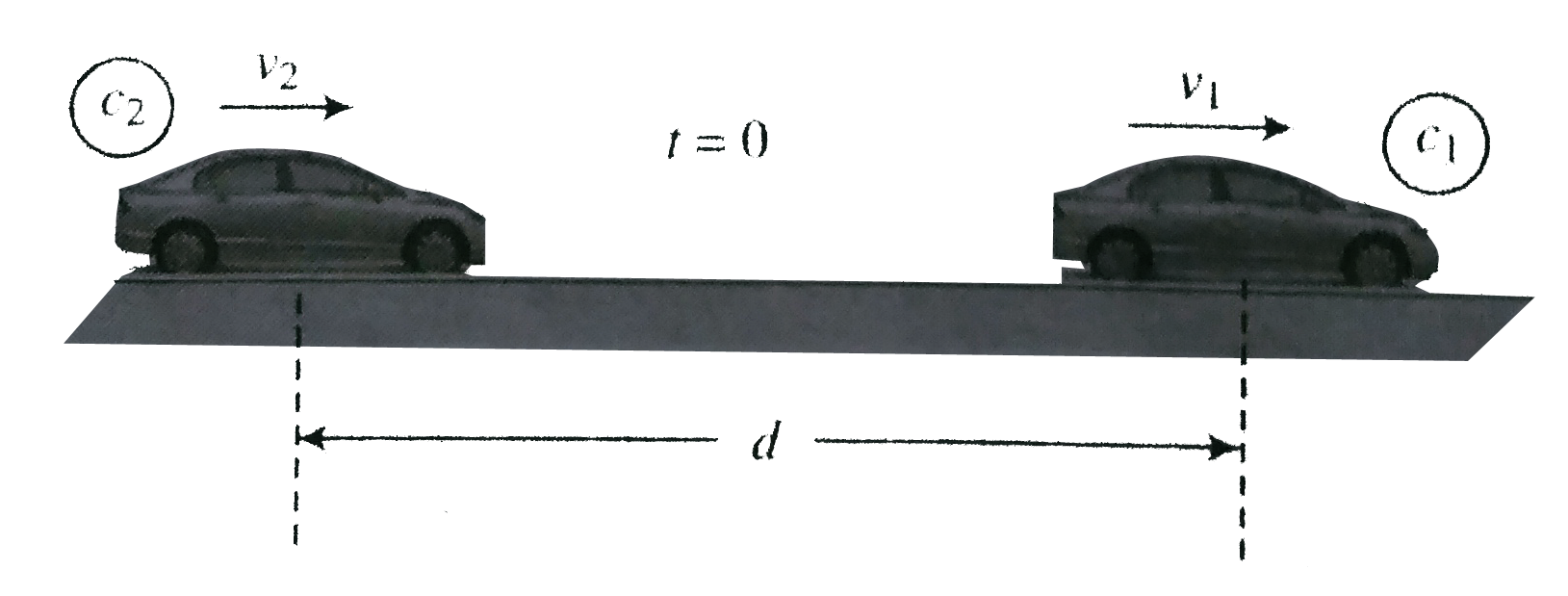
- Two cars C(1) and C(2) moving in the same direction on a straight sing...
Text Solution
|
- Two boys enter a running escalator at the ground floor in a shopping m...
Text Solution
|
- A body is thrown up in a lift with a velocity u relative to the lift, ...
Text Solution
|
- A passenger and a good train are headed in the same direction on paral...
Text Solution
|
- The speed of a motor launch with respect to still water in a stream is...
Text Solution
|
- Two boats A and B moved away from a buoy anchored in the middle of a r...
Text Solution
|
- A ship of length l-150m moving with velocity v(s)=36 km h^(-1) on the ...
Text Solution
|
- A 10-km long straight road connects two towns A and B, Two cyclists di...
Text Solution
|