Home
Class 11
PHYSICS
You are given the position-time graph of...

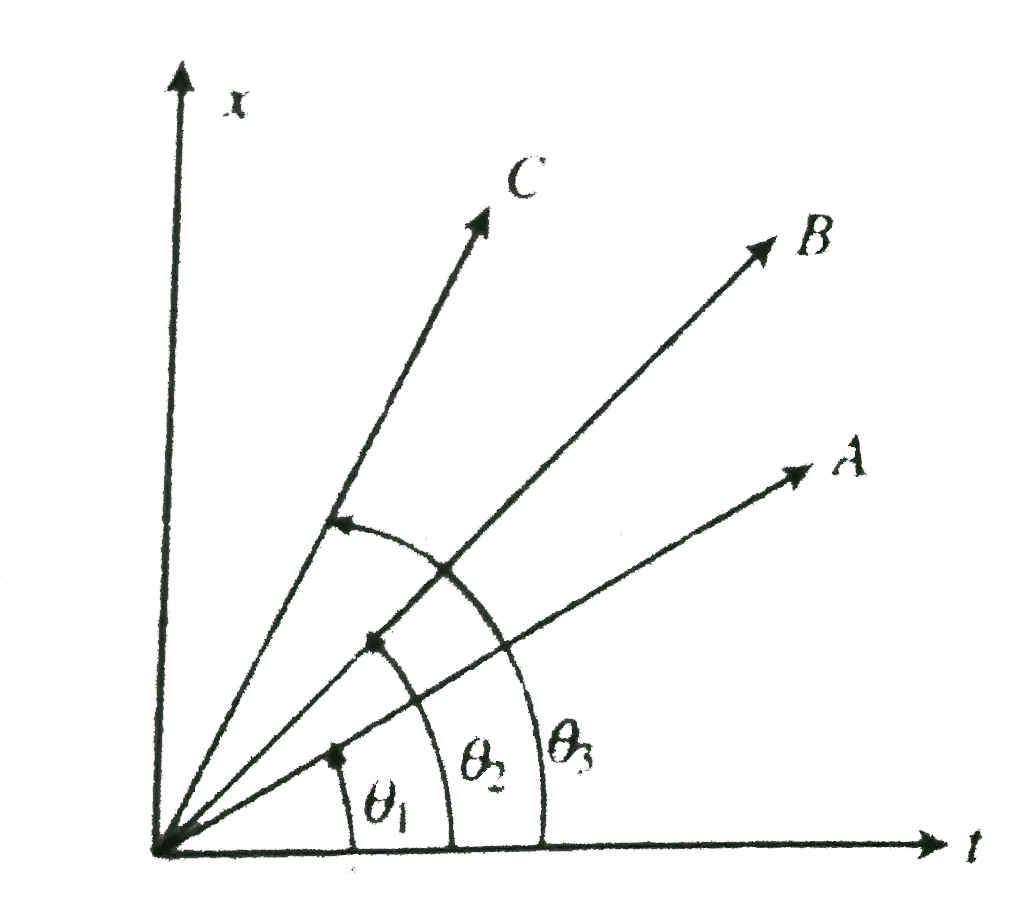
You are given the position-time graph of three deffernt bodies `A,B,` and `C`, Find which will have grater velocity an which will have least velocity.
.

Text Solution

Verified by Experts

Slope for `C` is greatest, so `C` will have greater velocity and slope for `A` is least. So `A` will have least velocity.
Promotional Banner

Topper's Solved these Questions

  • KINEMATICS-1

    CENGAGE PHYSICS ENGLISH|Exercise Subjective|29 Videos
  • KINEMATICS-1

    CENGAGE PHYSICS ENGLISH|Exercise Single Correct|52 Videos
  • KINEMATICS-1

    CENGAGE PHYSICS ENGLISH|Exercise Exercise 4.3|15 Videos
  • GRAVITATION

    CENGAGE PHYSICS ENGLISH|Exercise INTEGER_TYPE|1 Videos
  • KINEMATICS-2

    CENGAGE PHYSICS ENGLISH|Exercise Exercise Integer|9 Videos

Similar Questions

Explore conceptually related problems

Can a body have zero velocity and finite acceleration?

Which of the following position-time graphs correctly represents two moving objects A and B with zero relative velocity ?

A transverse wave is traelling along a string from left to right. The fig. represents the shape of the string (snap-shot) at a given instant. At this instant (A) Which points have an upward velocity , (B) which points have downward velocity (C) which point have zero velocity , (D) which point have maximum magnitude of velocity.

The position-time (x-t) graph of an object in uniform motion is shown below. Calculate the velocity with which the object is moving.

If position time graph of particle is sine curve as shown, what will be its velocity-time graph.

The velocity - time graph of two bodies A and B is shown in figure. Choose correct statement.

A transverse wave is travelling along a string in the positive x-axis. The shows the photograph of the wave at an instant. Find (a) the points moving upwards (b) the points moving downwards (c ) the points which have zero velocity (d) the points which have maximum velocity

A transverse wave is travelling along a string in the positive x-axis. The shows the photograph of the wave at an instant. Find (a) the points moving upwards (b) the points moving downwards (c ) the points which have zero velocity (d) the points which have maximum velocity

Which of the following gases will have the highest RMS velocity at 25^(@)C ?

Which of the following gases will have the highest RMS velocity at 25^(@)C ?

CENGAGE PHYSICS ENGLISH-KINEMATICS-1-Exercise 4.4
  1. a. What can you say about velocity in each of the following position-t...

    Text Solution

    |

  2. a. A ball is thrown vertically upwards. Aftre some time it trturns to ...

    Text Solution

    |

  3. A body starts at t=0 with velcoity u and travels along a straight ling...

    Text Solution

    |

  4. Find the average acceleration in first 20 s. (Hint: Area under a-t gra...

    Text Solution

    |

  5. At t=0, a particle starts from reat and moves along a straight line, w...

    Text Solution

    |

  6. Given below shows the desplacemen-time graph for a particle moving alo...

    Text Solution

    |

  7. You are given the position-time graph of three deffernt bodies A,B, an...

    Text Solution

    |

  8. A physics professor leaves her house and walks along the sidewalk towa...

    Text Solution

    |

  9. Shows the position-time graphs of three cars A,B and C On the basis of...

    Text Solution

    |

  10. A cockroach moves rectilinearly such that after sometime t(0) let its ...

    Text Solution

    |

  11. A car accelerates from rest at a constant rate alpha for some time, af...

    Text Solution

    |

  12. Two cars, A and B move along the x-axis. Car A starts from rest with c...

    Text Solution

    |

  13. A rigid ball traveling in a straight line the x-axis hits a soled wall...

    Text Solution

    |

  14. Refering to v-s diagram, find: . a. Acceleration of the particle w...

    Text Solution

    |

  15. A racing motor boat speeds up in a straight line in a lake, from rest....

    Text Solution

    |

  16. Referring a-s diagram in the figure , find the velocity after particle...

    Text Solution

    |

