Home
Class 11
PHYSICS
Two particle are projected with same ini...

Two particle are projected with same initial velocities at an angle `30^(@)` and `60^(@)` with the horizontal .Then

Text Solution

Verified by Experts
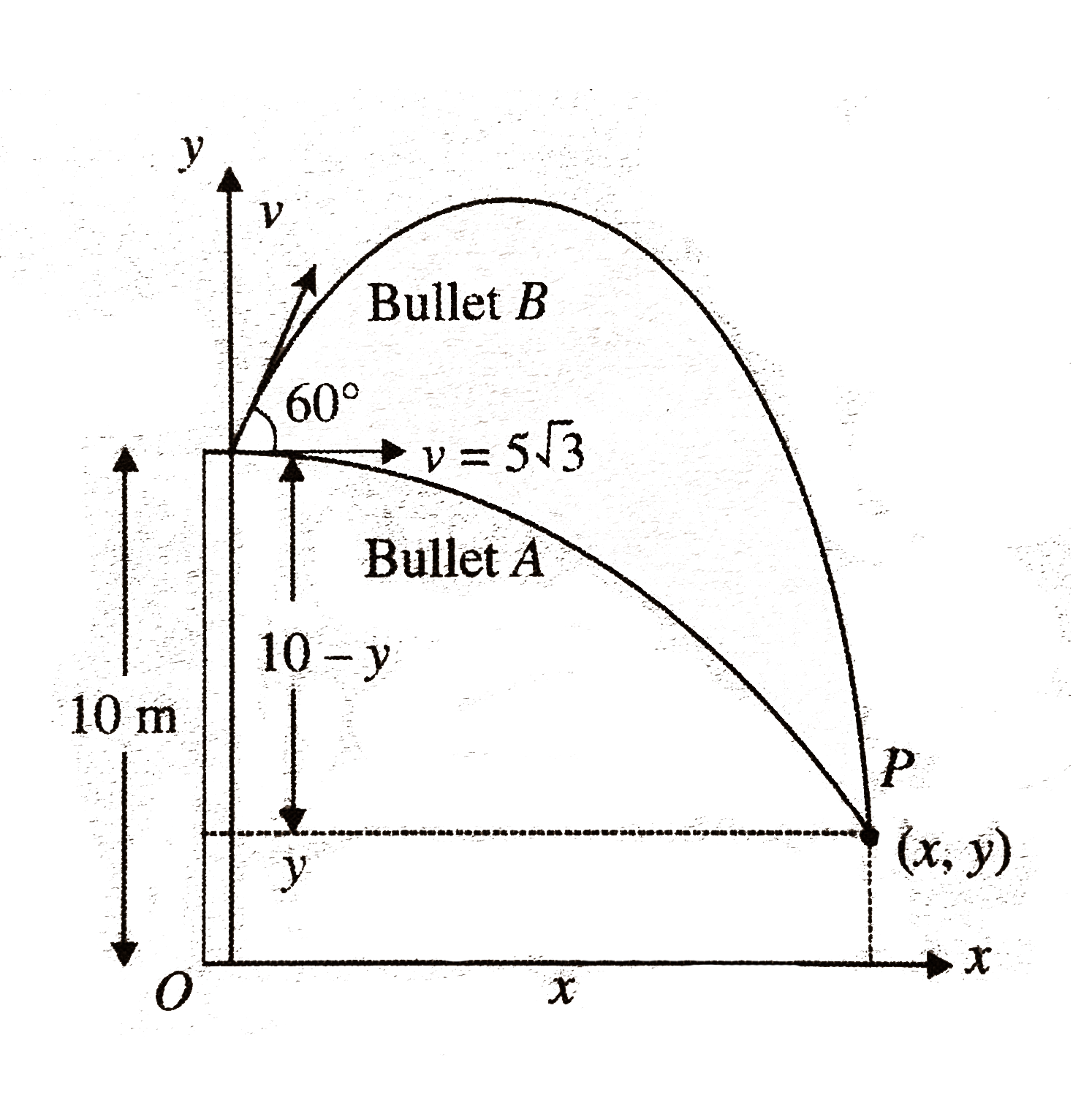
Method 1 : Foe bullet A. Let `t` be the time taken by bullet `A` to reach `P`
Vertical motion : `u_y = 0, S = ut + (1)/(2) at^2,S_y = -(10 -y)`
`a_y = -10 m s^-2 rArr 10 - y = 5 t^2` …(i)
Horizontal motion : `x = 5 sqrt(3) t` …(ii)
For bullet B. Let `(t + l)` be the time taken by bullet `B` to reach `P`.
Vertical motion : `uarr + u_y = + 5 sqrt(3) sin 60^@ = + 7.5 m s^-1`
`S = ut + (1)/(2) at^2 , a_y = -10 m s^-2`
`y - 10 = 7.5 (t + t') - 5 (t + t')^2` ...(iii)
Horizontal motion : `x = (5 sqrt(3) cos 60^@)(t + t')`
`rArr 5 sqrt(3) t + 5 sqrt(3) t' = 2x` ...(iv)
Substituting the value of `x` from (ii) in (iv), we get
`5 sqrt(3) t + 5 sqrt(3) t' = 10 sqrt(3)) t rArr t = t'`
(a) Putting `t = t'` in (iii),
`y - 10 = 15 t - 20 t^2` ...(v)
Adding (i) and (v), `0 = 15 t - 15 t^2 rArr t = 1 s`
So time interval between the firings is `t' = 1 s`
(b) Putting `t - 1` in (ii), we get `x = s sqrt(3) m`.
Putting `t = 1` in (i), we get `y = 5`.
Therefore, the coordinates of point
`P are (5 (sqrt(3) , 5))` in meters.
Method 2 : We take the point of firing as origin and `x - and y` - axis as shown in (Fig. 5.174). Equation of trajectory of the projectile is
`y = x tan theta - (g x^2)/(2 v_i^2 cos^2 theta)`
For gun 1,`theta = 60^@`. Therefore,
`y = x tan 60^@ - (g x^2)/(2 v_i^2 cos^2 60^@)= x sqrt(3) - (2 g x^2)/(v_i^2)`
For gun 2, `theta = 0^@`. Therefore,
`y = (- g x^2)/(2 v_i^2)`
Two shots collide at point `P`. Therefore, their coordinates must be same.
`(- g x^2)/(2 v_i^2) = x sqrt(3) - (2 g x^2)/(2 v_i^2)`
`x sqrt(3) = (2 g x^2)/(v_i^2) - (g x^2)/(2 v_i^2) = (3 g x^2)/(2 v_i^2)`
`x = 0` and `x = (2 v_i^2)/(sqrt(3 g) = (2(5 sqrt(3))^2)/(sqrt(3 (10))) =5 sqrt(3)`
`y = (-g x^2)/(2 v_i^2) = (-10(5 sqrt(3))^2)/(2(5 sqrt(3))^2) = -5 m`
If the origin is assigned at ground, the coordinates of point `P` will be `(5 sqrt(3)) m, 5 m)`.
Now we consider the x - component of displacement for both the shots.
Gun 1 : `x = 5 sqrt(3) m = v_i t (5 sqrt(3) ms^-1) t`
or `t_1 = 1 s`
Gun 2 : `x = 5 sqrt(3)m = v_i cos 60^@ t_2 = (5 sqrt(3))/(2) t_2`
or `t_2 = 2 s`
Time interval between two shots, `Delta t = t_2 -t_1 = 1 s`.
,.
Promotional Banner

Topper's Solved these Questions

  • KINEMATICS-2

    CENGAGE PHYSICS ENGLISH|Exercise Exercise 5.1|15 Videos
  • KINEMATICS-2

    CENGAGE PHYSICS ENGLISH|Exercise Exercise 5.2|25 Videos
  • KINEMATICS-2

    CENGAGE PHYSICS ENGLISH|Exercise Exercise Integer|9 Videos
  • KINEMATICS-1

    CENGAGE PHYSICS ENGLISH|Exercise Integer|9 Videos
  • KINETIC THEORY OF GASES

    CENGAGE PHYSICS ENGLISH|Exercise Compression|2 Videos

Similar Questions

Explore conceptually related problems

Two projectiles A and B are projected with same speed at an angle 30^(@) and 60^(@) to the horizontal, then which of the following is not valid where T is total time of flight, H is max height and R is horizontal range.

Two projectiles of same mass and with same velocity are thrown at an angle 60^(@) and 30^(@) with the horizontal, then which quantity will remain same:-

Two particles are projected with same initial velocity one makes angle theta with horizontal while other makes an angle theta with vertical. If their common range is R then product of their time of flight is directly proportional to :

Two bodies of same mass are projected with the same velocity at an angle 30^(@) and 60^(@) respectively.The ration of their horizontal ranges will be

Two particles are projected with same velocity but at angles of projection 25° and 65° with horizontal. The ratio of their horizontal ranges is

Two particles are projected with same velocity but at angles of projection 35° and 55°. Then their horizontal ranges are in the ratio of

A particle A is projected from the ground with an initial velocity of 10m//s at an angle of 60^(@) with horizontal. From what height should an another particle B be projected horizontally with velocity 5m//s so that both the particles collide in ground at point C if both are projected simultaneously g=10 m//s^(2) .

A particle A is projected with an initial velocity of 60 m//s at an angle 30^@ to the horizontal. At the same time a second particle B is projected in opposite direction with initial speed of 50 m//s from a point at a distance of 100 m from A. If the particles collide in air, find (a)the angle of projection alpha of particle B, (b) time when the collision takes place and (c) the distance of P from A, where collision occurs. (g= 10 m//s^2)

A particle is projected from ground with an initial velocity 20m//sec making an angle 60^(@) with horizontal . If R_(1) and R_(2) are radius of curvatures of the particle at point of projection and highest point respectively, then find the value of (R_(1))/(R_(2)) .

Four projectiles are projected with the same speed at angles 20^@,35^@,60^@ and 75^@ with the horizontal. The range will be the maximum for the projectile whose angle of projection is

