Home
Class 11
PHYSICS
Two particles 1 and 2 move with velociti...

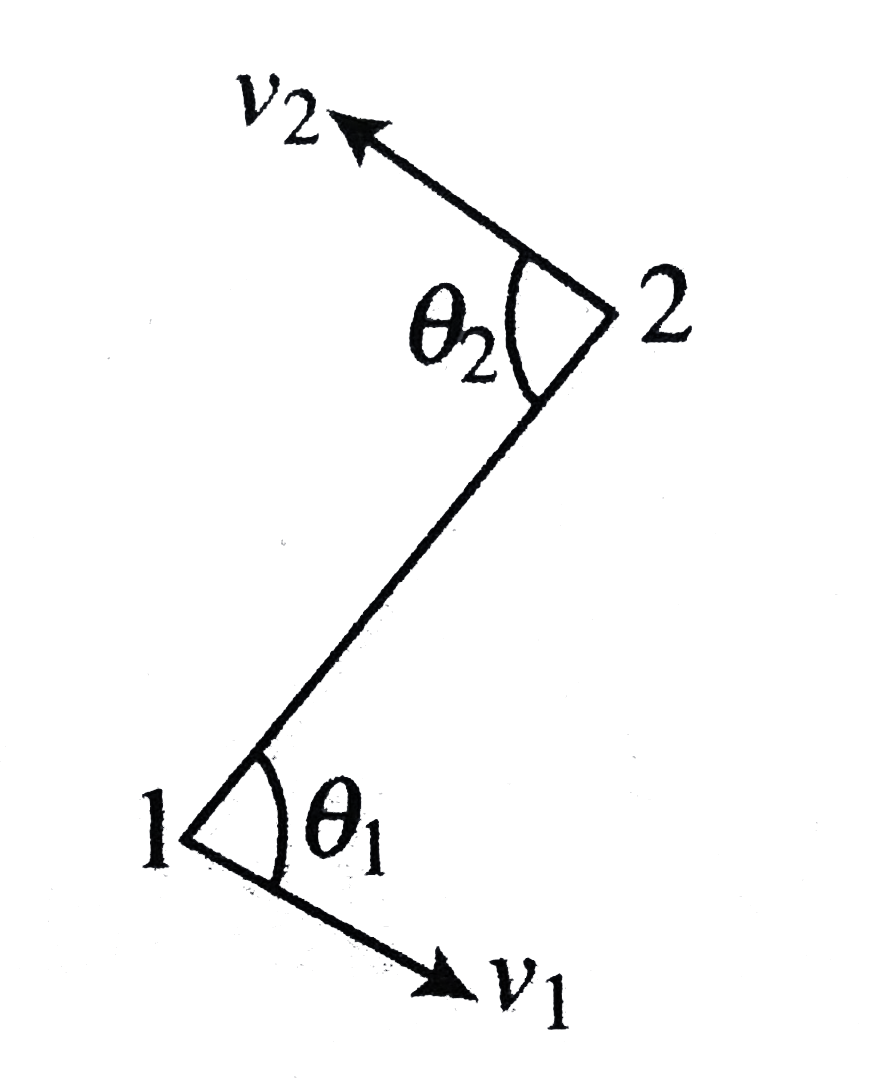
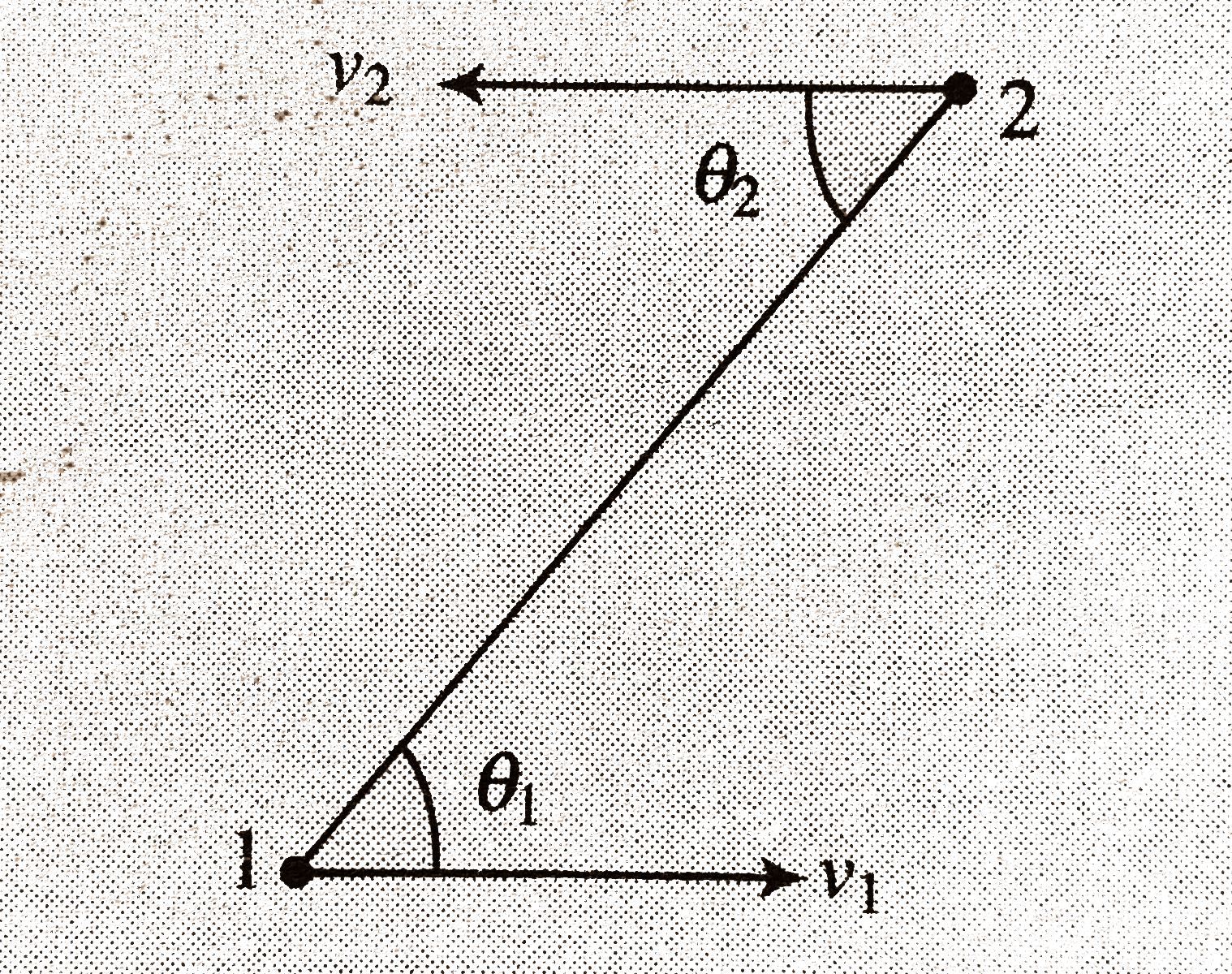
Two particles `1 and 2` move with velocities `vec v_1` and `vec v_2` making the angles `theta_1 and theta_2` with the line joining them, respectively. Find angular velocity of ` relative to 1`.
.

Text Solution

Verified by Experts

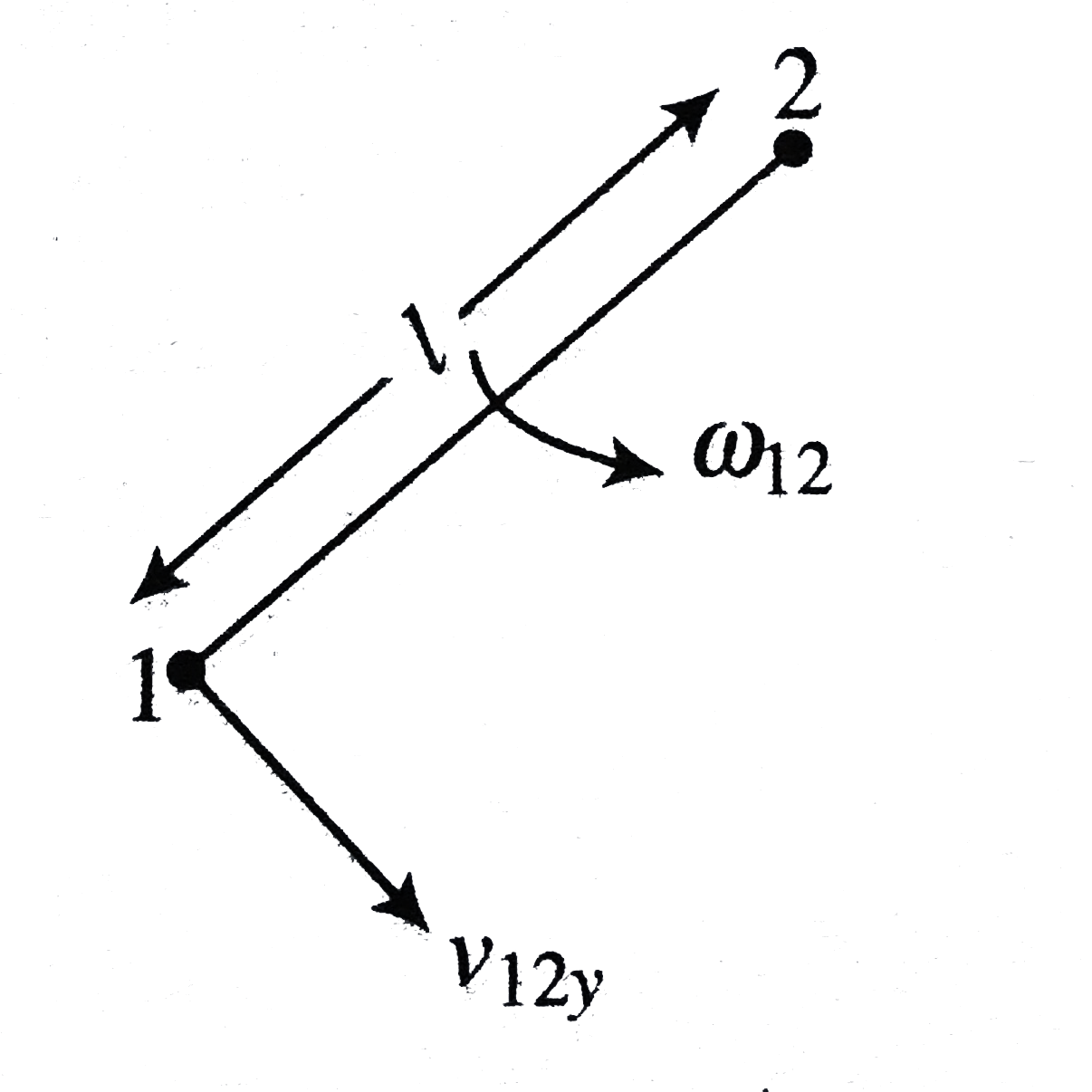
Let us find the relative velocity between the particles perpendicular to the line joining them, the velocity of `1` relative to velocity of `2` is
`vec v_(12) = vec v_1 - vec v_2`
Then, `vec v_(12_y) =vec v_(1_y) - vec v_(2_y) = -v_1 sin theta_1 hat j - v_2 sin theta_2 hat j`
Hence, `omega_(12) = (|vec v_(12_y)|)/(l)`
Substituting `|vec v_(12_y)|`, we have
`omega_(12)= (v_1 sin theta_1 + v_2 sin theta_2)/(l)`.
,.
Promotional Banner

Topper's Solved these Questions

  • KINEMATICS-2

    CENGAGE PHYSICS ENGLISH|Exercise Exercise Subjective|40 Videos
  • KINEMATICS-2

    CENGAGE PHYSICS ENGLISH|Exercise Exercise Single Correct|76 Videos
  • KINEMATICS-2

    CENGAGE PHYSICS ENGLISH|Exercise Exercise 5.3|12 Videos
  • KINEMATICS-1

    CENGAGE PHYSICS ENGLISH|Exercise Integer|9 Videos
  • KINETIC THEORY OF GASES

    CENGAGE PHYSICS ENGLISH|Exercise Compression|2 Videos

Similar Questions

Explore conceptually related problems

Two particles A and B are moving with constant velocities v_1 and v_2 . At t = 0 , v_1 makes an angle theta_0 with the line joining A and B and v_2 makes an angle theta_2 with the line joining A and B . (a) Find the condition for A and B to collide. (b) Find the time after which A and B will collide if separation between them is d at t = 0 . .

Two particles are moving with velocities v_(1) and v_2 . Their relative velocity is the maximum, when the angle between their velocities is

Two particles are projected from the same point making angles angle theta_1 and theta_2 with the horizontal respectively in such a way that their horizontal velocities are equal. The ratio of maximum heights (H_1/H_2) will be equal to

Two particles A and B move with constant velocity vec(v_1) and vec(v_2) along two mutually perpendicular straight lines towards intersection point O as shown in figure, At moment t = 0 particles were located at distance l_1 and l_2 respectively from O. Then minimu distance between the particles and time taken are respectively

Two particles, 1 and 2, move with constant velocities v_1 and v_2 . At the initial moment their radius vectors are equal to r_1 and r_2 . How must these four vectors be interrelated for the particles to collide?

A two particles P and Q are separated by distance d apart. P and Q move with velocity v and u making an angle 60^@ and theta with line PQ the graph between their relative separation (8) when time t is shown in figure (2). The velocity v in terms of u

Two projectiles are thrown simultaneously in the same plane from the same point. If their velocities are v_(1) and v_(2) at angles theta_(1) and theta_(2) respectively from the horizontal, then ansewer the following questions The trajectory of particle 1 with respect to particle 2 wil be

Two particles of equal mass 'm' are projected from the ground with speed v_(1) and v_(2) at angles theta_(1) and theta_(2) at the same times as shown in figure. The centre of mass of the two particles.

Two masses, m_(1) and m_(2) , are moving with velocities v_(1) and v_(2) . Find their total kinetic energy in the reference frame of centre of mass.

In fig., blocks A and B move with velocities v_(1) and v_(2) along horizontal direction. Find the ratio of v_(1)//v_(2)