Home
Class 11
PHYSICS
Force F is graduallly increased from zer...

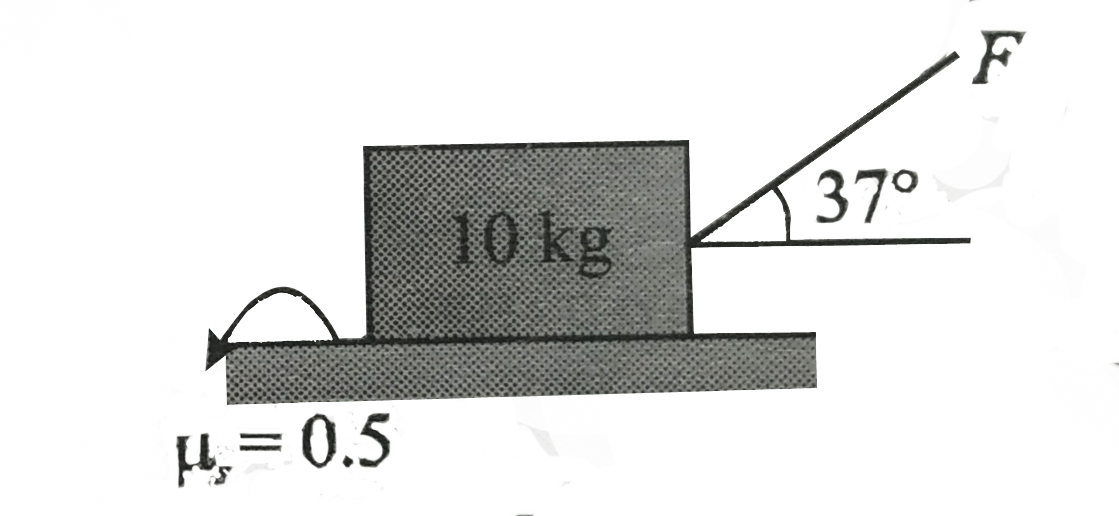
Force `F` is graduallly increased from zero .Determine whether the block will first slide or lift up?

Text Solution

Verified by Experts
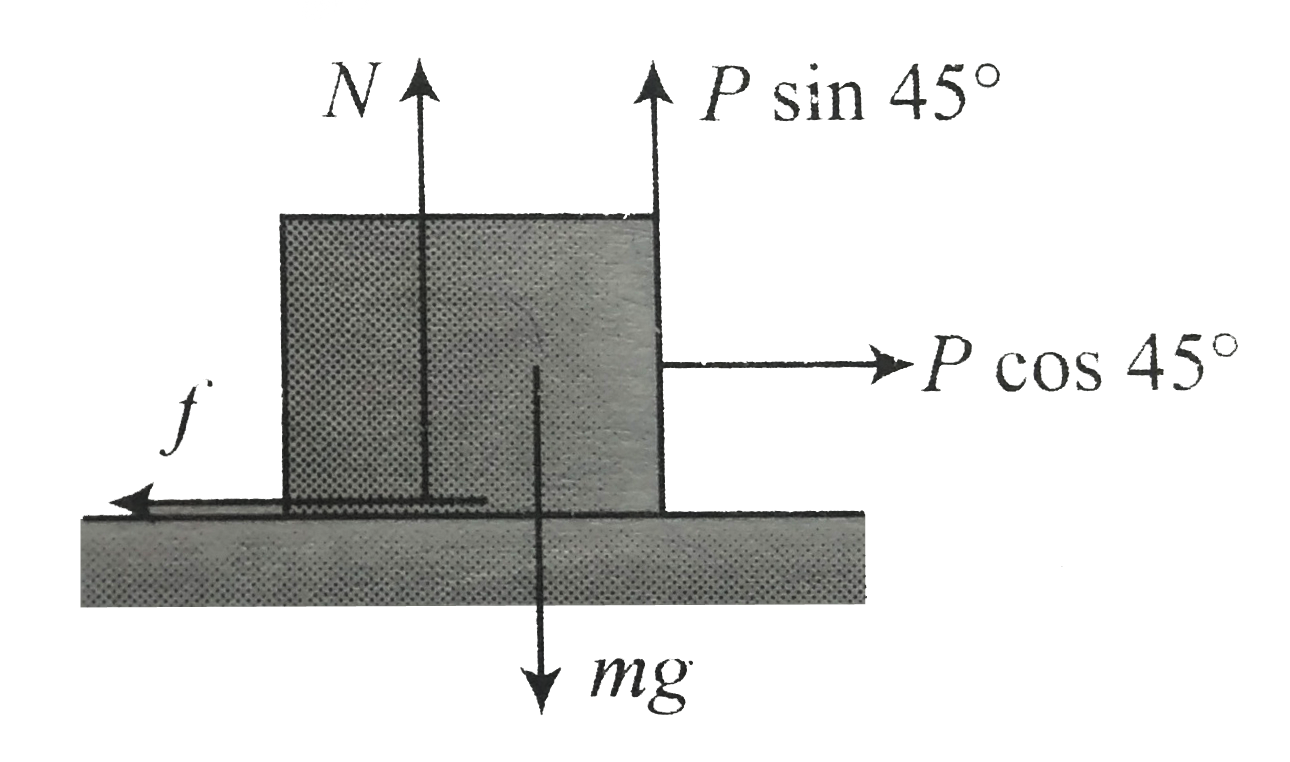
There is minimum magnitude of force required both in horizontal and verticle direction either to side ao lift up the block will first slide or lift up will depend apon which miximum magnitude of force is lesser

For verticle to start litting up
`F sin 37^(@) + N ge Mg`
`N` becomes zero just lifting condition
`F ge (Mg)/(sin 37^(@))`
`F_("lift") ge (10g)/(3//5) or F_("lift") ge (500)/(3) N`
For horizontal direction to starrt sliding
`F cos 37^(@) ge mu_(s)N`
`F cos 37^(@) gt 0.5[10g - F sin 37^(@)]`
`( :' N = 10g - F sin 37^(@))`
Hence `F _("slide") gt (50)/(cos 37^(@) + 0.5 sin 37^(@))`
` F _("slide") gt (500)/(11)N`
`F_("lift") gt (500)/(3) rArr F_("slide") lt F_("lift")`
Promotional Banner

Topper's Solved these Questions

  • NEWTON'S LAWS OF MOTION 2

    CENGAGE PHYSICS ENGLISH|Exercise Solved Examples|12 Videos
  • NEWTON'S LAWS OF MOTION 2

    CENGAGE PHYSICS ENGLISH|Exercise Exercise 7.1|25 Videos
  • NEWTON'S LAWS OF MOTION 1

    CENGAGE PHYSICS ENGLISH|Exercise Integer|5 Videos
  • PROPERTIES OF SOLIDS AND FLUIDS

    CENGAGE PHYSICS ENGLISH|Exercise INTEGER_TYPE|2 Videos

Similar Questions

Explore conceptually related problems

A block is being pulled by a force F on a long frictionless level floor. Magnitude of the force is gradually increases from zero until the block lifts off the floor. Immediately before the block leaves the floor, its acceleration is

In Fig force F is gradually increased from zero Draw the graph between applied force F and tension T is the string . The coefficient of string friction between the block and the ground is mu_(s)

Two blocks A and B of mass 10 kg and 20 kg respectivelly, are arranged as shown in figure In the figure given a constant force F_(0) = 120 N act on block A and a force F applied horizontally on block B is gradually increased from zero. Discuss the direction and nature of friction force and the acceleations of the block for different value of F

A block A (5kg) rests over another block B (3kg) placed over a smooth horizontal surface. There is friction between A and B. A horizontal force F_1 gradually increasing from zero to a maximum is supplied to A so that the blocks move together without relative motion. Instead of this another horizontal force F_2 , gradually increasing from zero to a maximum is supplied to B so that the blocks move together without relative motion. Then

In the figure shown, horizontal force F_(1) is applied on a block but the block does not slide. Then as the magnitude of vertical force F_(2) is increased from zero the block begins to slide, the correct statement is

For the potential energy curve shown in figure. (a) Determine whether the force F_x is positive, negative, or zero at the five points indicated, (b) Indicate points of stable, unstable, and neutral equilibrium, (c) Sketch the curve for F_x versus x from x=0 to x=8m .

In the figure shown, (a) find the force of friction acting on the block. (b) state whether the block will move or not. If yes then with what acceleration?

In the figure shown, (a) find the force of friction acting on the block. (b) state whether the block will move or not. If yes then with what acceleration?

A block is kept on a rough surface and applied with a horizontal force as shown which is gradually increasing for zero. The coefficient of static and kinetic friction are 1//sqrt3 then

A block of mass m is placed on a rough inclined plane. The corfficient of friction between the block and the plane is mu and the inclination of the plane is theta .Initially theta=0 and the block will remain stationary on the plane. Now the inclination theta is gradually increased . The block presses theinclined plane with a force mgcostheta . So welding strength between the block and inclined is mumgcostheta , and the pulling forces is mgsintheta . As soon as the pulling force is greater than the welding strength, the welding breaks and the blocks starts sliding, the angle theta for which the block start sliding is called angle of repose (lamda) . During the contact, two contact forces are acting between the block and the inclined plane. The pressing reaction (Normal reaction) and the shear reaction (frictional force). The net contact force will be resultant of both. Answer the following questions based on above comprehension: Q. For what value of theta will the block slide on the inclined plane:

