Home
Class 11
PHYSICS
Determine the magnitude of frictional fo...

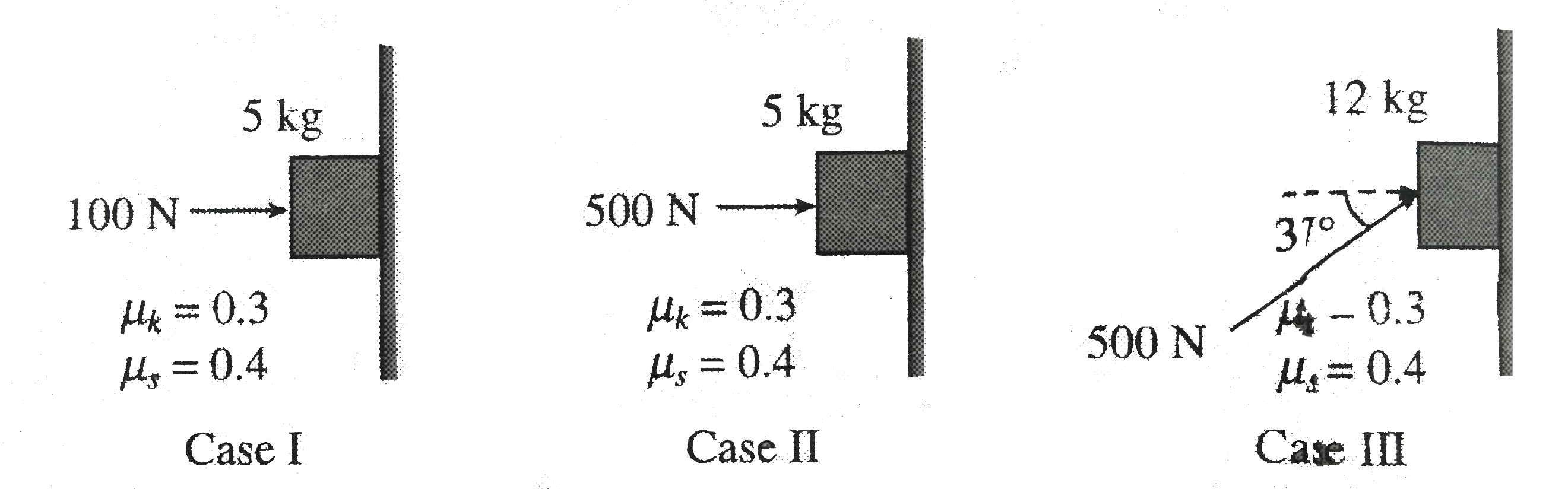
Determine the magnitude of frictional force and acceleration of the block in each of the following cases :

Text Solution

Verified by Experts

Case (i)`N_(1) = 100N , mg = 50N`
`f_(1) = mu_(s) N_(1) = 0.4 xx 100 = 40N`
`f_(k) = mu_(k) N_(1) = 0.3 xx 100 = 30N`
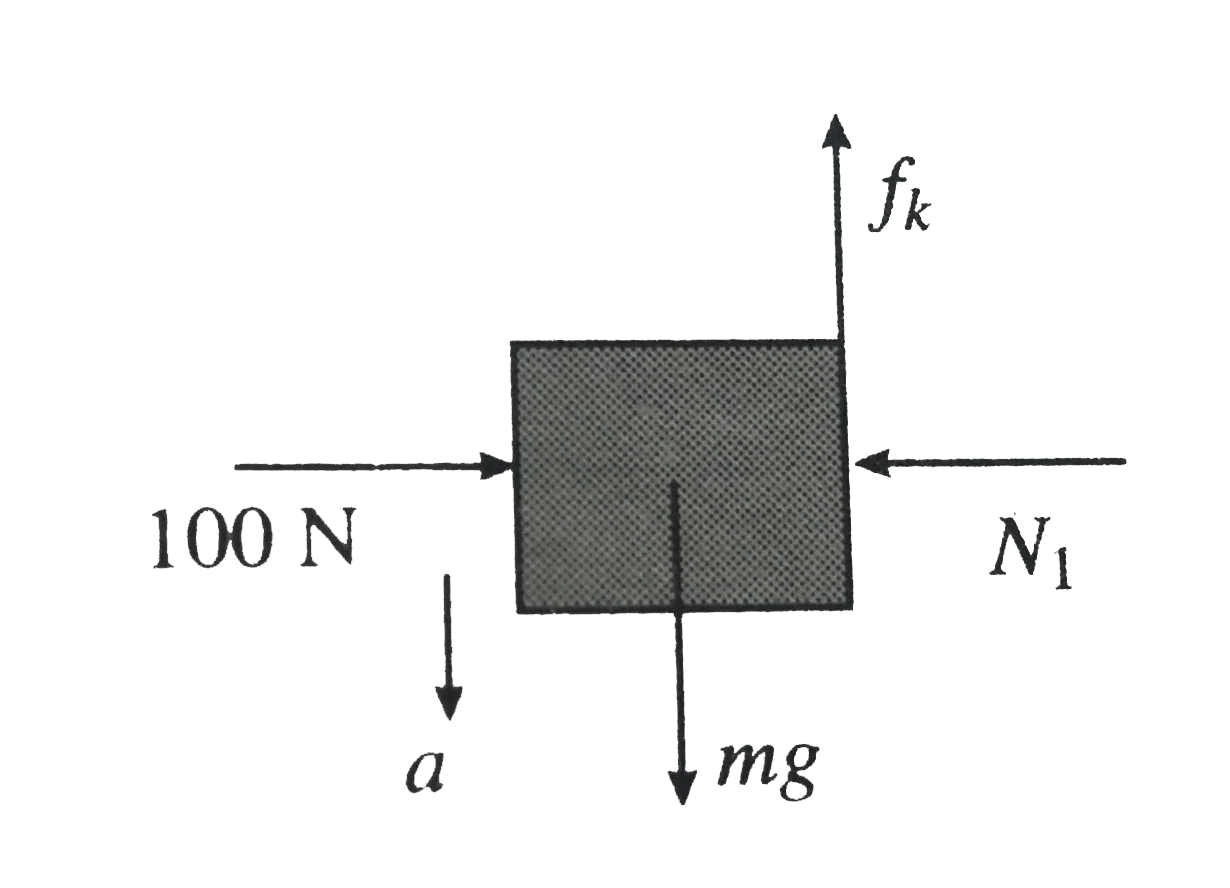
Here `mg` (driving force ) is greater than maximum friction `f_(1) = 40N` .Hence , the block will not be able to stay at rest if will accelerate downwards but where it starts slipping then kinetic friction will come into play. Now
`a = (mg - f_(k))/(m) = (50 - 30)/(5) = 4 ms^(-2)`
So, in this case ` f = f_(1) = 30N` and `a = 4 ms^(-2)` (downward)
Case(ii)
`N_(2) = 500N , mg = 50N`
`f_(1) = mu_(s)N_(2) = 200N`
`f_(k) = mu_(k) N_(2) = 150N`

Here `f_(1)` is graeter than `mg `(driving force) Hence block will not move so in this case `a = 0 , f= mg = 50N`
case III
`N_(3) = 400N`
`f_(1) = mu_(s)N_(3) = 160N`
`f_(k) = mu_(s) N_(3) = 120N`
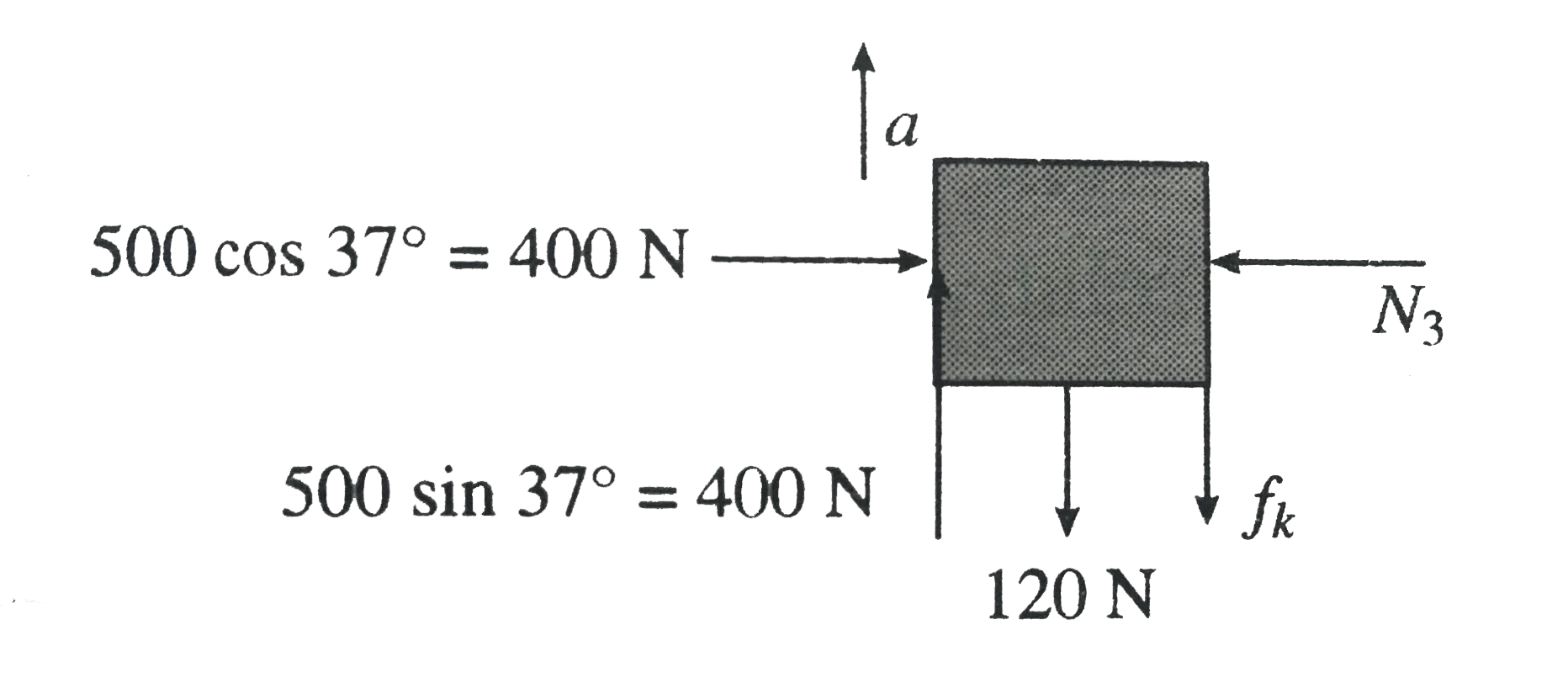
Here driving force `= 300 - 120 = 180 N` is apwards Driving force is more than `f_(1)` so the block will accelerate upward
`a = (180 - f_(1))/(m) = (180 - 120)/(12) = 5 ms^(-2) ` (upward)
So in this case,` f = f_(k) = 120N` and `5 ms^(-2)` (upwards)
Promotional Banner

Topper's Solved these Questions

  • NEWTON'S LAWS OF MOTION 2

    CENGAGE PHYSICS ENGLISH|Exercise Solved Examples|12 Videos
  • NEWTON'S LAWS OF MOTION 2

    CENGAGE PHYSICS ENGLISH|Exercise Exercise 7.1|25 Videos
  • NEWTON'S LAWS OF MOTION 1

    CENGAGE PHYSICS ENGLISH|Exercise Integer|5 Videos
  • PROPERTIES OF SOLIDS AND FLUIDS

    CENGAGE PHYSICS ENGLISH|Exercise INTEGER_TYPE|2 Videos

Similar Questions

Explore conceptually related problems

The frictional force acting on 1 kg block is

The magnitud of difference in accelerations of blocks of mass m in . Both the cases shown below is

Assertion: Magnitude of the contact force is always greater than the magnitude of frictional force. Reason: Contact force is the resultant of the friction force and normal reaction.

A block of mass 5 kg is kept on a rough horizontal surface. The coefficient of friction for the contact force block and surface are mu_(s) = 0*1 and mu_(k) = 0*9 respectively . A horizontal force F given by F 0*5t is applied at t = 0 . Here t represent time in seconds . Determine the force of friction and acceleration of the block at (i) t = 1s (ii) t= 10 s (iii) t = 12 s

34.The magnitude of acceleration of blocks of mass

A block B is pulled by a force of 18 N applied to a light pulley as shown in the figure. If the coefficient of friction is 0.4 and the acceleration of the block is 0.5 ms^(-2) , the mass of the block is (g = 10 m//s^2)

In the three figure shown, find acceleration of block and force of friction on it in each case.

In which of the following cases the magnitude of acceleration of the block A will be maximum (neglecting friction, mass of pulley and string)

In which of the following cases the magnitude of acceleration of the block A will be maximum (neglecting friction, mass of pulley and string)

Calculate the acceleration of block A and B in cases (a),(b), and (c ).

