Home
Class 11
PHYSICS
Two block A and B of mass m(A)= 10 kg a...

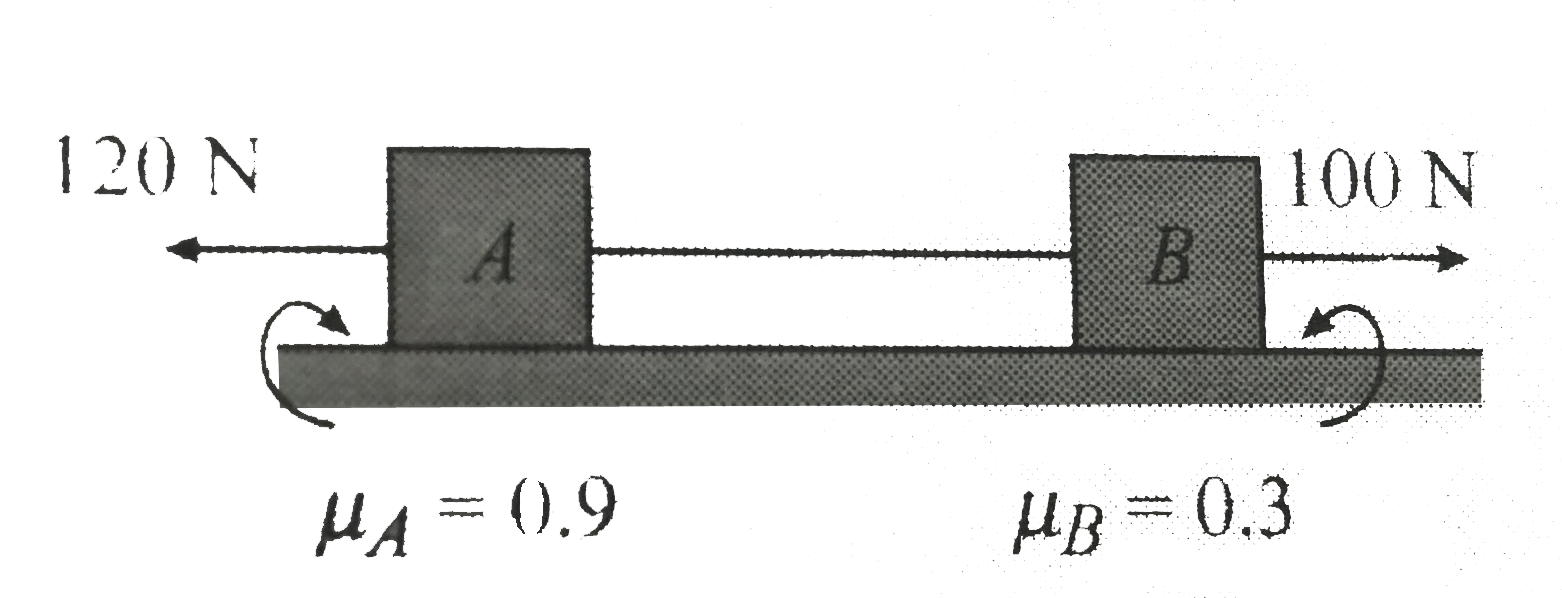
Two block `A and B` of mass `m_(A)= 10 kg` and `m_(A) = 20 kg ` are place on rough horizontal surface . The blocks are connected with a string. If the coefficient of fraction between block `A` and ground is ` mu _(A) = 0.9` and between block `B` and ground is `mu _(B) = 0.3 ` and the tension in the string in situation as shown in fig force `120 N `and `100 N` start acting when the system is at rest?

Text Solution

Verified by Experts

Let as assume that the system moves towards left .Then as it is clear from `FBD`
`F_("driving")= 120 - 100 20N`
`f_("resisting") = mu_(A)N_(A) + mu_(B)N_(B)`
`= 90 + 60 + 150 N`
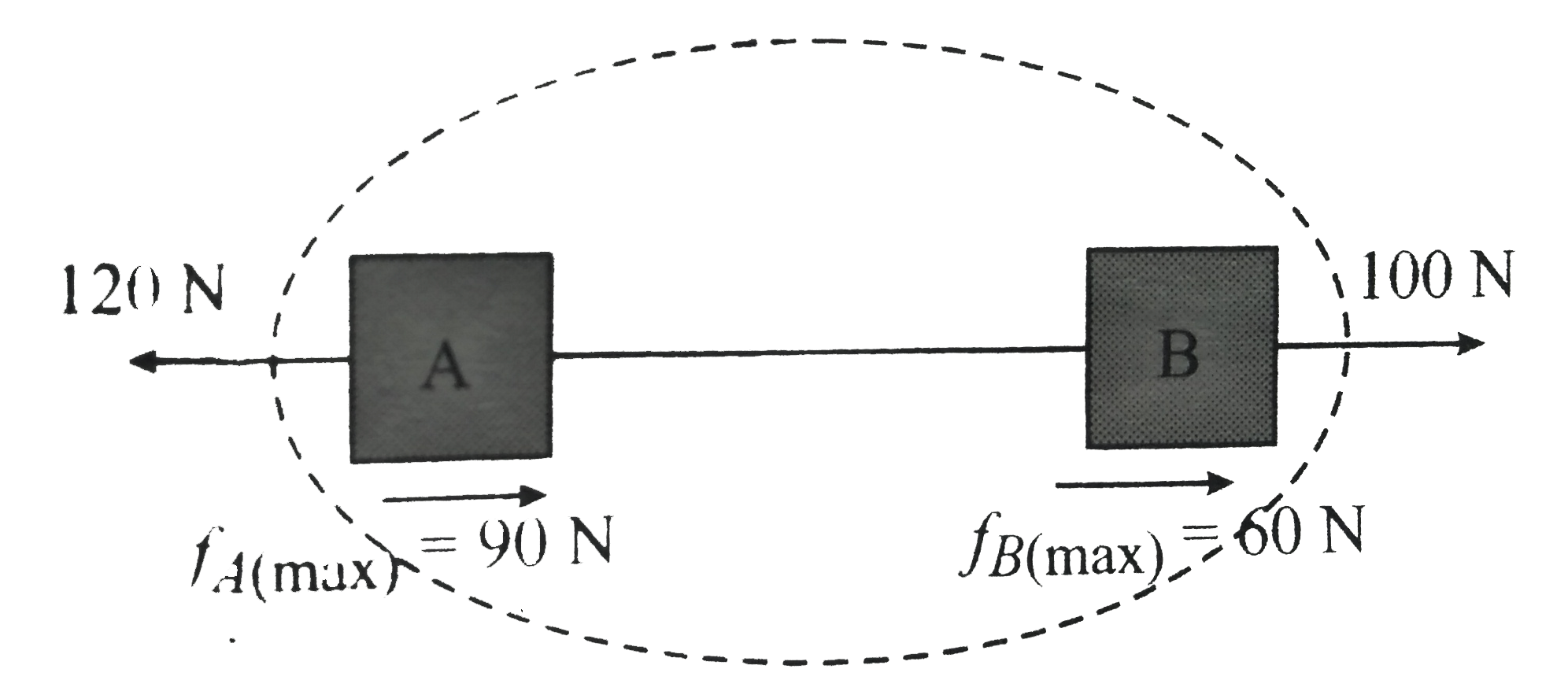
As `F_("resisting") gt F_("driving") ` therefore, it can be concuded that the system is stationary Now there may be two posibilities
The friction between both block and ground should be static
The friction between one block and between the after block and ground is limiting
If friction between both and ground static , the tension in string should be zero
The friction on block `A, f_(A) = 120N`
The friction on block `B, f_(B) = 100N`
But `(f_(A))_(max) = 90 N` and `(f_(B))_(max) = 60 N`
Hence the friction on both block cannot be static
Hence friction on one block is static and on block should be limiting
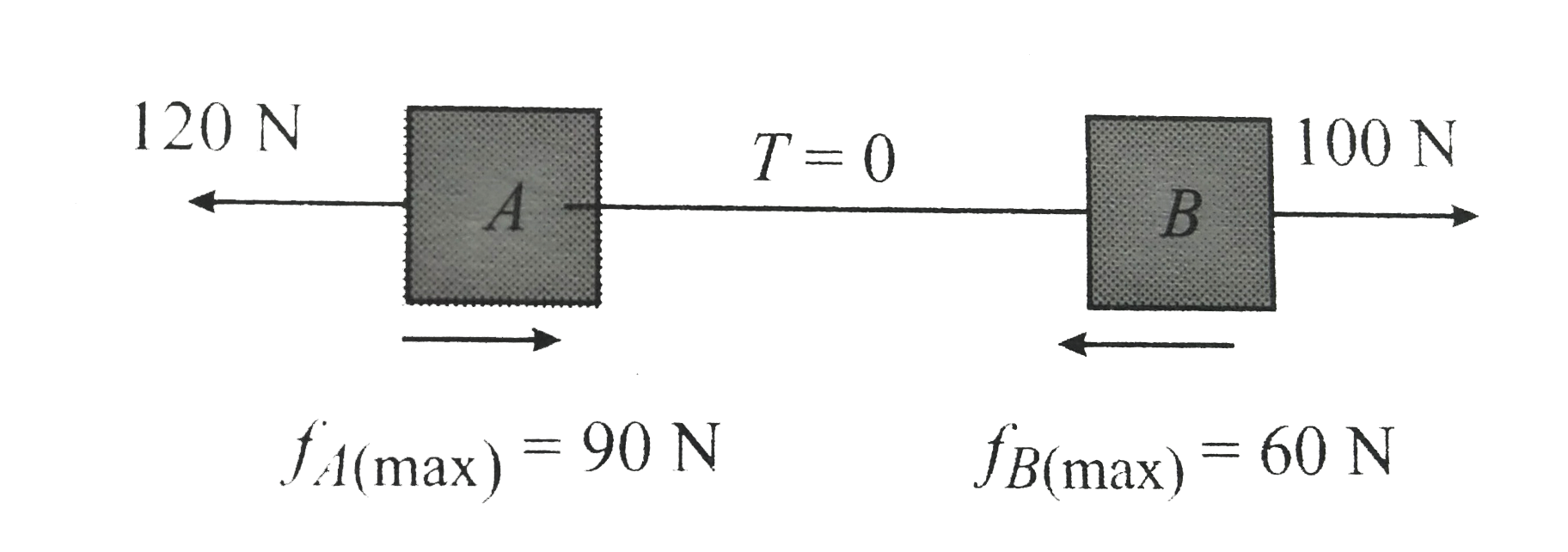
Assuming that the `10 kg` block reaches limiting friction first then using `FBD's`
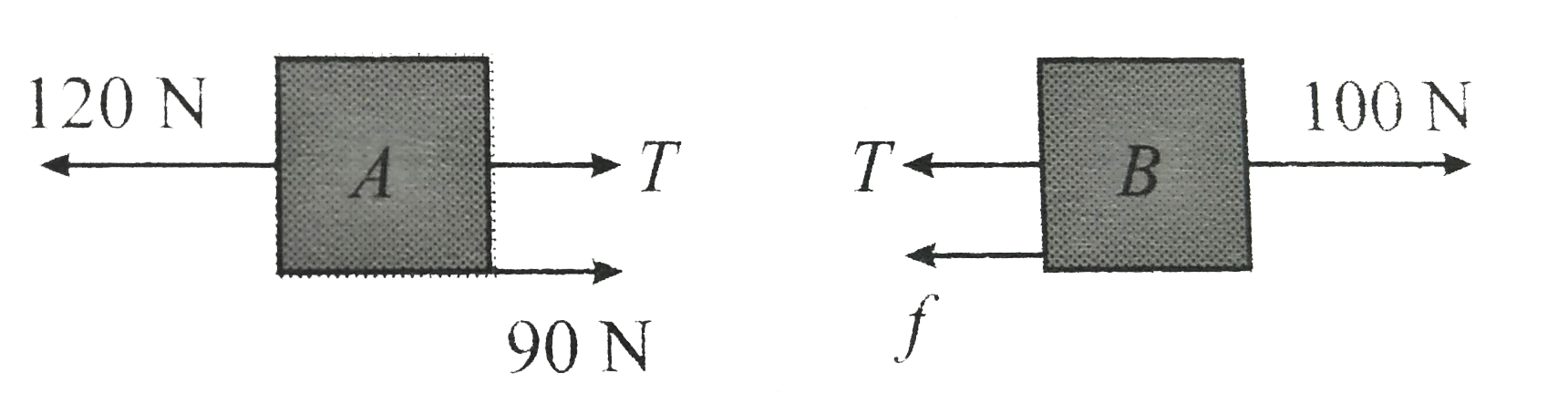
If block `A` is at rest
`120= T + 90 rArr T = 30N`
From `FBND` of `B` : ` T = f = 100`
` :. 30 + f = 100`
Then`f = 30N `which is not posible as the value is `60N` for this surface of block
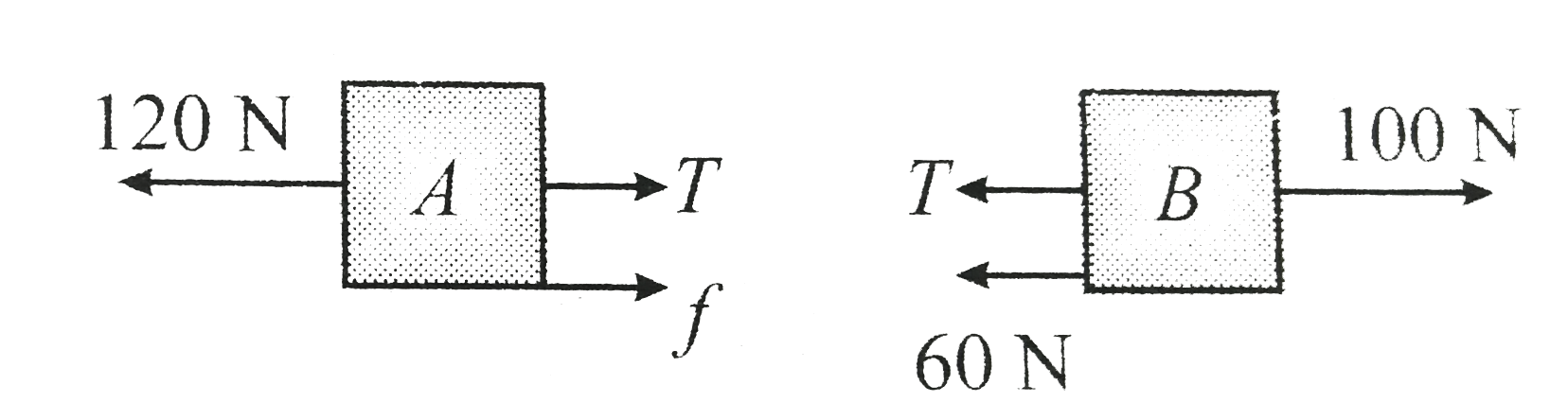
Therefore our assumption is wrong and now taking for `20 kg` surface to be limiting we have
from FBD of `B`
` T + 60 = 100 rArr T = 40 N`
From F`BD`of `A`
Also ` f + T = 120 rArr f = 80 N`
This is acceprable as the static friction at this should be less than `90 N`
Hence the tension in the string is `T = 40 N`
Promotional Banner

Topper's Solved these Questions

  • NEWTON'S LAWS OF MOTION 2

    CENGAGE PHYSICS ENGLISH|Exercise Solved Examples|12 Videos
  • NEWTON'S LAWS OF MOTION 2

    CENGAGE PHYSICS ENGLISH|Exercise Exercise 7.1|25 Videos
  • NEWTON'S LAWS OF MOTION 1

    CENGAGE PHYSICS ENGLISH|Exercise Integer|5 Videos
  • PROPERTIES OF SOLIDS AND FLUIDS

    CENGAGE PHYSICS ENGLISH|Exercise INTEGER_TYPE|2 Videos

Similar Questions

Explore conceptually related problems

In the figure shown coefficient of friction between block A and ground is 0.4 and that between wedge and block B is zero. Wedge is fixed. Find tension is string and acceleration of block A if F = 28 N.

In the diagram shown coefficient of friction between 2 kg block and 4 kg block is mu =0.1 and between 4 kg and ground is mu =0.2 then answer the following quwstions .(tis time) Force of friction on 2 kg block at t=(1)/(2) s will be

The block of mass M and are arrenged as the situation in fig is shown.The coefficient of friction between two block is mu and that between the bigger block and the ground is mu find the acceleration of the block

In the diagram shown coefficient of friction between 2 kg block and 4 kg block is mu =0.1 and between 4 kg and ground is mu =0.2 then answer the following quwstions .(tis time) At t=4 s, the friction between 4 kg block and ground will be

In the diagram shown coefficient of friction between 2 kg block and 4 kg block is mu =0.1 and between 4 kg and ground is mu =0.2 then answer the following quwstions .(tis time) The graph of frication force acting on 4 kg block and ground as a function of time

Two blocks A and B having masses 100 kg and 200 kg are placed as shown in the figure. The block A is connected to a wall with a light inextensible string. The coefficient of friction between the blocks is 0.3 and that between the block B and the floor is 0.03. Then the minimum force required to move the block B will be (take g=10m//s^(2) )

A block is kept on a rough horizontal surface as shown. Its mass is 2 kg and coefficient of friction between block and surface (mu)=0.5. A horizontal force F is acting on the block. When

Two blocks M and m are arranged as shown in the diagram The coefficient of friction between the block is mu_(1) = 0.25 and between the ground and M is mu_(2) = (1)/(3) If M = 8 kg then find the value of m so that the system will remain at rest

A block of mass m slides over a smooth wedge of mass M which is placed over a rough horizontal surface . The centre of mass of the system will move towards left Here mu = coefficient of friction between the wedge and the ground .

Two blocks A and B of masses 10 kg and 15 kg are placed in contact with each other rest on a rough horizontal surface as shown in the figure. The coefficient of friction between the blocks and surface is 0.2. A horizontal force of 200 N is applied to block A. The acceleration of the system is ("Take g"=10ms^(-2))

