Home
Class 11
PHYSICS
Let as consider the next case in the pre...

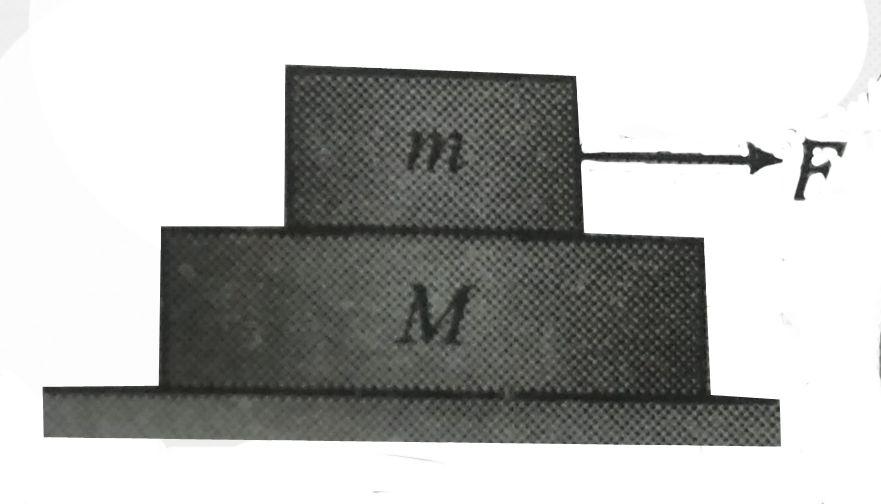
Let as consider the next case in the previous illustration when there is no friction between ground and `M` . The coefficient of static and kinetic friction are `mu_(2)` and `mu_(1)`, respectively, and force `F` acts upper block as shown in figure
a. What is the maximum possible value of `F` so that the system moves together ?
b . If there is releative sliding between `M` and `m` then calculate acceleration of `M` and `m`

Text Solution

Verified by Experts
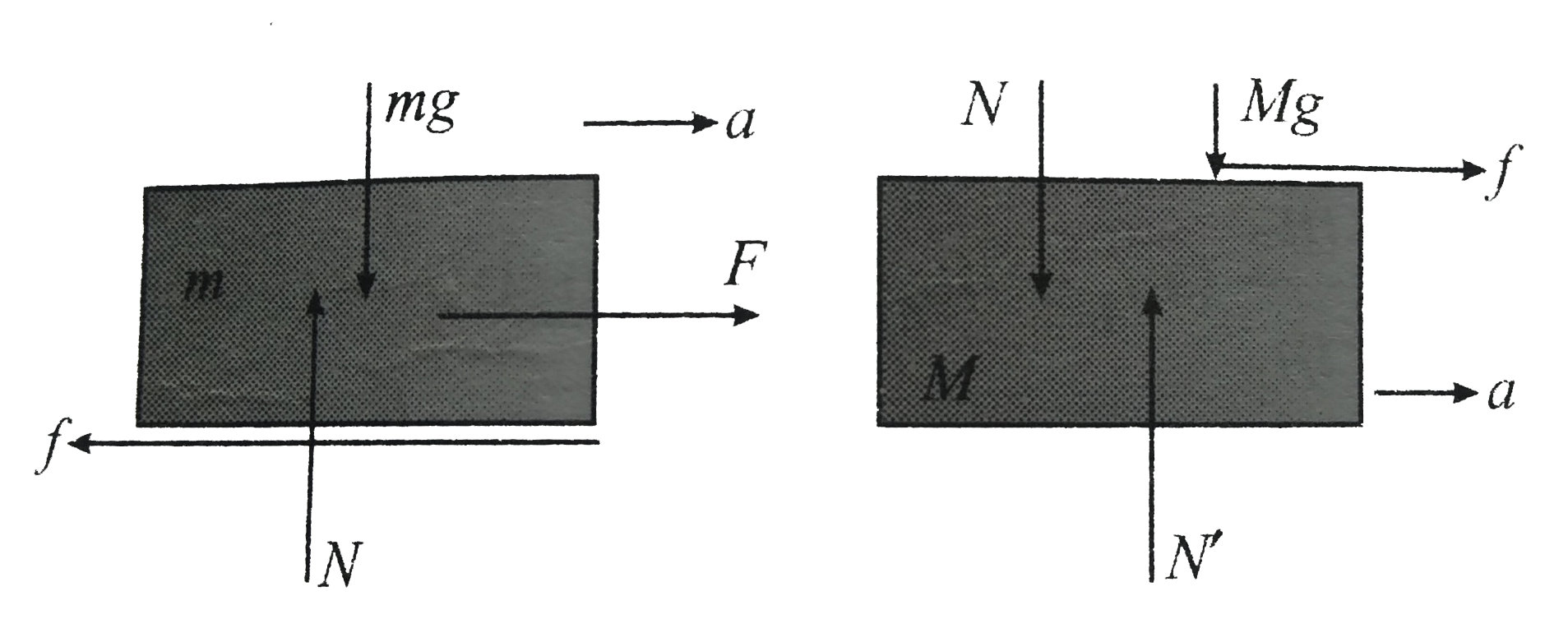
Let the system move together , then `a = (F)/((M + m))`
`FBD` of `m` and `M`
From `FBD` of `M : f = ma = M((F)/(M + m))` ….(i)

As there is no sliding between `M` and `m`
` M((F)/(M + m))le mu_(s) mg`
`rArr F le mu_(s)(m)/(M)(M + m)g`
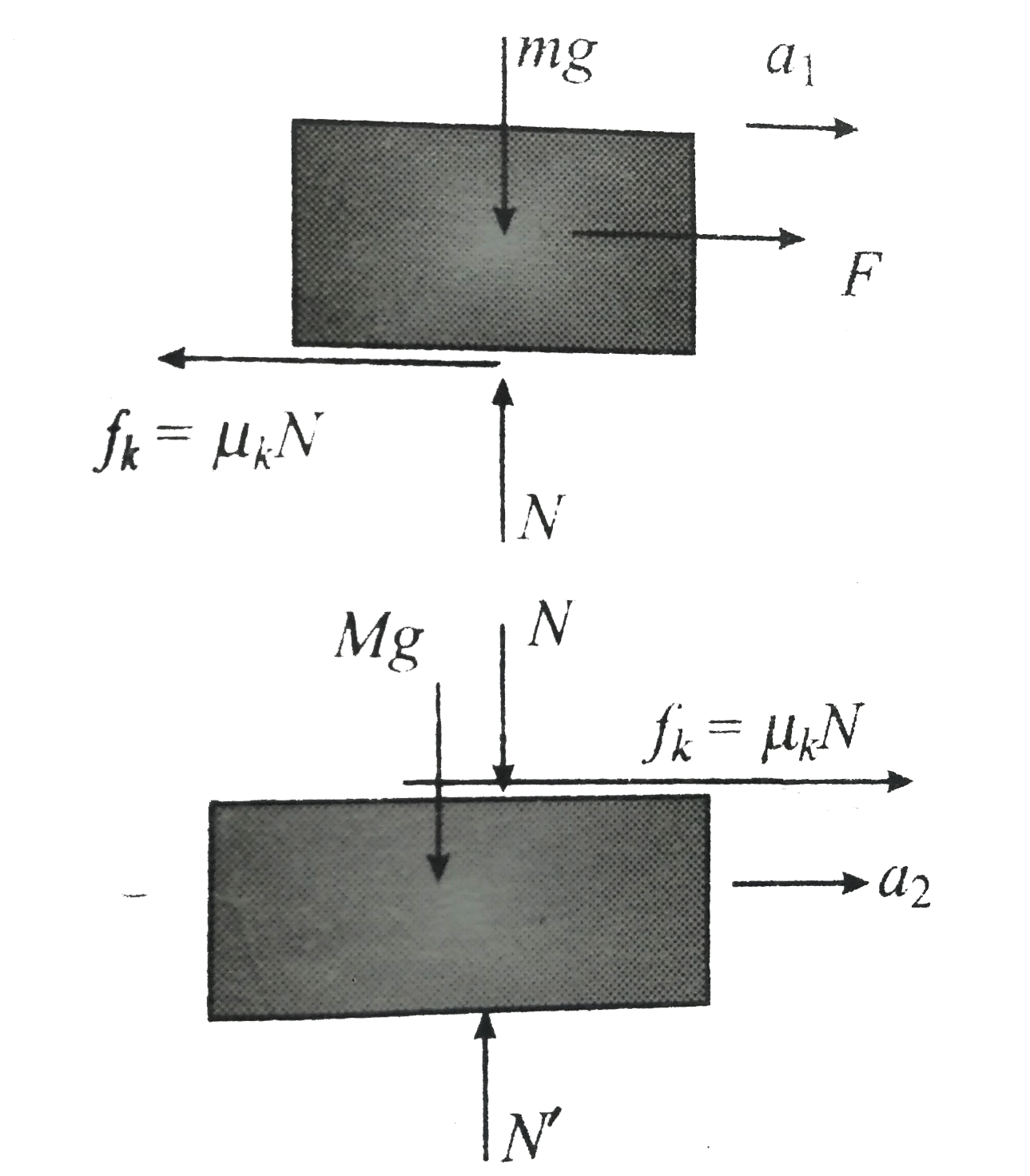
If `F gt mu_(s)(m)/(M)(M + m)g` the relative sliding between the blocks starts . The friction force between the block will be of kinetic nature and both blocks will move with different accelerations.

Acceleration of `m. a_(1) = (F - mu_(s) mg)/(m)`
Acceleration of `M, a_(2) = (mu_(s) mg)/(M)`
Promotional Banner

Topper's Solved these Questions

  • NEWTON'S LAWS OF MOTION 2

    CENGAGE PHYSICS ENGLISH|Exercise Solved Examples|12 Videos
  • NEWTON'S LAWS OF MOTION 2

    CENGAGE PHYSICS ENGLISH|Exercise Exercise 7.1|25 Videos
  • NEWTON'S LAWS OF MOTION 1

    CENGAGE PHYSICS ENGLISH|Exercise Integer|5 Videos
  • PROPERTIES OF SOLIDS AND FLUIDS

    CENGAGE PHYSICS ENGLISH|Exercise INTEGER_TYPE|2 Videos