Home
Class 11
PHYSICS
(a) Find the acceleration of the two blo...

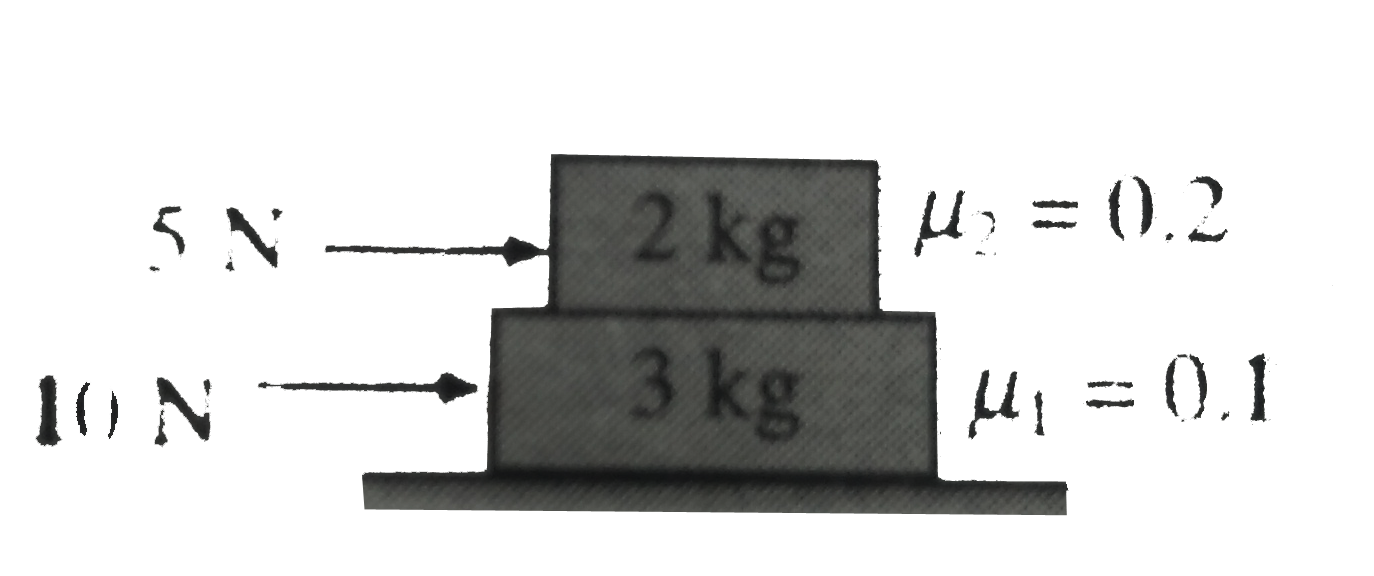
(a) Find the acceleration of the two block shown in figuer (b) Find the friction force between alll contant surface

Text Solution

Verified by Experts
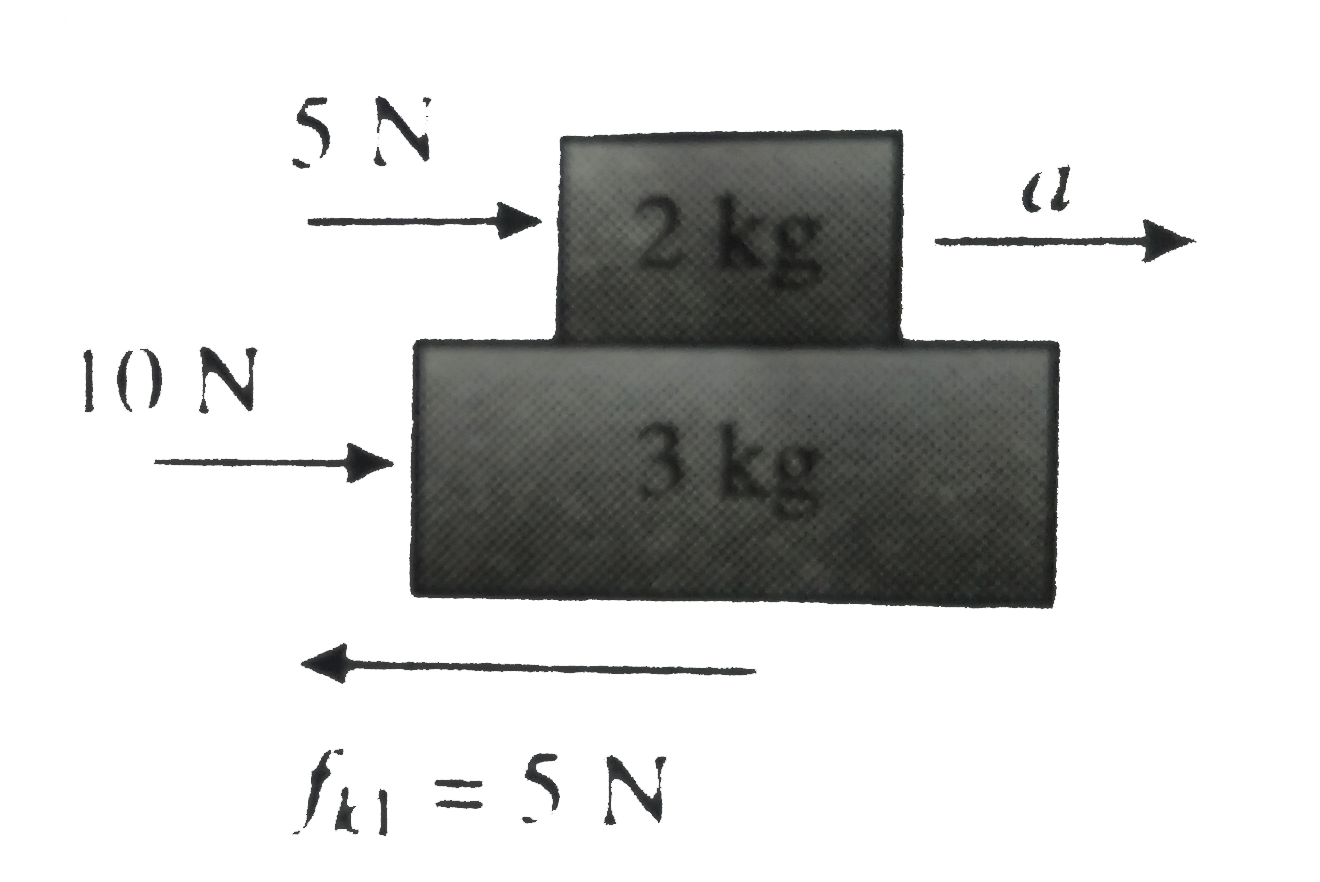
Let as first calculate the limiting and kinetic friction between varius surface between `3 kg` and ground

`f_(t_(1)) = f_(k_(1)) = mu_(1) (2 + 3) g = 0.1 xx 5 kg = 5 N`
Between `2 kg` and `3 kg`
` f_(t_(2)) = f_(k_(2)) = mu_(2)2g = 0.2 xx 2 kg = 4 N`
Let us first assume that both block move together with common acceleratia a.
`a = (5 + 10 - f_(k_(1)))/(2 + 3) rArr a = (15 - 5)/(5) = 2ms^(-2)`
Now let us see how much friction is required between 2 and `3 kg` for common acceleration a
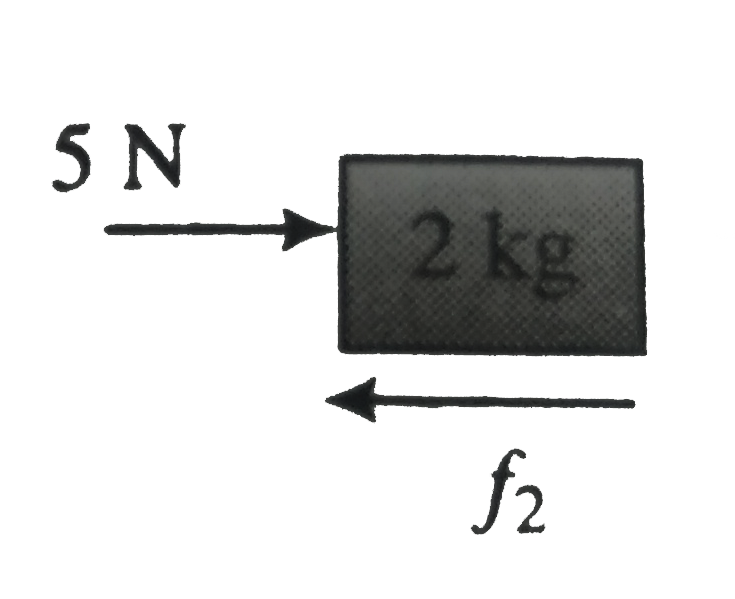
`5 - f_(2) = 2a rArr 5 - f_(2) = 2 xx 2 rArr f_(2) = 1 N`
Since `f_(2) lt f_(t_(2))`

1. Both blocks will move together with common acceleration `a = 2 ms^(-2)`
Friction between `2 kg` and `3 kg = f_(2) = 1 N` friction between `3 kg` and ground `= f_(k_(1) = 5 N`
Promotional Banner

Topper's Solved these Questions

  • NEWTON'S LAWS OF MOTION 2

    CENGAGE PHYSICS ENGLISH|Exercise Solved Examples|12 Videos
  • NEWTON'S LAWS OF MOTION 2

    CENGAGE PHYSICS ENGLISH|Exercise Exercise 7.1|25 Videos
  • NEWTON'S LAWS OF MOTION 1

    CENGAGE PHYSICS ENGLISH|Exercise Integer|5 Videos
  • PROPERTIES OF SOLIDS AND FLUIDS

    CENGAGE PHYSICS ENGLISH|Exercise INTEGER_TYPE|2 Videos

Similar Questions

Explore conceptually related problems

Find the acceleration of the block and magnitude and direction of frictional force between block A and table, if block A is pulled towards Left with a force of 50 N.

Find the accelerations of rod A and wedge B in the arrangement shown in figure if the ratio of the mass of the wedge to that of the rod equals eta , and the friction between all contact surfaces is negligible.

Find the acceleration of the two blocks . The system is initialy at rest and the friction are as shown in fig .Given m_(A) = m_(B) = 10 kg

A system of two blocks is placed on a rought horizontal surface as shown in figure below The coefficient of staic and kinetic friction at two surfaces are shown A force F is horizontal applied on the upper block as shown .Let f_(1) ,f_(2) represent the frictional force between upper and lower surface of contact respectively and a_(1),a_(2) represent the acceleration of 3kg and 2kg block respectively For relative motion to be there between two blocks the minimum value of F should be

Find the acceleration of block B as shown in fig. (a) and (b) relative to block A and relative to ground if block A is moving toward right with acceleration a.

A system of two blocks is placed on a rought horizontal surface as shown in figure below The coefficient of staic and kinetic friction at two surfaces are shown A force F is horizontal applied on the upper block as shown .Let f_(1) ,f_(2) represent the frictional force between upper and lower surface of contact respectively and a_(1),a_(2) represent the acceleration of 3kg and 2kg block respectively For F= 12N mark the correct option

Two block of masses m_(1) and m_(2) are placed side by side on a smooth horizontal surface as shown in fig. A horizontal force F is applied on the block . (a) Find the acceleration of each block. (b) Find the normal reaction between the two blocks.

Two blocks A and B of the same mass and surface finish are sliding on the same surface. Area of contact of A is twice that of the B. The frictional force between A and the surface is

A 2kg block is placed over a 5kg block and both are placed on a smooth horizontal surface. The coefficient of friction between the blocks is 0.10. Find the acceleration of the two blocks if a horizontal force of 14N is applied to the upper block (g = 10ms^(-2) ).

In the sitution shown in figure there is no friction between 2 kg and ground. a. For what maximum value of force F can all three blocks move together? b. Find the value of force F at which sliding starts at other rough surfaces. c. Find acceleration of all blocks, nature and value of friction force for the following values of force F (i) 10N (ii) N and (iii) 25 N