Home
Class 11
PHYSICS
The coefficient of friction between the ...

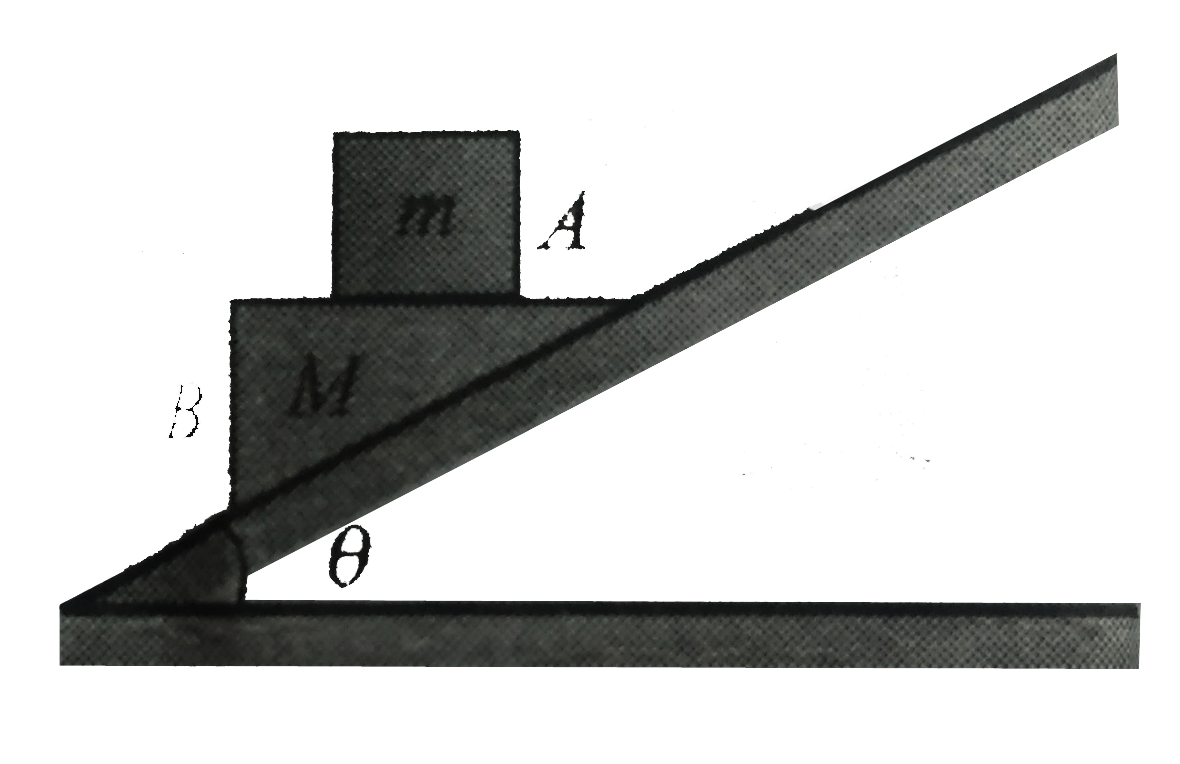
The coefficient of friction between the block `A` of mass `m` and the triangular wedge `B` of mass `M` is `mu`. There in no friction between the wedge and the plane if the system (block `A+` wedge `B)` is released so that there is no stiding between `A` and `B` find the inclination `theta`

Text Solution

Verified by Experts
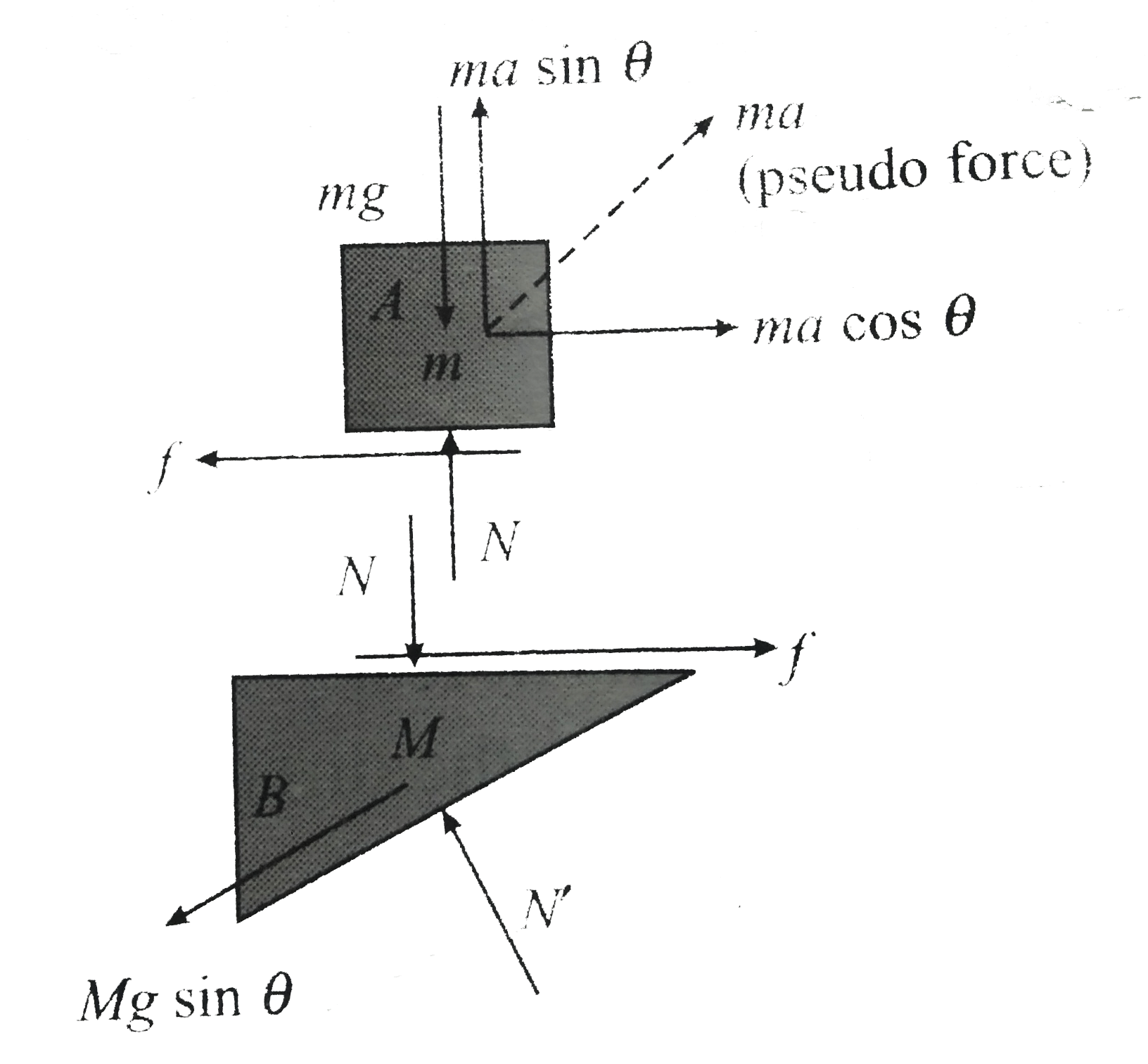
Acceleration of the `(A + B)`down the plane `= g sin theta` .In both the blockand weight , friction between then will static . The block `A` is at rest w.t.t. wedge `B`

From `FBD` of `A` :
`N = mg - ma sin theta `
`f = ma cos theta`
For no sliding between `A` and `B` .
`f lt mu N`
` mg sin theta .cos theta lt mu(mg - mg sin ^(2) theta)`
or `mg sin theta .cos theta lt mu mg - mg (1 - sin ^(2) theta)`
`sin theta cos theta lt mu cos^(2)theta`
` rArr tan theta lt mu` or `theta = tan^(-1)(mu)`
Promotional Banner

Topper's Solved these Questions

  • NEWTON'S LAWS OF MOTION 2

    CENGAGE PHYSICS ENGLISH|Exercise Solved Examples|12 Videos
  • NEWTON'S LAWS OF MOTION 2

    CENGAGE PHYSICS ENGLISH|Exercise Exercise 7.1|25 Videos
  • NEWTON'S LAWS OF MOTION 1

    CENGAGE PHYSICS ENGLISH|Exercise Integer|5 Videos
  • PROPERTIES OF SOLIDS AND FLUIDS

    CENGAGE PHYSICS ENGLISH|Exercise INTEGER_TYPE|2 Videos

Similar Questions

Explore conceptually related problems

The coefficient of friction between block of mass m and 2m is mu=2tantheta . There is no friction between block of mass 2 m and inclined plane. The maximum amplitude of the two block system for which there is no relative motion between both the blocks is

The coefficient of friction between block of mass m and 2m is mu=2tantheta . There is no friction between block of mass 2 m and inclined plane. The maximum amplitude of the two block system for which there is no relative motion between both the blocks is

Block A of mass m and block B of mass 2m are placed on a fixed triangular wedge by means of a light and inextensible string and a frictionless pulley as shown in fig . The wedge is inclined at 45^(@) to the horizontal on both sides . The coefficient of friction between the block A and the wedge is 2//3 and that between the block B and the wedge is 1//3 .If the system of A and B is released from rest then find . a. the acceleration of A b. tension in the string c.the magnitude and direction of the frictional force acting on A

a Block of mass m is placed on a wedge of mass M there is no friction between the block and the wedge .The minmum coefficient of friction between the wedge and the gound so that wedge does not move is,

A wedge B of mass 2 m is placed on a rough horizontal suface. The coefficient of friction between wedge and the horizontal surface is mu_(1) . A block of mass m is placed on wedge as shown in the figure. The coefficient of friction between block and wedge is mu_(2) . The block and wedge are released from rest. Q. Suppose the inclined surface of the wedge is at theta=37^(@) angle from horizontal and mu_(2)=0.9 then the wedge:

A wedge B of mass 2 m is placed on a rough horizontal suface. The coefficient of friction between wedge and the horizontal surface is mu_(1) . A block of mass m is placed on wedge as shown in the figure. The coefficient of friction between block and wedge is mu_(2) . The block and wedge are released from rest. Q. Suppose the inclined surface of the wedge is at theta=37^(@) from angle from horizontal and mu_(2)=0 are wedge will remain in equilibrium if

If the coefficient of friction between A and B is mu , the maximum acceleration of the wedge A for which B will remain at rest with respect to the wedge is

If the coefficient of friction between A and B is mu , the maximum acceleration of the wedge A for which B will remain at rest with respect to the wedge is

A block A of mass M rests on a wedge B of mass 2M and inclination theta . There is sufficient friction between A and B so that A does not slip on B. If there is no friction between B and ground, the compression in spring is

A block A of mass M rests on a wedge B of mass 2M and inclination theta . There is sufficient friction between A and B so that A does not slip on B. If there is no friction between B and ground, the compression in spring is

