Home
Class 11
PHYSICS
The pulley of the system shown in Fig i...

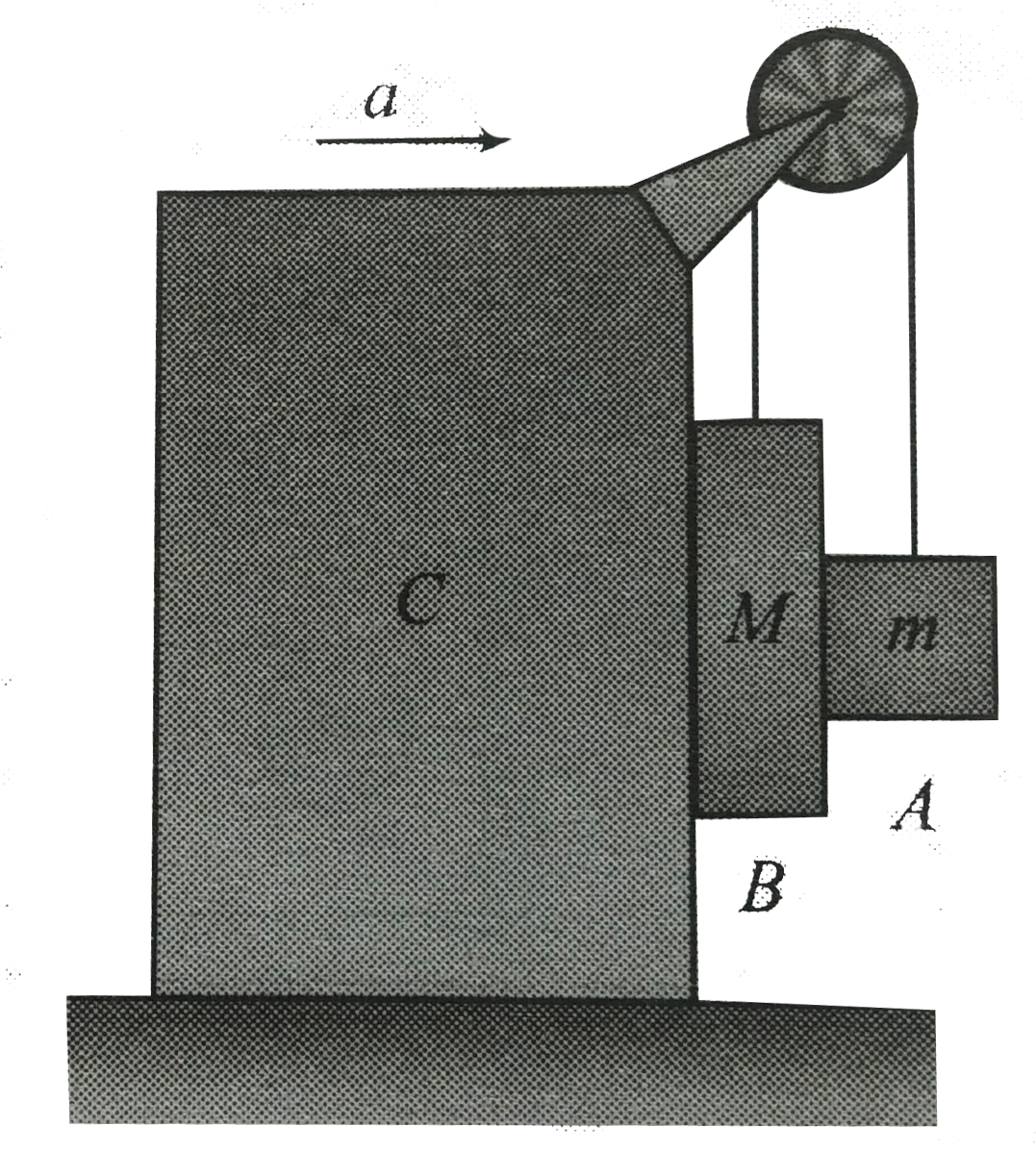
The pulley of the system shown in Fig is massless and frictionless and thread and thread is inextensible Then horizontal surface over which block `C` is smooth while for all the remaining surface is `mu`

Calculate minimum acceleration a with which the system should be moved to the right so that suspented block `A`(mass m ) and `B` (mass `M` and `M gt m )`can remain stationary relative to `C `

Text Solution

Verified by Experts
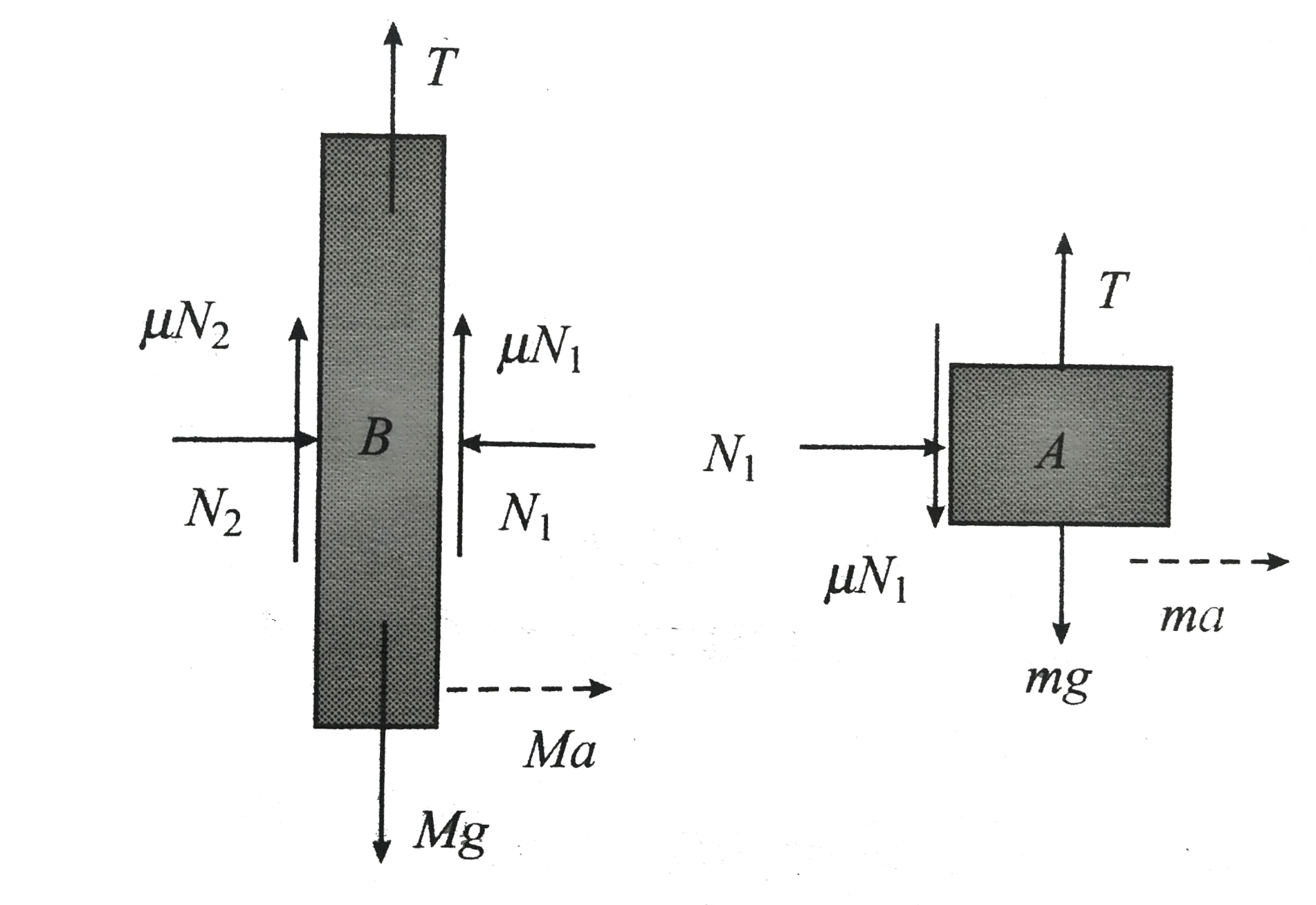
Since blocks `A and B` are stationary relative to `C` It means their acceleration will also be equal to a (rightward). Since mass `m` of block `A` is less than mass `M` of block `B` hence block `A` has tendency to slip upward while `B` has tendency to slip downward .
Since `A` has to slip upward therefore on its left surface will act downward and friction on both the surface of block `B` will act upward because it has tendency to slip downward hence , their free body diagram will be as shown in fig

For horizontal forces on `A ,N_(1) = ma`
For verticle equillibruim of `A`,
`T = (mu N_(1) + mg ) = (mu ma + mg)` ....(i)
For horizontal forces on `B N_(2) - N_(1) = Ma`
or `N_(2)= (m + M)a`
For verticle equillibruim of `B`
`T + mu N_(1) + mu N_(2) = Mg`
`(mu ma + mg) + mu ma + mu(m + M)a= Mg`
`a = (M - m)/(mu(3m + M)).g`
Promotional Banner

Topper's Solved these Questions

  • NEWTON'S LAWS OF MOTION 2

    CENGAGE PHYSICS ENGLISH|Exercise Solved Examples|12 Videos
  • NEWTON'S LAWS OF MOTION 2

    CENGAGE PHYSICS ENGLISH|Exercise Exercise 7.1|25 Videos
  • NEWTON'S LAWS OF MOTION 1

    CENGAGE PHYSICS ENGLISH|Exercise Integer|5 Videos
  • PROPERTIES OF SOLIDS AND FLUIDS

    CENGAGE PHYSICS ENGLISH|Exercise INTEGER_TYPE|2 Videos

Similar Questions

Explore conceptually related problems

In the arrangement , shown below pulleys are massless and frictionless and threads are inextensible , block of mass m_(1) will remain at rest if

In the arrangement shown below, pulleys are mass-less and friction-less and threads are in-extensible. Block of mass m_(1) will remain at rest if :

In the arrangement shown in fig. pulleys are smooth and massless. Threads are massless and inextensible. Find acceleration of mass m_(1) .

For the following system shown assume that pulley is frictionless, string is massless (m remains on M), Q. The acceleration of the block A is

For the following system shown assume that pulley is frictionless, string is massless (m remains on M), Q. The acceleration of the block A is

A block of mass m is placed on the inclined sufrace of a wedge as shown in fig. Calculate the acceleration of the wedge and the block when the block is released. Assume all surfaces are frictionless.

Two masses m and m' are tied with a thread passing over a pulley, m' is on a frictionless horizontal surface and m is hanging freely. If acceleration due to gravity is g, the acceleration of m' in this arrangment will be :

A block of mass m is placed on the top of another block of mass M as shown in the figure. The coefficient of friction between them is mu . The maximum acceleration with which the block M may move so that m also moves along with it is

In the system shown in fig. m_(1) gt m_(2) . The system is held at rest by thread BC. Now thread BC is burnt. Answer the following: Just after burning the thread, what is the acceleration of m_(2) ?

In the system shown in fig., m_(A)=4m , m_(B)=3m , and m_(c)=8m . Friction is absent everywhere. String is inextensible and light. If the system is released from rest, then Acceleration of Block B is

