Home
Class 11
PHYSICS
Find the acceleration a(1) , a(2) and a(...

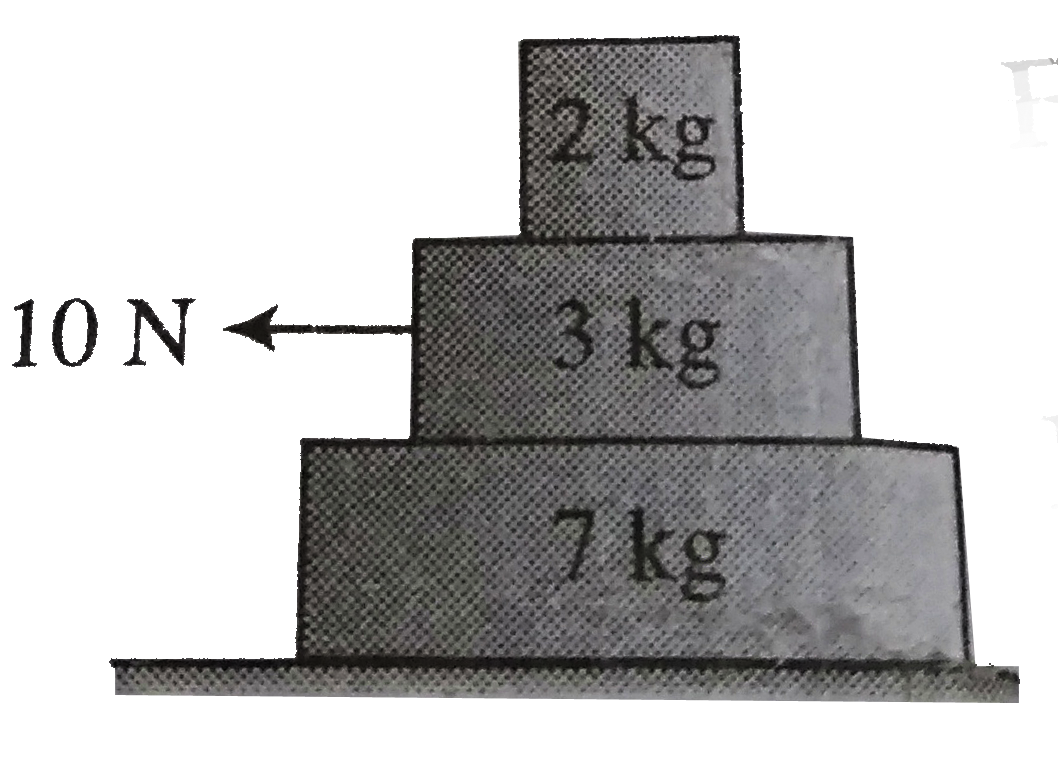
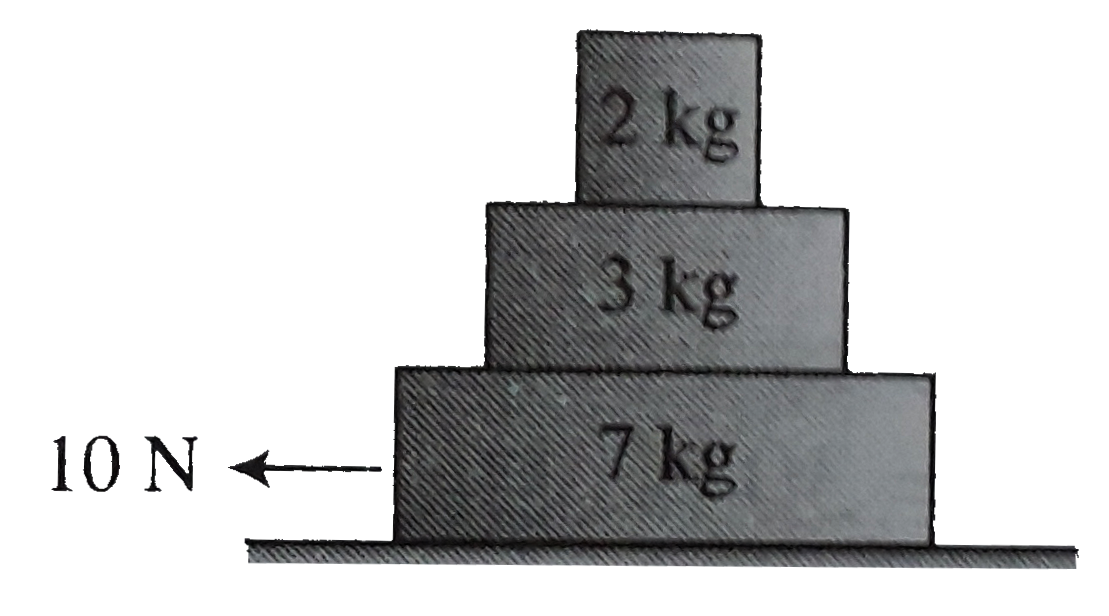
Find the acceleration `a_(1) , a_(2) and a_(3)` of the three blocks shown in Fig if a horizontal force of `10 N` is applied on

(a) `2 kg` blocks, (b) `3 kg` blocks and ( c) `7 kg` blocks (Take `g = 10 ms^(-2))`

Text Solution

Verified by Experts
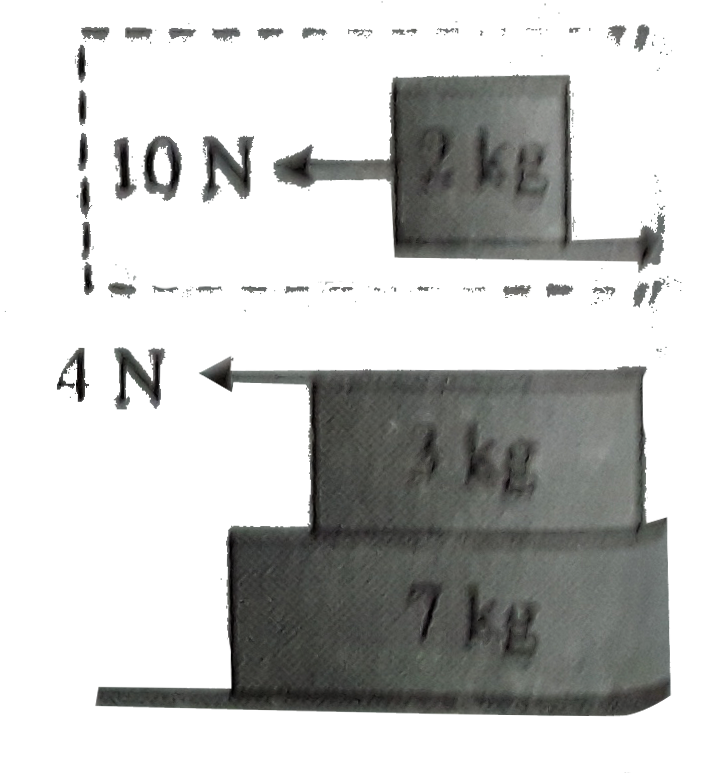
When force of `10N` is applied on `2 kg` blocks . The limiting friction force between `2 kg and 3 kg` blocks
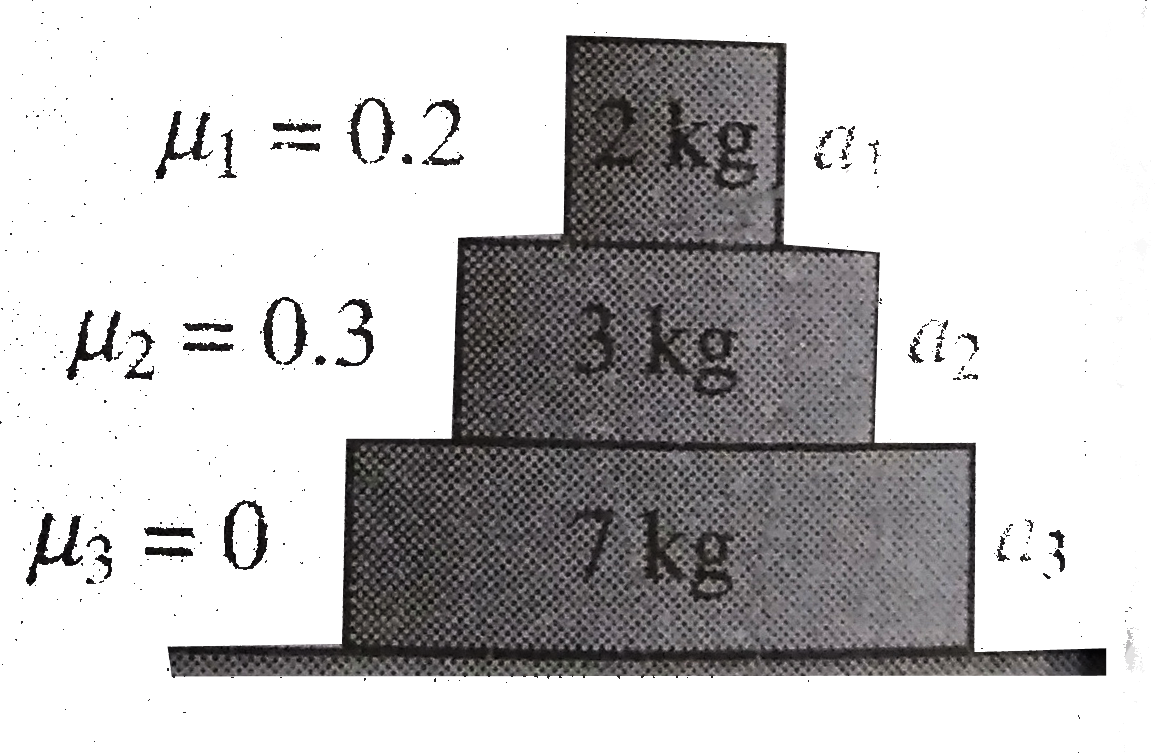
`f_(l_(1)) = 0.2 xx 2 kg = 0.2 xx 2 xx 10= 4 N`
The limiting friction force between`3 kg` and `7 kg`
`f_(l_(2)) = 0.3 xx 5g`
`= 0.3 xx 5 xx 10 = 15 N`
After proper analysis , we find that `2 kg ` will slip over `3 kg` but `3 kg` will not slip over `7 kg`
Thus the we have `a_(1) = (10 - 4)/(2) = 3ms^(-2)`
`a_(2) = a_(3)= (4)/(3 +7) = 0.4ms^(-2)`
Since `a_(1)` is coming out to be greater than `a_(2), 2 kg` will slip over `3 kg`

b. When force of `10 N` is applied on `3 kg` blocks
Let us assume that all these blocks move together with common acceleration a then

`a = (10)/(2 xx 3 + 7) = (5)/(6) ms^(-2)`
Under this assumption
Friction between `2 kg` and `3 kg`
`f_(1) = 2a = (2 xx 5)/(6) = (5)/(3)N lt f_(l_(1))`
Friction between `3 kg` and `7 kg `
`f_(2) = 7a = (7 xx 5)(6) (35)/(3)N lt f_(l_2)`
Hence, no slipping occut any where
c. When force of `10 N` is applied on `7 kg` block. The acceleration of the whole system

`a = (10)/(2 xx 3 + 7) = (5)/(6) ms^(-2)`
The pseudo force on `2 kg` block `= (2 xx 5)/(6) = (5)/(3)N` ,which is less than the friction forces between `2 kg` and `3 kg` blocks so they move together.
Now check whether `2 kg` and `3 kg ` move together over `7 kg` blocks The pseudo force on `( 2+ 3) kg` is `5 xx (5)/(6) = (25)/(6)N` , which is also less than friction force between ` 3kg` and `7 kg` blocks move with a common acceleration of `5//6ms^(-2)` Therefore
`a = a_(1) = a_(2) = a_(3) (10)/(2 + 3 + 7)= (5)/(6)ms^(-2)`
Promotional Banner

Topper's Solved these Questions

  • NEWTON'S LAWS OF MOTION 2

    CENGAGE PHYSICS ENGLISH|Exercise Exercise 7.1|25 Videos
  • NEWTON'S LAWS OF MOTION 2

    CENGAGE PHYSICS ENGLISH|Exercise Exercise 7.2|16 Videos
  • NEWTON'S LAWS OF MOTION 2

    CENGAGE PHYSICS ENGLISH|Exercise Integer type|1 Videos
  • NEWTON'S LAWS OF MOTION 1

    CENGAGE PHYSICS ENGLISH|Exercise Integer|5 Videos
  • PROPERTIES OF SOLIDS AND FLUIDS

    CENGAGE PHYSICS ENGLISH|Exercise INTEGER_TYPE|2 Videos

Similar Questions

Explore conceptually related problems

Find the relation between acceleration of blocks a_(1), a_(2) and a_(3) .

Three blocks of masses 5 kg, 3 kg and 2 kg are placed on a rough surface as shown in figure. Coefficient of friction between block and surface is same for all the blocks and is equal to mu = 0.2 . A horizontal force of 15 N is applied on 5 kg block. The force exerted by 3 kg block on 2 kg block is : (g = 10 m/ s^(2) )

A 3 kg block is placed over a 10 kg block and both are palced on a smooth horizontal surface. The coefficient of friction between the block is 0.2 . If a horizontal force of 20 N is applied to 3 kg block, accelerations of the two block in ms^(-2) are (take, g=ms^(-2) )

Three blocks of masses 3kg ,2kg and 1kg are placed side by side on a smooth surface as shown in figure. A horizontal force of 12N is applied on 3kg block. Find the net force on 2kg block.

Three blocks of masses 3kg ,2kg and 1kg are placed side by side on a smooth surface as shown in figure. A horizontal force of 12N is applied on 3kg block. Find the net force on 2kg block.

Two blocks A and B of masses 10 kg and 15 kg are placed in contact with each other rest on a rough horizontal surface as shown in the figure. The coefficient of friction between the blocks and surface is 0.2. A horizontal force of 200 N is applied to block A. The acceleration of the system is ("Take g"=10ms^(-2))

A 5 kg block is placed on the top of a 15 kg block as shown in figure . A horizontal force of 60 N is applied to the 15 kg block and the 5kg block is tied to the wall . The coefficient of friction between moving surfaces is 0.2 (a) Draw the free body diagram for each block w.r.t ground and identify the action reaction forces between two blocks . (b) Determine the tension in the string and magnitude of the acceleration of the 15 kg block .

2gk block is kept on 1kg block as shown . The friction between 1kg block and fixed surface is absent and the coefficient of friction between 2kg block is mu=0.1 . A constant horizontal force F=4N is applied on 1kg block. If the work done by the friction on 1 kg block in 2s is -X J , then find X . Take g=10m//s^(2) .

The acceleration of the 10 kg mass block shown in the figure is : -

Find the acceleration of the two blocks . The system is initialy at rest and the friction are as shown in fig .Given m_(A) = m_(B) = 10 kg