Home
Class 11
PHYSICS
Find the acceleration of the two blocks ...

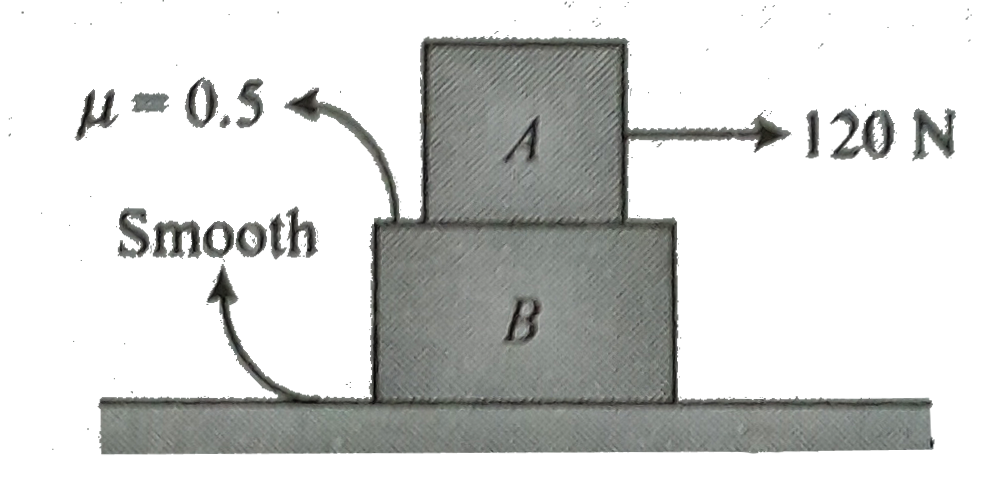
Find the acceleration of the two blocks . The system is initialy at rest and the friction are as shown in fig .Given `m_(A) = m_(B) = 10 kg`

Text Solution

Verified by Experts
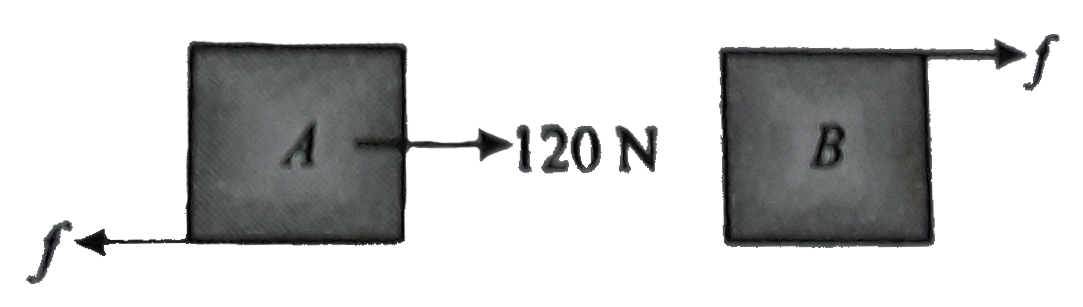
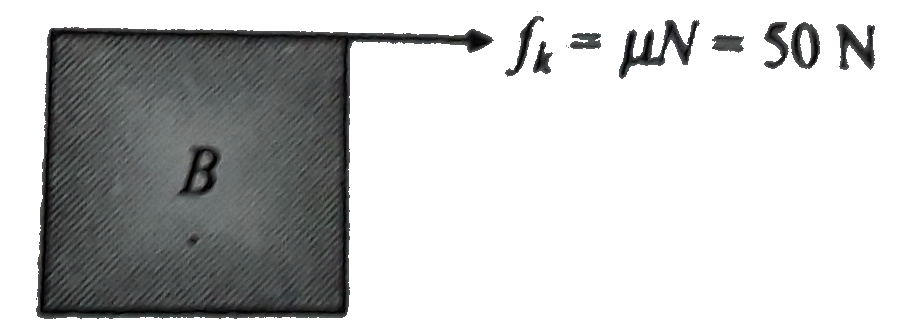
`f_(max) = 50 N`

If they move together
`a = (120)/(20) = 6 ms^(-2)`
Check friction on B

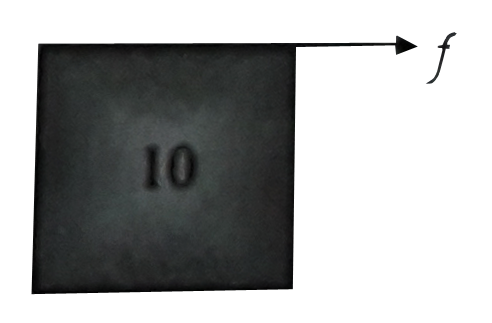
`f_(B) = 10 xx 6 = 60 N`
`60N gt 50 N`(therefore required gt available)
Hence they will not move together

Hence they move separately so kinetic friction is involved

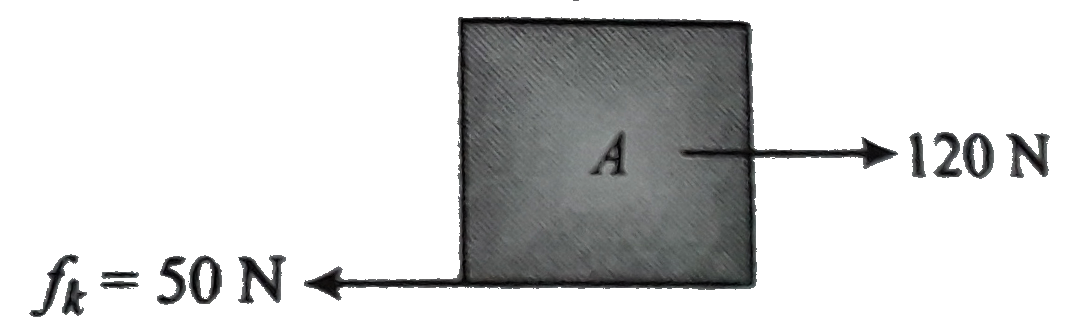
`:. f or a_(A) = (120 - 50)/(10) = 7.0 ms^(-2) rArr a_(B) = (50)/(10) = 5 ms^(-2) `
Promotional Banner

Topper's Solved these Questions

  • NEWTON'S LAWS OF MOTION 2

    CENGAGE PHYSICS ENGLISH|Exercise Exercise 7.3|27 Videos
  • NEWTON'S LAWS OF MOTION 2

    CENGAGE PHYSICS ENGLISH|Exercise Subjective|21 Videos
  • NEWTON'S LAWS OF MOTION 2

    CENGAGE PHYSICS ENGLISH|Exercise Exercise 7.1|25 Videos
  • NEWTON'S LAWS OF MOTION 1

    CENGAGE PHYSICS ENGLISH|Exercise Integer|5 Videos
  • PROPERTIES OF SOLIDS AND FLUIDS

    CENGAGE PHYSICS ENGLISH|Exercise INTEGER_TYPE|2 Videos

Similar Questions

Explore conceptually related problems

Find the acceleration of the two blocks The system initally at rest and the friction coefficient are as shown in fig 7.140? Also find maximum F for which two blocks will move togather Given m_(A) = 10 kg and m_(B) = 20 kg

Two blocks each of mass M are resting on a frictionless inclined plane as shown in fig then:

In the given figure the co- efficient of friction between the block and the incline plane is '1'. The acceleration with which the system should be accelerated so that the friction between the block and the wedge becomes zero ( g = 10 m//s^(2) ) is

Given the setup shown in Fig Block A, B and C have masses m_(A)= M and m_(B) =m_(C) = m . The strings are assumed maseless and unstreichable, and the pulleys frictionless .There is no friction between block B and the support table, but there is friction between blocks B and C , denoted by a given coefficient mu a . In terms the given find (i) the acceleration of block A and B b. Suppose the system is released from rest with block C near the right end of block B as shown in the above figure. If the the length L of block B is given, what is the speed of block C as it reached the left end of block B ? Tear the size of C as small c. If the mass of block A is less then some critical value, the blocks will not accelerate when released from rest. Write down as expression for that critical mass.

The acceleration of 3 kg block in the arrangement shown in the diagram ,when the given system is released from rest is

In Fig. initialy the system is at rest .Find out minimum value of F for which sliding start between the two blocks Given m_(A) = 10 kg and m_(B) = 20 kg

In the figure shown co-efficient of friction between the block B and C is 0.4. There is no friction between the block C and hte surface on which it is placed. The system of blocks is released from rest in the shown situation. Find the distance moved by the block C when block A descends through a distance 2m. Given masses of the blocks are m_(A)=3 kg, m_(B)=5 kg and m_(C)=10 kg .

Two blocks of masses 10 kg and 9 kg are connected with light string which is passing over an ideal pulley as shown in figure. If system is released from rest then the acceleration of 9 kg block at the given instant is about (Assume all the surfaces are smooth and g = 10 m/s^2 )

Find the acceleration of block B as shown in fig. (a) and (b) relative to block A and relative to ground if block A is moving toward right with acceleration a.

According to the principle of conservation of linear momentum, if the external force acting on the system is zero, the linear momentum of the system will remain conserved. It means if the centre of mass of a system is initially at rest, it will remain, at rest in the absence of external force, that is, the displacement of centre of mass will be zero. Two blocks of masses 'm' and '2m' are placed as shown in Fig. There is no friction anywhere. A spring of force constant k is attached to the bigger block. Mass 'm' is kept in touch with the spring but not attached to it. 'A' and 'B' are two supports attached to '2m' . Now m is moved towards left so that spring is compressed by distance 'x' and then the system is released from rest. Find the relative velocity of the blocks after 'm' leaves contact with the spring.

CENGAGE PHYSICS ENGLISH-NEWTON'S LAWS OF MOTION 2-Exercise 7.2
  1. A block of mass 1 kg is horizontal thrown with a velocity of 10 ms^(-1...

    Text Solution

    |

  2. In Fig. initialy the system is at rest .Find out minimum value of F fo...

    Text Solution

    |

  3. Find the acceleration of the two blocks . The system is initialy at re...

    Text Solution

    |

  4. Find the acceleration of the two blocks . The system is initialy at re...

    Text Solution

    |

  5. Find the acceleration of the two blocks The system initally at rest a...

    Text Solution

    |

  6. The block A is kept over a plan B. The maximum horizontal acceleration...

    Text Solution

    |

  7. Figure shown a small block A of mass m kept at the left end of a plank...

    Text Solution

    |

  8. A small block of mass m is placed on a plank of masss M .The block is ...

    Text Solution

    |

  9. Two block A and B are arrenged as shown in figure (m(A) = 5 kg and m(B...

    Text Solution

    |

  10. In Fig block 1 is placed on top of block 2 .Both of then have a mass o...

    Text Solution

    |

  11. A mass of 80 kg stands on a horizontal weight machine of negligible ma...

    Text Solution

    |

  12. A block of mass 1 kg is horizontal thrown with a velocity of 10 ms^(-1...

    Text Solution

    |

  13. In figure the coefficient of friciton between the floor and the block ...

    Text Solution

    |

  14. Find minimum normal force to be each hand to hold there identical boo...

    Text Solution

    |

  15. A plank of mass M is placed on a rough horizontal surface and a consta...

    Text Solution

    |

  16. A man of mass m is moving with a constant acceleration a w.r.t plank i...

    Text Solution

    |