Home
Class 11
PHYSICS
A particle is projected with a speed v(0...

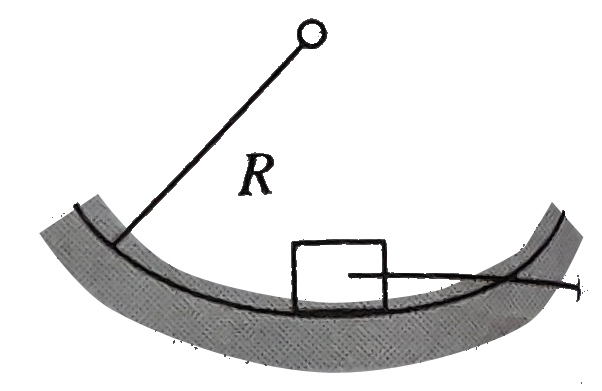
A particle is projected with a speed `v_(0) = sqrt(gR)`. The coefficient of friction the particle and the hemi- spherical plane is `mu = 0.5` Then , the acceleration of the partical is

A

`g`

B

`(sqrt(5)g)/(2)`

C

`sqrt(2)g`

D

none of these

Text Solution

Verified by Experts

The correct Answer is:
B

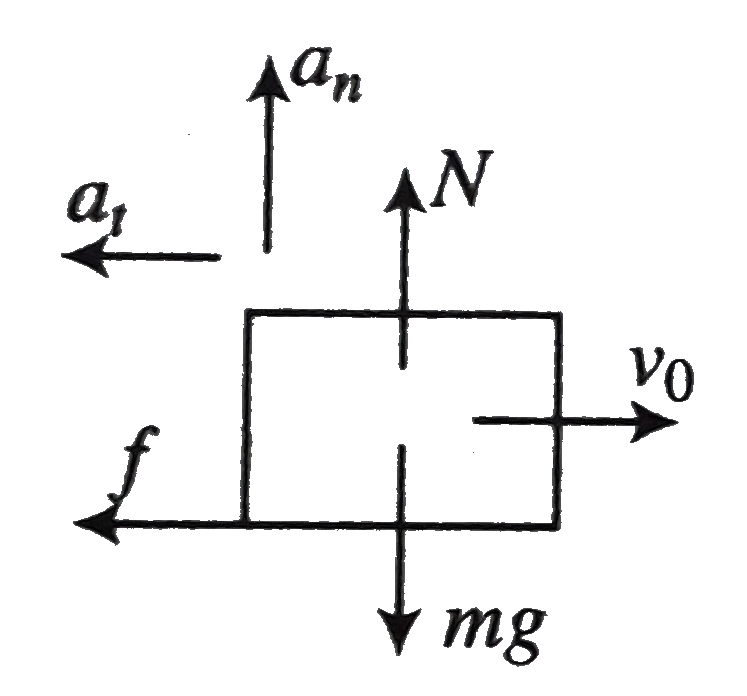
When the particle comes with the contact of hemisphere surface it will slide and friction will be kinetic nature This kinetic friction will provided tangential acceleration to the particle Tangential acceleration of the particle

`a_(1) = (mu mg)/(m) = mu mg = (g)/(2)larr`
Normal acceleration of the particle
`a_(n) = (v^(2))/(R ) = (gR)/(R ) = g uarr`
Net acceleration of the particle
`a_(net) = sqrt(a_(1)^(2) + a_(n)^(2) = sqrt((g^(2))/(4) + g^(2)) = (sqrt(5)g)/(2) `
Promotional Banner

Topper's Solved these Questions

  • NEWTON'S LAWS OF MOTION 2

    CENGAGE PHYSICS ENGLISH|Exercise Multiple Correct|2 Videos
  • NEWTON'S LAWS OF MOTION 2

    CENGAGE PHYSICS ENGLISH|Exercise Linked Comprehension|52 Videos
  • NEWTON'S LAWS OF MOTION 2

    CENGAGE PHYSICS ENGLISH|Exercise Subjective|21 Videos
  • NEWTON'S LAWS OF MOTION 1

    CENGAGE PHYSICS ENGLISH|Exercise Integer|5 Videos
  • PROPERTIES OF SOLIDS AND FLUIDS

    CENGAGE PHYSICS ENGLISH|Exercise INTEGER_TYPE|2 Videos

Similar Questions

Explore conceptually related problems

A positively charged particle of mass m and charge q is projected on a rough horizontal x-y plane surface with z-axis in the vertically upward direction. Both electric and magnetic fields are acting in the region and given by vec E = - E_0 hat k and vec B= -B_0 hat k , respectively. The particle enters into the field at (a_0, 0, 0) with velocity vec v = v_0 hat j . The particle starts moving in some curved path on the plane. If the coefficient of friction between the particle and the plane is mu . Then calculate the (a) time when the particle will come to rest (b) distance travelled by the particle when it comes to rest.

A positively charged particle of mass m and charge q is projected on a rough horizontal x-y plane surface with z-axis in the vertically upward direction. Both electric and magnetic fields are acting in the region and given by vec E = - E_0 hat k and vec B= -B_0 hat k , respectively. The particle enters into the field at (a_0, 0, 0) with velocity vec v = v_0 hat j . The particle starts moving in some curved path on the plane. If the coefficient of friction between the particle and the plane is mu . Then calculate the (a) time when the particle will come to rest (b) distance travelled by the particle when it comes to rest.

A particle is projected in gravity with a speed v_0 . Using W-E theorem, find the speed of the particle as the function of vertical distance y.

A particle is placed at rest inside a hollow hemisphere of radius R . The coefficient of friction between the particle and the hemisphere is mu = (1)/sqrt(3) . The maximum height up to which the particle can remain stationary is

A particle is projected horizontally with a speed v_(0) at t = 0 from a certain point above the ground . What is the magnitude of tangential acceleration of the particle at t = t_(1) is ( Assume that the particle does not strike the ground between the time interval t = 0 to t = t_(1) )

A particle moves in a circle of radius 5 cm with constant speed and time period 0.2pis . The acceleration of the particle is

A particle is projected on an inclined plane with a speed u as shown in (Fig. 5.61). Find the range of the particle on the inclined plane. .

A sphere is projected up an inclined plane with a velocity v_(0) and zero angular velocity as shown. The coefficient of friction between the sphere and the plane is mu=tantheta .. Find the total time of rise of the sphere.

A wedge of mass M = 4m lies on a frictionless plane. A particle of mass m approaches the wedge with speed v. There is no friction between the particle and the plane or between the particle and the wedge. The maximum height climbed by the particle on the wedge is given by:

The v-s and v^(2)-s graph are given for two particles. Find the accelerations of the particles at s=0 . .

CENGAGE PHYSICS ENGLISH-NEWTON'S LAWS OF MOTION 2-Single Correct
  1. Two identical particles are attached at the end of a light string whic...

    Text Solution

    |

  2. A block of mass m is revolving in a smooth horizontal plane with a con...

    Text Solution

    |

  3. A particle is projected with a speed v(0) = sqrt(gR). The coefficient ...

    Text Solution

    |

  4. A car travels with constant speed on a circular road level ground in f...

    Text Solution

    |

  5. A block of mass m is projected on a smooth horizontal circular track w...

    Text Solution

    |

  6. In the figure shown q is in coulomb and t in second. At time t=1 s

    Text Solution

    |

  7. Consider the setup is of a Ferris wheel in an amusement part. The whee...

    Text Solution

    |

  8. Two blocks of masses m(1) and m(2) are connected through a massless in...

    Text Solution

    |

  9. In Fig if F = 4N , m= 2 kg M = 4 kg then

    Text Solution

    |

  10. A 20 kg blocks is placed on of 50 kg block as shown in figure An horiz...

    Text Solution

    |

  11. Find the acceleration of the two blocks . The system is initialy at re...

    Text Solution

    |

  12. Two rough blocks A and B ,A placed over B move with acceleration veca(...

    Text Solution

    |

  13. Mark the correct statement (s) regarding friction .

    Text Solution

    |

  14. A 3 kg block of wood is on a level surface where mu(s) = 0.25 and mu(s...

    Text Solution

    |

  15. A block is resting over a rough horizontal floor. At t = 0 a time -ve...

    Text Solution

    |

  16. Two blocks A and B of masses 5 kg and 2 kg respectively connected by a...

    Text Solution

    |

  17. The coefficient of friction between the two two blocks is 0.3 where as...

    Text Solution

    |

  18. A 10 kg block is placed on top of a 40 kg block as shown in figure .A ...

    Text Solution

    |

  19. A car moving along a circular track of radius 50.0m acceleration from ...

    Text Solution

    |

  20. A particle of m(1) moves in a circular path of radius R on a rotating ...

    Text Solution

    |

