Home
Class 11
PHYSICS
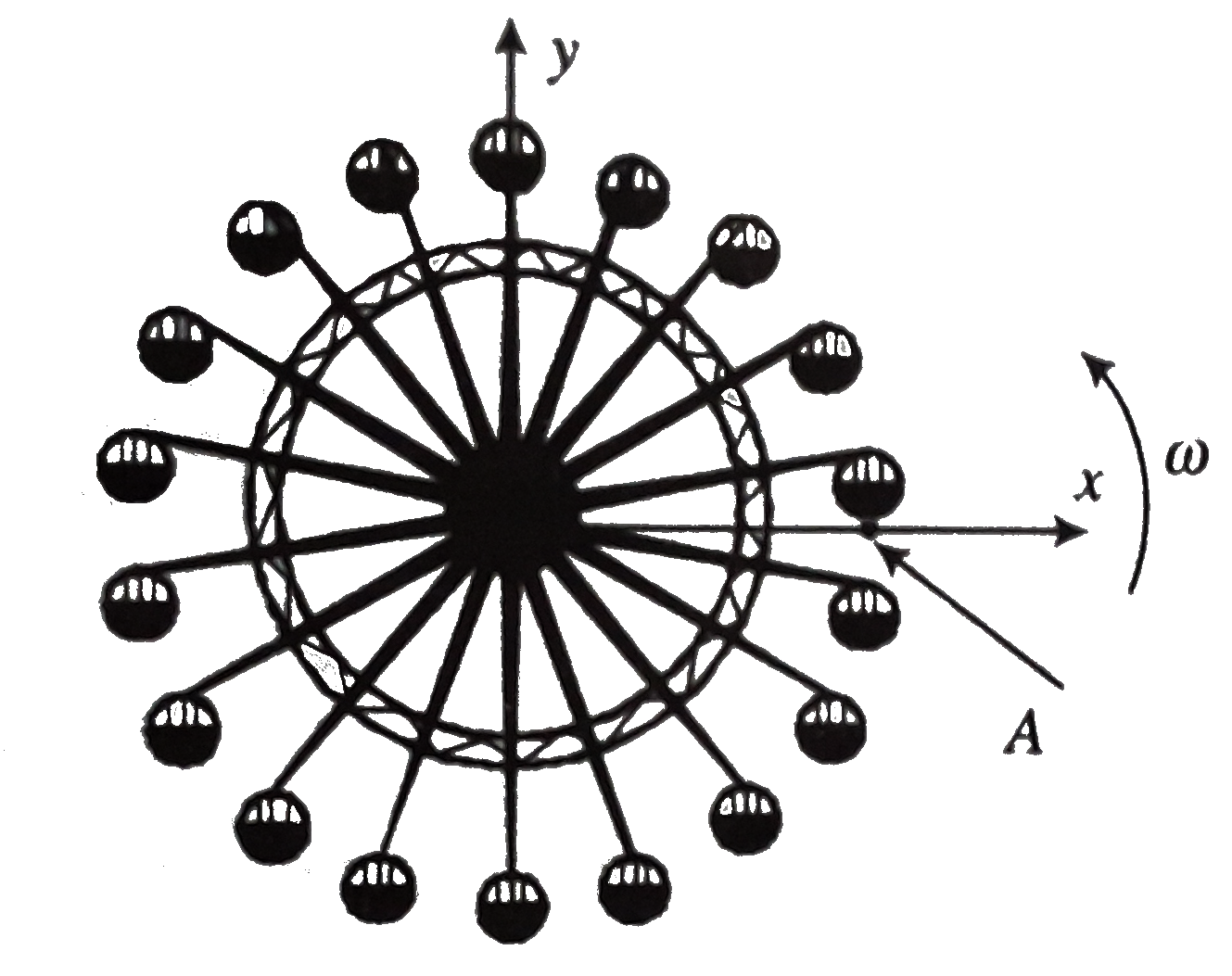
Consider the setup is of a Ferris wheel ...

Consider the setup is of a Ferris wheel in an amusement part. The wheel is turning in acounterclockwise manner Contrary i.e. parralel to the x- axis Determine the orienation of the normal to seat as it passes point A

A

parallel to the x- axis

B

in the first/third quadrants

C

parallel to the y- axis

D

in the second/fourth quadrants

Text Solution

Verified by Experts

The correct Answer is:

d

`F` is contrifogal force Net force is along AB so seat will so aligned along AB
Promotional Banner

Topper's Solved these Questions

  • NEWTON'S LAWS OF MOTION 2

    CENGAGE PHYSICS ENGLISH|Exercise Multiple Correct|2 Videos
  • NEWTON'S LAWS OF MOTION 2

    CENGAGE PHYSICS ENGLISH|Exercise Linked Comprehension|52 Videos
  • NEWTON'S LAWS OF MOTION 2

    CENGAGE PHYSICS ENGLISH|Exercise Subjective|21 Videos
  • NEWTON'S LAWS OF MOTION 1

    CENGAGE PHYSICS ENGLISH|Exercise Integer|5 Videos
  • PROPERTIES OF SOLIDS AND FLUIDS

    CENGAGE PHYSICS ENGLISH|Exercise INTEGER_TYPE|2 Videos

Similar Questions

Explore conceptually related problems

Your are riding on a Ferris wheel that is rotating with a constant speed . The car in which you are riding always maintain its correct upward orientation , it does not invert. a. What is the direction of the normal force on you form the seat when you are at the top of the wheel ? i. upward ii. downward .iii. impossible to determine b. From the same choices, what is the direction of the net force on you when you are at the top of the wheel?

A magnetic field is established by a circular current i of radius a. Find the magnetic field gradient (i.e. the derivative of the magnetic field induction vector) in the direction of the circular current's axis at a point whose distance from the centre of the turn is x.

The general motion of a rigid body can be considered to be a combination of (i) a motion of its centre of mass about an axis, and (ii) its motion about an instantaneous exis passing through the centre of mass. These axes need not be stationary. Consider, for example, a thin uniform disc welded (rigidly fixed) horizontally at its rim to a massless, stick as shown in the figure. When the disc-stick system is rotated about the origin on a horizontal frictionless plane with angular speed omega the motion at any instant can be taken as a combination of (i) a rotation of the disc through an instantaneous vertical axis passing through its centre of mass (as is seen from the changed orientation of points P and Q). Both these motions have the same angular speed omega in this case Now consider two similar system as shown in the figure: Case (a) the disc with its face vertical and parallel to x-z plane, Case (b) the disc with its face making an angle of 45^@ with x-y plane and its horizontal diameter parallel to x-axis. In both the cases, the disc is welded at point P, and the systems are rotated with constant angular speed omega about the z-axis. Which of the following statements regarding the angular speed about the instantaneous axis (passing through the centre of mass) is correct?

The general motion of a rigid body can be considered to be a combination of (i) a motion of its centre of mass about an axis, and (ii) its motion about an instantaneous exis passing through the centre of mass. These axes need not be stationary. Consider, for example, a thin uniform disc welded (rigidly fixed) horizontally at its rim to a massless, stick as shown in the figure. When the disc-stick system is rotated about the origin on a horizontal frictionless plane with angular speed omega the motion at any instant can be taken as a combination of (i) a rotation of the disc through an instantaneous vertical axis passing through its centre of mass (as is seen from the changed orientation of points P and Q). Both these motions have the same angular speed omega in this case Now consider two similar system as shown in the figure: Case (a) the disc with its face vertical and parallel to x-z plane, Case (b) the disc with its face making an angle of 45^@ with x-y plane and its horizontal diameter parallel to x-axis. In both the cases, the disc is welded at point P, and the systems are rotated with constant angular speed omega about the z-axis. . Which of the following statements about the instantaneous axis (passing through the centre of mass) is correct?

Huygen was the figure scientist who proposed the idea of wave theory of light he said that the light propagates in form of wavelengths. A wavefront is a imaginary surface of every point of which waves are in the same. phase. For example the wavefront for a point source of light is collection of concentric spheres which have centre at the origin w_(1) is a wavefront w_(2) is another wavefront. The radius of the wavefront at time 't' is 'ct' in thic case where 'c' is the speed of light the direction of propagation of light is perpendicular to the surface of the wavelength. the wavefronts are plane wavefronts in case of a parallel beam of light. Huygen also said that every point of the wavefront acts as the source of secondary wavelets. The tangent drawn to all secondary wavelets at a time is the new wavefront at that time. The wavelets are to be considered only in the forward direction (i.e., the direction of propagation of light) and not in the reverse direction if a wavefront w_(1) and draw spheres of radius 'cDeltat' they are called secondary wavelets. Draw a surface w_(2) which is tangential to all these secondary wavelets w_(2) is the wavefront at time t+Deltat Huygen proved the laws of reflection and laws of refraction using concept of wavefront. Q. The wavefrot of a light beam is given by the equation x+2y+3z=c (where c is arbitrary constant) then the angle made by the direction of light with the y-axis is

A wheel of radius R and mass M is placed at the bottom of a fixed step of height R as shown in the figure. A constant force is continuously applied on the surface of the wheel so that it just clims the step without slipping. Consider the torque tau about an axis normal to the plane of the paper passing through the point Q. Which of the following options is/are correct?

Consider a uniform electric field E = 3xx10^(3) hat(i) N//C . (a) What is the flux of this field through a square of 10 cm on a side whose plane is parallel to the yz plane ? (b) What is the flux through the same square if the normal to its plane makes a 60^(@) angle with the x-axis ?

Consider a uniform electric field E = 3xx10^(3) hat(i) N//C . (a) What is the flux of this field through a square of 10 cm on a side whose plane is parallel to the yz plane ? (b) What is the flux through the same square if the normal to its plane makes a 60^(@) angle with the x-axis ?

Consider a uniform electric field E = 3xx10^(3) hat(i) N//C . (a) What is the flux of this field through a square of 10 cm on a side whose plane is parallel to the yz plane ? (b) What is the flux through the same square if the normal to its plane makes a 60^(@) angle with the x-axis ?

ABC is a plane lamina of the shape of an equilateral triangle. D , E are mid points of AB,AC and G is the centroid of the lamina . Moment of inertia of the lamina about an axis passing through G and perpendicular to the plane ABC is I_0 If part ADE is removed, the moment of inertia of a remaining part about the same axis is (NI_0)/16 where N is an integer . Value of N is

CENGAGE PHYSICS ENGLISH-NEWTON'S LAWS OF MOTION 2-Single Correct
  1. A block of mass m is revolving in a smooth horizontal plane with a con...

    Text Solution

    |

  2. A particle is projected with a speed v(0) = sqrt(gR). The coefficient ...

    Text Solution

    |

  3. A car travels with constant speed on a circular road level ground in f...

    Text Solution

    |

  4. A block of mass m is projected on a smooth horizontal circular track w...

    Text Solution

    |

  5. In the figure shown q is in coulomb and t in second. At time t=1 s

    Text Solution

    |

  6. Consider the setup is of a Ferris wheel in an amusement part. The whee...

    Text Solution

    |

  7. Two blocks of masses m(1) and m(2) are connected through a massless in...

    Text Solution

    |

  8. In Fig if F = 4N , m= 2 kg M = 4 kg then

    Text Solution

    |

  9. A 20 kg blocks is placed on of 50 kg block as shown in figure An horiz...

    Text Solution

    |

  10. Find the acceleration of the two blocks . The system is initialy at re...

    Text Solution

    |

  11. Two rough blocks A and B ,A placed over B move with acceleration veca(...

    Text Solution

    |

  12. Mark the correct statement (s) regarding friction .

    Text Solution

    |

  13. A 3 kg block of wood is on a level surface where mu(s) = 0.25 and mu(s...

    Text Solution

    |

  14. A block is resting over a rough horizontal floor. At t = 0 a time -ve...

    Text Solution

    |

  15. Two blocks A and B of masses 5 kg and 2 kg respectively connected by a...

    Text Solution

    |

  16. The coefficient of friction between the two two blocks is 0.3 where as...

    Text Solution

    |

  17. A 10 kg block is placed on top of a 40 kg block as shown in figure .A ...

    Text Solution

    |

  18. A car moving along a circular track of radius 50.0m acceleration from ...

    Text Solution

    |

  19. A particle of m(1) moves in a circular path of radius R on a rotating ...

    Text Solution

    |

  20. Block B rests on a smooth surface .The coefficient of static friction ...

    Text Solution

    |
