Home
Class 11
PHYSICS
Two blocks A and B of masses m and 2m, r...

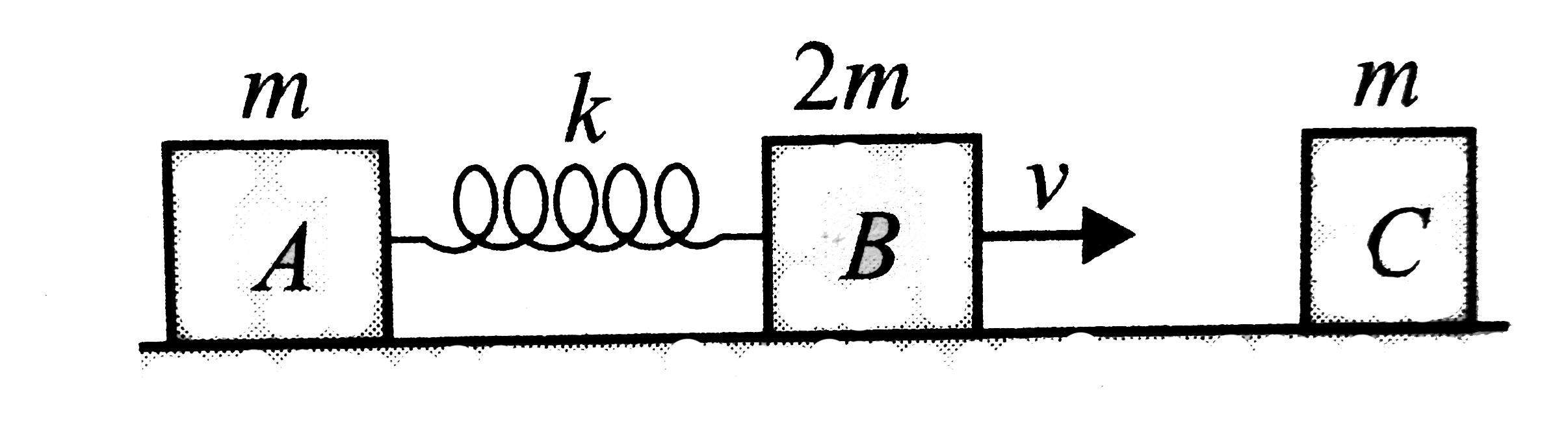
Two blocks `A` and `B` of masses `m` and `2m`, respectively are connected by a spring of force constant `k`. The masses are moving to the right with uniform velocity `v` each, the heavier mass leading the lighter one. The spring is in the natural length during this motion. Block `B` collides head on with a third block `C` of mass `m`, at rest, the collision being completely inelastic. Calculate the maximum compression of the spring.

Text Solution

Verified by Experts

The correct Answer is:
`x=sqrt((mv^(2))/(12k))`

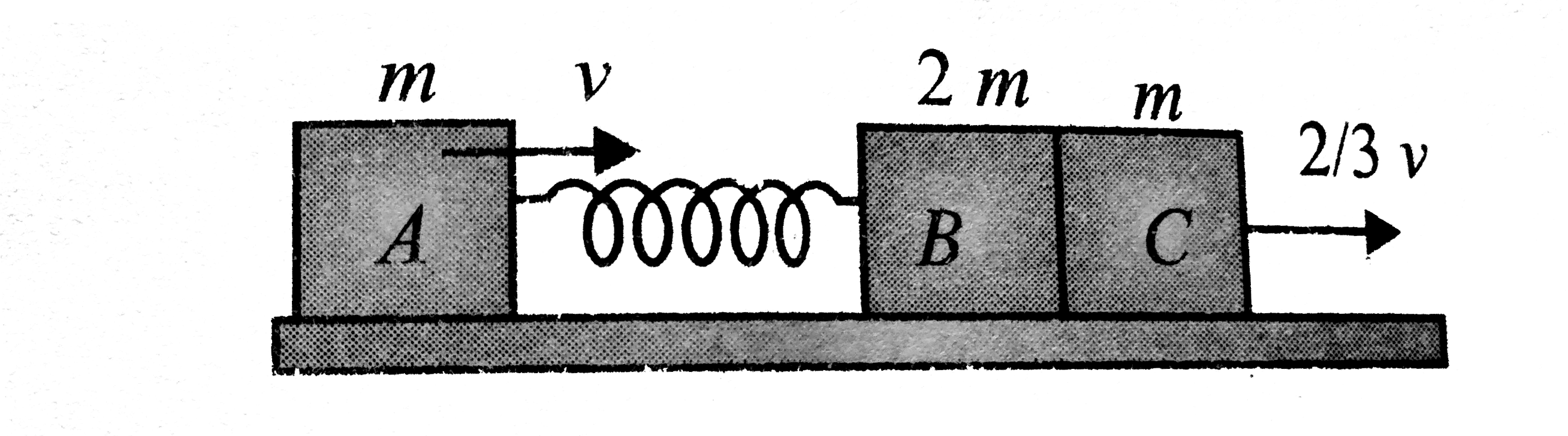
First considering an inelastic collision between `B` and `C`.
`2mv(m+2m)v_(B)`
`v_(B)=2/3v` velocity of (`B` and `C`)
Then velocity of centre of mass during maximum compression
`v_(CM)=(3mv)/(4m)=3/4v`

`1/2mv_(4)^(2)+1/23mv_((b+c))^(2)=1/24mv_(CM)^(2)+1/2kx^(2)`
Then substituting the value `x=sqrt((mv^(2))/(12k))`
Promotional Banner

Topper's Solved these Questions

  • CENTRE OF MASS

    CENGAGE PHYSICS ENGLISH|Exercise Single Correct|141 Videos
  • CENTRE OF MASS

    CENGAGE PHYSICS ENGLISH|Exercise Multiple Correct|25 Videos
  • CENTRE OF MASS

    CENGAGE PHYSICS ENGLISH|Exercise Exercise 1.3|24 Videos
  • CALORIMETRY

    CENGAGE PHYSICS ENGLISH|Exercise Solved Example|13 Videos
  • DIMENSIONS & MEASUREMENT

    CENGAGE PHYSICS ENGLISH|Exercise Integer|2 Videos

Similar Questions

Explore conceptually related problems

Two block A and B of masses m and 2m respectively are connected by a spring of spring cosntant k. The masses are moving to the right with a uniform velocity v_(0) each, the heavier mass leading the lighter one. The spring is of natural length during this motion. Block B collides head on with a thrid block C of mass 2m . at rest, the collision being completely inelastic. The velocity of block B just after collision is -

Two blocks A and B of mass m and 2m respectively are connected by a light spring of force constant k. They are placed on a smooth horizontal surface. Spring is stretched by a length x and then released. Find the relative velocity of the blocks when the spring comes to its natural length

Two blocks A and B of masses in and 2m , respectively, are connected with the help of a spring having spring constant, k as shown in Fig. Initially, both the blocks arc moving with same velocity v on a smooth horizontal plane with the spring in its natural length. During their course of motion, block B makes an inelastic collision with block C of mass m which is initially at rest. The coefficient of restitution for the collision is 1//2 . The maximum compression in the spring is

Two blocks A and B of mass 2m and m respectively are connected to a massless spring of force constant K as shown in figure A and B are moving on the horizontal frcitionless surface with velocity v to right with underformed spring. If B collides with C elastically, then maximum compression of the spring will be

Two blocks A and B of mass 2 m and m respectively are connected to a massless spring of spring constant K. if A and B moving on the horizontal frictionless surface with velocity v to right. If A collides with C of mass m elastically and head on, then the maximum compressions of the spring will be

Two blocks A and B of masses m and 2m, respectively , are held at rest such that the spring is in natural length. Find out the acceleration of both the blocks just after relese.

Two blocks of masses m_1 and m_2 are connected by a spring of spring constant k figure. The block of mass m_2 is given a shape impulse so that it acquires a velocity v_0 towards right. Find a. the velocity of the centre of mass b. the maximum elongation that the spring will suffer.

Two block A and B of masses m_(1) = 3kg and m_(2) = 6kg respectively are connected with each other by a spring of force constant k = 200 N//m as shown in figure. Blocks are pulled away from each other by x_(0) = 3cm and then released. When spring is in its natural length and block are moving towards each other, another block C of mass m = 3kg moving with velocity v_(0) = 0.4m//s (towards right) collides with A and gets stuck to it. Neglecting friction, calculate (a) velocity v_(1) and v_(2) of the blocks A and B respectively just before collision and their angular frequency . (b) velocity of centre of mass of the system, after collision, ( c) amplitude of oscillation of combined body, (d) loss of energy during collision.

A block of mass m is suspended by different springs of force constant shown in figure.

Two blocks each of mass m are connected with springs each of force constant K as shown in fig. The mass A is displaced to the left & B to the right by the same amount and released then the time period of oscillation is -

CENGAGE PHYSICS ENGLISH-CENTRE OF MASS-Subjective
  1. A stationary light, smooth pulley can rotate without friction about a ...

    Text Solution

    |

  2. Two blocks A and B are joined by means of a slacked string passing ove...

    Text Solution

    |

  3. Two blocks A and B of masses m and 2m, respectively are connected by a...

    Text Solution

    |

  4. Two small spheres A and B of equal radius but different masses of 3m a...

    Text Solution

    |

  5. Four railroad cars, each of mass 2.50 xx 10^4 kg, are coupled together...

    Text Solution

    |

  6. A particle of mass m is made to move with uniform speed v along the pe...

    Text Solution

    |

  7. A smooth ball of mass 1 kg is projected with velocity 7 m//s horizonta...

    Text Solution

    |

  8. A small ball is projected from point P towards a vertical wall as show...

    Text Solution

    |

  9. A small steel ball A is suspended by an inextensible thread of length ...

    Text Solution

    |

  10. A tennis ball with (small) mass m(2) rests on the top of a basketball ...

    Text Solution

    |

  11. A ball of mass m hits a wedge of mass M vertically with speed u, which...

    Text Solution

    |

  12. A ball of mass m moving with constant horizontal velocity u strikes a ...

    Text Solution

    |

  13. A ball of mass m collides with a stationary wedge of mass M, perpendic...

    Text Solution

    |

  14. A small bucket of mass M is attached to a long inextensible cord of le...

    Text Solution

    |

  15. Two wooden plank of mass M(1)= 1 kg, M(2) = 2.98 kg smooth surface. A ...

    Text Solution

    |

  16. In the diagram shown, no friction at any contact surface. Initially, t...

    Text Solution

    |

  17. Two blocks A and B of mass m and 2m respectively are moving towards a ...

    Text Solution

    |

  18. A boy throws a ball with initial speed sqrt(ag) at an angle theta to t...

    Text Solution

    |

  19. A ball falls freely form a height onto and smooth inclined plane formi...

    Text Solution

    |

  20. A ball is projected form a point A on a smooth inclined plane which ma...

    Text Solution

    |

