Home
Class 11
PHYSICS
Two blocks of masses m(1)= 2 kg and m(2)...

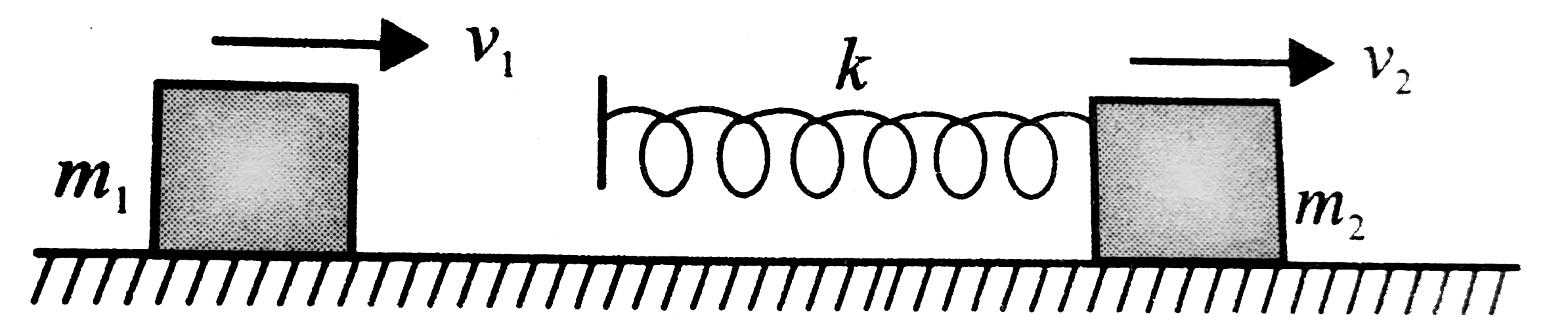
Two blocks of masses `m_(1)= 2 kg` and `m_(2) = 4 kg` are moving in the same direction with speeds `v_(1) = 6 m//s` and `v_(2) = 3 m//s`, respectively on a frictionless surface as shown in the figure. An ideal spring with spring constant `k = 30000 N//m` is attached to the back side of `m_(2)`. Then the maximum compression of the spring after collision will be

A

`0.06m`

B

`0.04m`

C

`0.02m`

D

none of these

Text Solution

Verified by Experts

The correct Answer is:

C

At the time of maximum compression, the speeds of blocks will be the same. Let the speed be `v` and maximum compression be `x`.
Applying conservation of momentum,
`(m_(1)+m_(2))v=m_(1)v_(1)+m_(2)v_(2)`
`impliesV=4m//s` Applying conservation of mechanical energy,
`1/2kx^(2)+1/2(m_(1)+m_(2))v^(2)=1/2m_(1)v_(2)^(2)+1/2m_(2)v_(2)^(2)`
solving we get `x=0.02m`
Promotional Banner

Topper's Solved these Questions

  • CENTRE OF MASS

    CENGAGE PHYSICS ENGLISH|Exercise Multiple Correct|25 Videos
  • CENTRE OF MASS

    CENGAGE PHYSICS ENGLISH|Exercise Assertion - Reasoning|2 Videos
  • CENTRE OF MASS

    CENGAGE PHYSICS ENGLISH|Exercise Subjective|23 Videos
  • CALORIMETRY

    CENGAGE PHYSICS ENGLISH|Exercise Solved Example|13 Videos
  • DIMENSIONS & MEASUREMENT

    CENGAGE PHYSICS ENGLISH|Exercise Integer|2 Videos

Similar Questions

Explore conceptually related problems

Two blocks of masses m_(1) = 2 kg and m_(2) = 5 kg are moving in the same direction along a frictionless surface with speeds 10 m//s and 3 m//s , respectively, m_(2) being ahead of m_(1) . An ideal spring with k = 1120 N//m is attached to the back side of m_(2) . Find the maximum compression of the spring when the blocks collide. What are the final velocities of the blocks when they separate?

Two particles of mass 1 kg and 0.5 kg are moving in the same direction with speed of 2 m//s and 6 m/s respectively on a smooth horizontal surface. The speed of centre of mass of the system is

Two blocks of mass 2kg and 5kg are given speed as shown in the figure. System is lying on a frictionless surface and the blocks are connected by a massless spring if spring constant 35 N/m . Find the maximum compression in the spring.

A block of 10 g slides on smooth horizontal surface with 20 m/s towards a spring of spring constant 100 N/m placed horizontally (as shown in figure). The maximum compression in spring is

The block of mass M moving on the frictionless horizontal surface collides with the spring constant k and compresses it by length L . The maximum momention of the block after collision is

A body of mass M is moving on a smooth surface with speed v_(0) . Another body of same mass M attached to a spring is kept on the same surface as shown. The moving mas makes an impact with the spring of spring constant k and starts compressing it. What is the maximum compression in the spring ?

Two spring are connected toa block of mass M placed a frictionless surface as shown if both the spring have a spring constant k the frequency of oscillation block is

A block of mass 2.0 kg is moving on a frictionless horizontal surface with a velocity of 1.0 m/s figure towards another block of equal mass kept at rest. The spring constant of the spring fixed at one end is 100 N/m. Find the maximum compression of the spring.

A body of mass 5 kg moving with a speed of 1.5 m/s on a horizontal smooth surface collides with a nearly weightless spring of force constant k = 5 N/m. The maximum compression of the spring would be

A mass of 0.5 kg moving with a speed of 1.5 m//s on a horizontal smooth surface, collides with a nearly weightless spring of force constant k =50 N//m The maximum compression of the spring would be.

CENGAGE PHYSICS ENGLISH-CENTRE OF MASS-Single Correct
  1. A particle of mass 2 kg moving with a velocity of 3 m//s is acted upon...

    Text Solution

    |

  2. A body of mass 3 kg moving with a velocity of 4 m//s towards left coll...

    Text Solution

    |

  3. Two blocks of masses m(1)= 2 kg and m(2) = 4 kg are moving in the same...

    Text Solution

    |

  4. A cracker is thrown into air with a velocity of 10ms^(-1) at an angle ...

    Text Solution

    |

  5. A force exerts an impulse Ion a particle changing its speed from initi...

    Text Solution

    |

  6. A ball falls vertically onto a floor with momentum p and then bounces ...

    Text Solution

    |

  7. A ball released from a height ho above a horizontal surface rebounds t...

    Text Solution

    |

  8. Two identical balls of equal masses A and B, are lying on a smooth sur...

    Text Solution

    |

  9. A particle of mass in is made to move with uniform speed v0 along the ...

    Text Solution

    |

  10. A continuous stream of particles, of mass m and velocity r, is emitted...

    Text Solution

    |

  11. A ball kept in a close box moves in the box making collisions with the...

    Text Solution

    |

  12. A particle of mass m moving with a velocity u makes an elastic one-dim...

    Text Solution

    |

  13. A stationary body explodes into two fragments of masses m(1) and m(2)....

    Text Solution

    |

  14. A ball of mass m is projected with a speed v into the barrel of a spri...

    Text Solution

    |

  15. A railway flat car has an artillery gun installed on it. The combined ...

    Text Solution

    |

  16. Two blocks of masses 6 kg and 4 kg are attached to the two ends of a m...

    Text Solution

    |

  17. The momentum of a moving particle is vectorially given a, vecp=p(0)(co...

    Text Solution

    |

  18. A gun of mass M. fires a shell of mass m horizontally and the energy o...

    Text Solution

    |

  19. An inverted T-shaped object is placed on a horizontal floor as shown i...

    Text Solution

    |

  20. Two blocks m(1) and m(2) are pulled on a smooth horizontal surface, an...

    Text Solution

    |
