Home
Class 11
PHYSICS
Three balls A, B and C of masses 2 kg, 4...

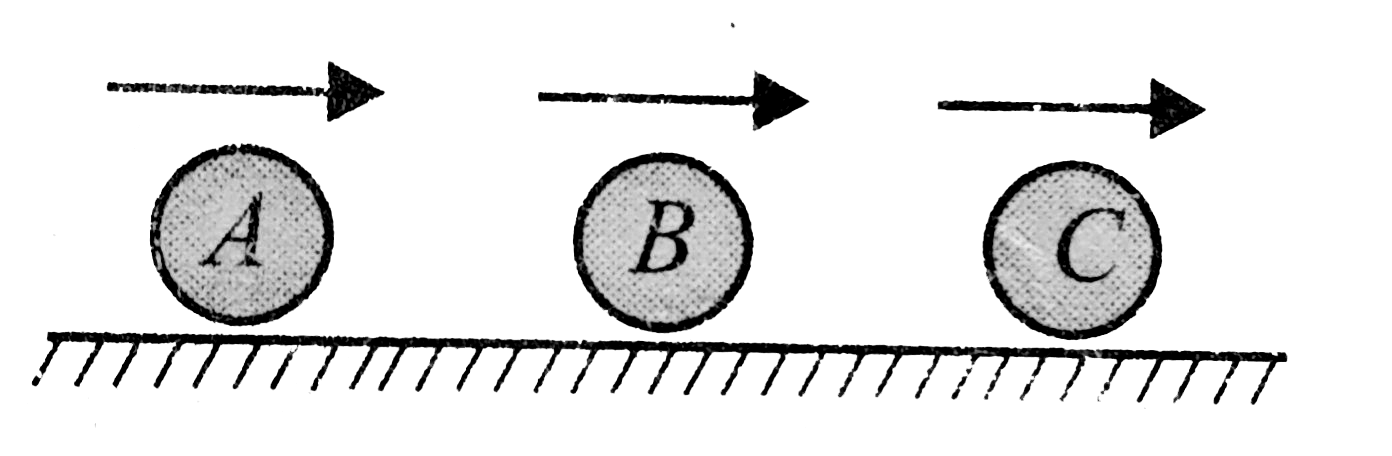
Three balls `A, B` and `C` of masses `2 kg, 4 kg` and `8 kg`, respectively, move along the same straight line and in the same direction, with velocities `4m//s,1m//s, 3/4m//s`. If `A` collides with `B` and subse-quently `B` collides with `C`, find the velocity of ball `A` and ball `B` after collision, taking the coefficient of restitution as unity.

A

`V_(A)=3,V_(B)=9//4`

B

`V_(A)=0, V_(B)=3`

C

`V_(A)=3, V_(B)=0`

D

`V_(A)=0, V_(B)=0`

Text Solution

Verified by Experts

The correct Answer is:
D

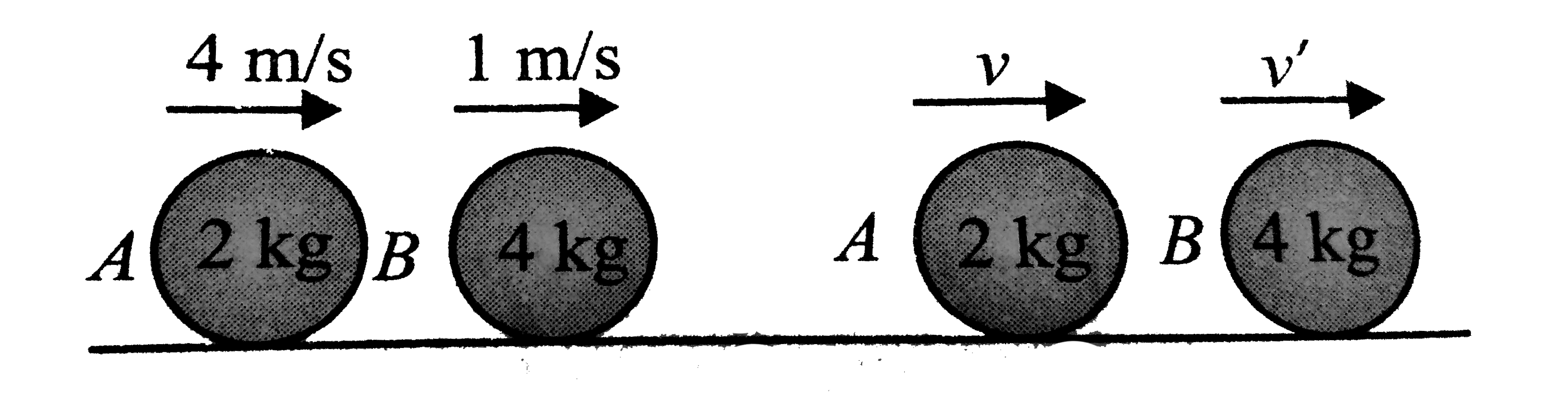
First consider the collision of balls `A` and `B`. let the velocities of these two balls after their collision be `v` and `v'`.
Momentum after impact `=` Momentum before impact

`:. 2v+4v'=2xx4+4xx1`
`:. 2v+4v'=12`
`implies v+2v'=6`..........i
relative velocity after impact `=-exx` relative velocity before impact
`v-v'=-(4-1)`
`v-v'=(-3)`............ii
substracting eqn ii from eqn i we get
`3v'=9`
`v'=3m//s` Substituting in eqn ii we get
`v_3=-3impliesv=0`

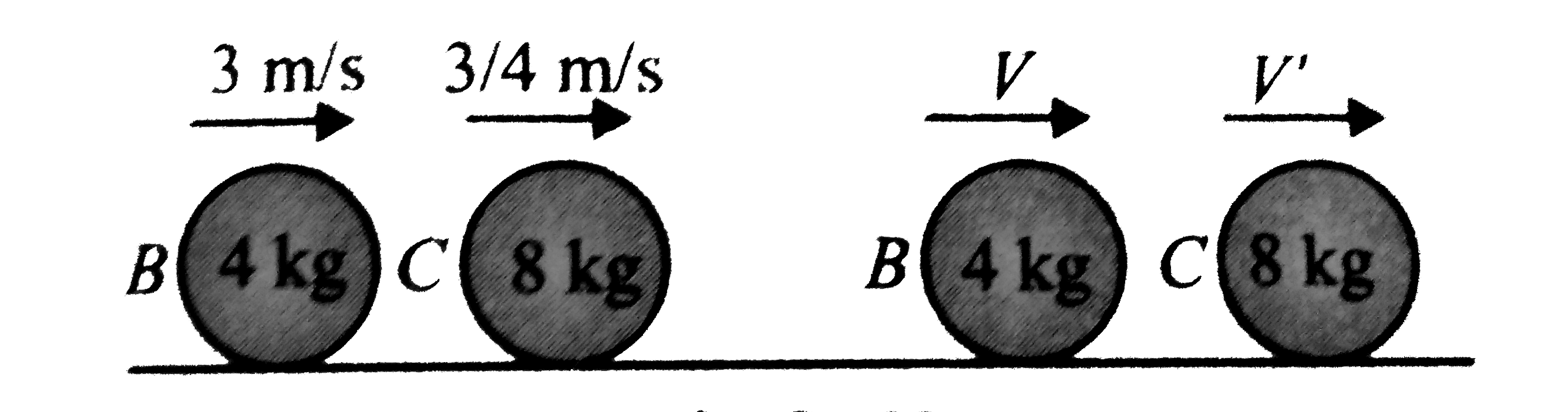
Hence, after the collision ball `A` is brought to rest, while ball `B` will move with a velocity of `3m//s`. now consider the collision of balls `B` and `C`.Let the velocities of these balls after collision be `V` and `V'` respectively.
Total momentum after impact = Total momentum before impact
`4V+8V'=4xx3+8xx3/4=18`
`V+2V'=9/2`............iii
Relative velocity after impact `=-exx` relative velocity before impact
`V-V'=(-1)(3-3/4)`
`V-V'=-9/4`.........iv
Subtracting eq iv from eqn iii we get
`3V'=27/4impliesV'=9/4m//s`
`V=0`
`V_(A)=0,V_(B)=0`
Promotional Banner

Topper's Solved these Questions

  • CENTRE OF MASS

    CENGAGE PHYSICS ENGLISH|Exercise Multiple Correct|25 Videos
  • CENTRE OF MASS

    CENGAGE PHYSICS ENGLISH|Exercise Assertion - Reasoning|2 Videos
  • CENTRE OF MASS

    CENGAGE PHYSICS ENGLISH|Exercise Subjective|23 Videos
  • CALORIMETRY

    CENGAGE PHYSICS ENGLISH|Exercise Solved Example|13 Videos
  • DIMENSIONS & MEASUREMENT

    CENGAGE PHYSICS ENGLISH|Exercise Integer|2 Videos

Similar Questions

Explore conceptually related problems

A particle moving with velocity (2hati-3hatj) m/s collides with a surface at rest in xz–plane as shown in figure and moves with velocity (2hati+2hatj) m/s after collision. Then coefficient of restitution is :

Two objects of masses 100g and 200g are moving along the same line in the same direction with velocities of 2m//s and 1m//s , respectively. They collide and after the collison, the first object moves at a velocity of 1.67 m//s in the same direction. Determine the velocity of the second object.

Two smooth spheres A and B of masses 4kg and 8kg move with velocities 9m//s and 3m//s in opposite directions. If A rebounds on its path with velocity 1m//s , then

Two identical balls A and B moving with velocities + 0.5 m/s and -0.3 .m/s respectively collide head-on elastically. The velocities of the ball A and B after collision will be respectively

A ball of mass 2kg moving with speed 5m/s collides directly with another ball of mass 3kg moving in the same direction with speed 4m/s. The coefficient of restitution is 2/3. Find the velocities of both ball after the collision.

Two balls of masses 2 kg and 4 kg are moved towards each other with velocities 4m//s and 2m//s , respectively, on a frictionless surface. After colliding, the 2kg ball returns back with velocity 2m//s . then find a. velocity of the 4 kg after collision b. coefficient of restitution e, c. impulse of deformation J_(D) d. maximum potential energy of deformation, e. impulse of reformation J_(R)

A ball A of mass M collides elastically with a similar ball B at rest as shown in figure. Initially velocity of ball A is u m/s. After collision,

The solid rubber balls A and B having masses 200 and 400 gm respectively are moving in opposite directions with velocity of A equal to 0.3 m / s . After collision the two balls come to rest, then the velocity of B is

A ball is moving with velocity 2m//s towards a heavy wall moving towards the ball with speed 1m//s as shown in figure. Assuming collision to be elastic, find the velocity of ball immediately after the collision.

A ball is moving with velocity 2m//s towards a heavy wall moving towards the ball with speed 1m//s as shown in figure. Assuming collision to be elastic, find the velocity of ball immediately after the collision.

CENGAGE PHYSICS ENGLISH-CENTRE OF MASS-Single Correct
  1. A particle at rest is constrained to move on a smooth horizontal surfa...

    Text Solution

    |

  2. A particle of mass m comes down on a smooth inclined plane from point ...

    Text Solution

    |

  3. Three balls A, B and C of masses 2 kg, 4 kg and 8 kg, respectively, mo...

    Text Solution

    |

  4. A ball of mass m moving with velocity v(0) collides with a wall as sho...

    Text Solution

    |

  5. Five balls are placed one after the other along a straight line as sho...

    Text Solution

    |

  6. Two objects are at rest on a level frictionless surface. The objects a...

    Text Solution

    |

  7. A highly elastic ball moving at a speed of 3 m//s approaches a wall mo...

    Text Solution

    |

  8. Two identical billiard balls undergo an oblique elastic collision. Ini...

    Text Solution

    |

  9. A ball of mass m is attached to a cord of length L, pivoted at point O...

    Text Solution

    |

  10. A ball of mass m is released from rest relative to elevator at a heigh...

    Text Solution

    |

  11. Two blocks A and B of masses in and 2m, respectively, are connected wi...

    Text Solution

    |

  12. A 3000 kg space probe is moving in a gravity free space at a constant ...

    Text Solution

    |

  13. After a totally inelastic collision, two objects of the same mass and ...

    Text Solution

    |

  14. An object of mass 10 kg is launched from the ground at t = 0, at an an...

    Text Solution

    |

  15. For the system shown in Fig. the string is light and pulley is frictio...

    Text Solution

    |

  16. A parallel beam of particles each of mass m moving with velocity v imp...

    Text Solution

    |

  17. A block of mass m starts from rest and slides down a frictionless semi...

    Text Solution

    |

  18. Three blocks are initially placed as shown in figure , block A has mas...

    Text Solution

    |

  19. In the figure shown, the two identical balls of mass M and radius R ea...

    Text Solution

    |

  20. Three blocks are placed on smooth horizontal surface and lie on same h...

    Text Solution

    |